The three forehand grips every serious player should know: eastern, semi-western, western
The forehand grip is the single most consequential choice you make about your ground game. Change your grip and every other thing you do on the forehand side changes with it, from ball flight to shot selection to what you can and cannot do with a high bounce. Here are the three grips every serious player needs to understand, what each does to the ball, which pros play with each, and the specific question that decides whether you should change yours.

The forehand grip is the single most consequential technical choice you make on the tennis court. Change your grip and every other thing that follows on the forehand side changes with it. The height of your backswing. The angle of your racket face at contact. The height at which you naturally like to strike the ball. The kind of ball flight you can produce. The shots you can and cannot mix into your pattern. The tactical game you can and cannot play. Grip is upstream of everything.
Most club players inherited whatever grip they started with, either from a first coach, from a summer camp when they were nine, from a parent who put a racket in their hand, or from watching a specific pro whose forehand they wanted to copy. Very few players have ever consciously chosen their grip against the game they now want to play. That is what this piece is for. Here are the three grips every serious player should be able to name, use, and reason about, plus the specific question that decides whether the grip you currently hold is the one you should keep.
The reference: the eight bevels of the handle
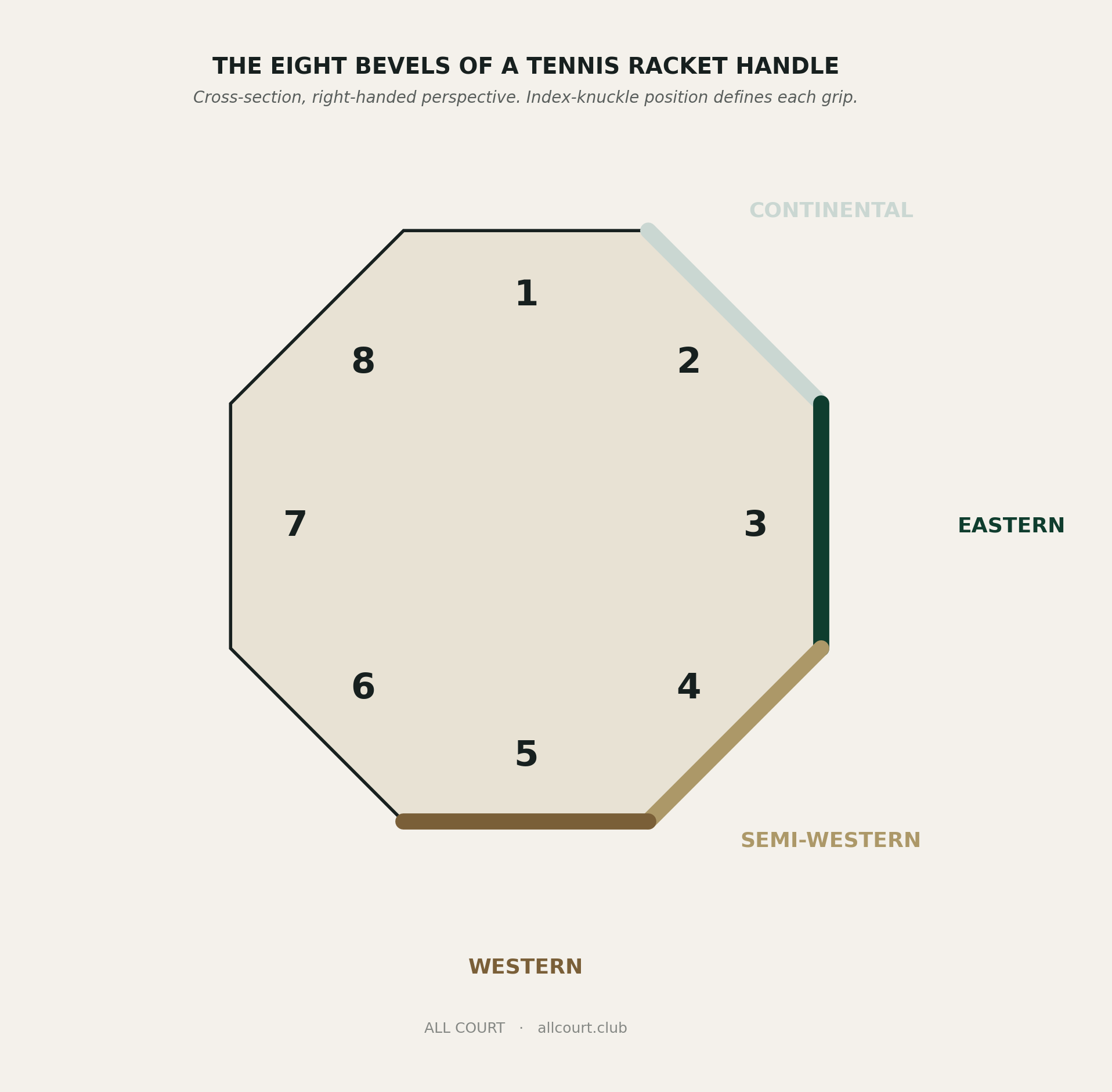
A tennis racket handle is octagonal. Eight flat sides, running the length of the grip, called bevels. The same octagon is the map for the backhand grips, too: one-handed on bevel 1, slice on bevel 2, two-handed on bevels 2 and 3 stacked. Numbered one through eight, with bevel one on top of the handle as you hold it out in front of you like a hammer, then rotating clockwise around the handle for a right-handed player.
Every named grip is a specific position of the index-finger knuckle on one of those bevels. The continental grip, the one you use for serves and volleys and slices, sits with the index knuckle on bevel two. From there, rotating the hand under the handle by one bevel at a time gives you each of the forehand grips in turn. Bevel three is the eastern forehand. Bevel four is the semi-western. Bevel five is the full western. Beyond bevel five is the extreme western, sometimes called the Hawaiian grip, played by very few professionals and no one you will meet on a club court.
For most of the twentieth century, the continental was the standard forehand grip too, not just the reference position it is today. Bill Tilden, Fred Perry, Rod Laver and John Newcombe all played essentially continental forehands in the wooden-racket era. Graphite frames with larger heads and higher string tensions changed the calculation. Higher-bouncing courts changed it further. By the 1980s the continental had migrated out of the forehand and settled into its current role. It is now the grip for serves, volleys, slices and overheads, but not for the ground stroke that starts most points.
Left-handed players count the bevels in the opposite direction but the principle is identical. The grip is the geometric relationship between the palm and the racket face, and that relationship decides everything about what the ball does after it leaves your strings.
Grip one: the eastern forehand (bevel three)
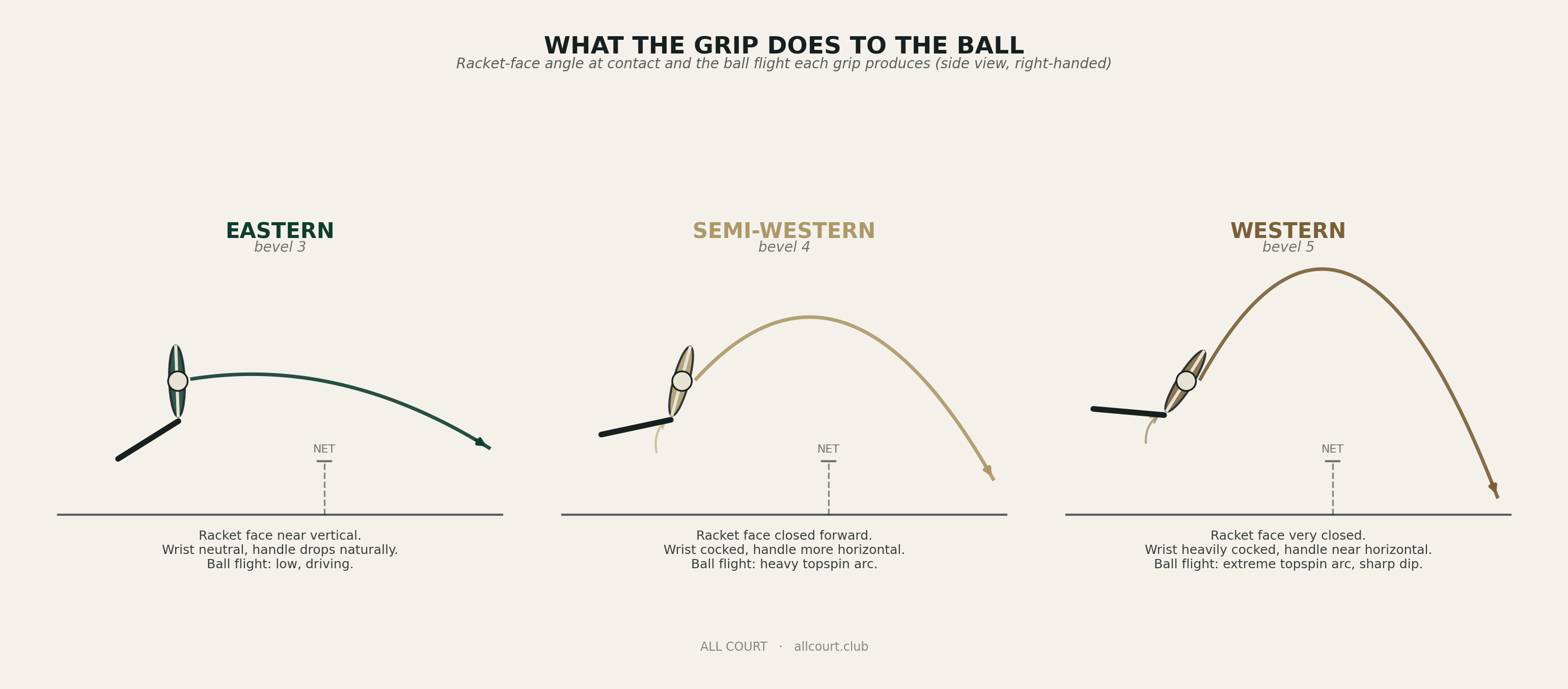
If you were going to shake hands with someone, this is the position your palm ends up in when you close it around the grip. The racket face sits close to vertical at contact.
What the eastern grip does to the ball: it hits flat. The natural ball flight is low and driving, with a small amount of natural topspin but nothing dramatic. The shot has pace but not much upward margin over the net. The eastern player is trading net clearance for penetration, which is a good trade on fast surfaces and a poor one on slow ones.
The wrist stays close to neutral through the swing and follow-through. The forearm rotates only slightly on the way out of contact. The power source is the shoulder and core, driving the racket forward through the ball more than upward across it. Because the face is near vertical and there is no meaningful wrist cock to release, there is little added racket-head speed at the last moment beyond the arm swing itself. The ball comes off the strings flat because both the swing path and the wrist position produce a flat contact.
The players you would recognise with an eastern forehand: Roger Federer for most of his career, Pete Sampras before him, and a number of the older-school one-handed backhanders whose forehand mirrors the same principles. Federer's forehand is often described as sitting between eastern and semi-western, drifting toward bevel three-and-a-half in some strokes, but the anchor is eastern.
What the eastern grip does not do well: it cannot easily handle high balls above the shoulder. A ball that bounces up to your face on a slow hard court or a heavy topspin ball on clay is a difficult ball for an eastern-grip player. To hit it aggressively you have to either take the ball early on the rise, before it has climbed to shoulder height, or step back and let it drop into your hitting zone. Federer's whole tactical game was built on solving that problem, by taking the ball early with beautiful footwork. Most club players cannot solve the problem the same way.
What the eastern grip is good for: flat drives, a fast transition to a slice, a comfortable relationship with low balls, and clean net approaches. If your game is flat and you play mostly on hard courts or grass, and if you can consistently get to the ball early, the eastern grip is a defensible choice.
Grip two: the semi-western (bevel four)
The semi-western grip rotates the hand one bevel further underneath the racket. The palm is now angled slightly downward at contact, which naturally closes the racket face and produces a low-to-high swing path with a much steeper topspin component than the eastern grip allows.
The semi-western is the modern tour default. Rafael Nadal, Novak Djokovic, Aryna Sabalenka and Carlos Alcaraz all play with the index knuckle on bevel four. Alcaraz drifts occasionally toward full western on clay but bevel four remains his anchor. If you watch a WTA or ATP top-ten match in 2026 and pick a random forehand, it is a semi-western more often than not.
What the semi-western does to the ball. Heavy topspin. Much more upward net margin than the eastern grip because the racket face closes over the ball. The ball dips into the court quickly, kicks up high on the bounce, and pushes the opponent back off the baseline. The natural ball flight is dangerous because it forces the opponent to strike from a defensive position, above their shoulder, or well behind the baseline.
The wrist cocks back meaningfully before contact, laying the racket head down and behind the ball. Forearm pronation is a real part of the swing, releasing through the strike zone and adding racket-head speed on the low-to-high path. Combined with a face that closes over the ball, the wrist release and the pronation are what convert the closed-face contact into heavy topspin rather than a shanked line drive. Take the wrist cock and pronation out of a semi-western swing and the ball goes into the net every time; put them in and the ball dips sharply into the court.
What the semi-western is good for: high-bouncing balls above the shoulder, aggressive mid-court attacks, natural offense on second serves, and the ability to hit heavy topspin winners from defensive positions. It gives the modern player a shot that works on every surface, but is especially devastating on hard and clay.
What the semi-western does less well: extremely low balls that skid off the surface below the knee. The closed racket face makes it hard to lift the ball with control. On grass the shot has to be more deliberate. On a low-bouncing hard court the shot is doable but requires a conscious drop of the racket head. The eastern player can knife those balls back with ease; the semi-western player has to work.
Grip three: the western (bevel five)
The western grip rotates the hand one further bevel under the racket. The palm is now well underneath, the racket face is significantly closed, and the swing path is even steeper from low to high. Some coaches call bevel five the full western; others reserve full western for a position slightly further under the handle. The point of the label matters less than what the position produces.
Who plays with it: very few tour professionals play a true western, and the most notable current example is Iga Świątek. Her forehand is described by coaches and analysts as extremely closed, with the palm facing upward at contact rather than facing forward or down. Marion Bartoli has described the grip as "a really extreme grip, from right underneath, that requires you to meet the ball" in a specific way, and has noted that this position generally requires wrist strength most tour players do not have. Nadal has been described by different analysts as anywhere between semi-western and full western at different points in his career, drifting deeper on clay. A number of Spanish and South American players raised on clay have western grips. Alcaraz slides toward it on clay. But the pure western remains rarer at tour level than either the eastern or the semi-western, and Świątek's is the most distinctive current example.
What the western does to the ball: extreme topspin. The ball dips heavily into the court and kicks up violently on the bounce. The shot is a weapon on clay because the surface amplifies the top-spin kick. On slower hard courts it works. On grass it becomes a liability because the ball skids low and the closed racket face is fighting against the surface bounce.
What the western is good for: nothing else does what heavy topspin does. If your game is built on pushing opponents back, on mid-court attacks that force short returns, on second-serve punishment, the western is the grip that produces the most severe version of that ball. It also gives you the biggest margin of error over the net, because the racket face closes over the ball and pulls it down inside the court even when you hit long.
The wrist lag required to make this grip work is more extreme, and the forearm pronation through contact is heavier still. The racket head has to drop well below the ball before the wrist snaps it upward through the strike zone; the pronation then continues the acceleration to the finish. The combination of the very closed face, the pronounced wrist cock, and the fast pronation is what produces the ball's characteristic dip and kick. It is a mechanically demanding swing that shifts more of the racket-head-speed generation into the wrist and forearm and less into the shoulder, which is part of what produces the extreme topspin the grip is chosen for.
What the western does not do well: low balls. Slice transitions. Volley transitions. The change from western on your forehand to continental on a volley is a bigger physical rotation than the same change from eastern or semi-western, and under pressure it does not happen fast enough. A western player at the net is often a western player about to lose the point unless that transition around the bevels is quickly done by the time you strike that volley.
How to know which grip your game is asking for
The specific question that decides whether the grip you currently hold is the right one is this. When your forehand misses, does it miss into the net or long? And in which specific ball situations does it miss.
If your forehand consistently misses into the net on high-bouncing balls above the shoulder, and you play mostly on hard or clay, your eastern grip is fighting your game. A semi-western would put those balls in the court.
If your forehand consistently misses long on flat rally balls and low-bouncing balls, and you play on faster surfaces or with lots of slice, your semi-western or western grip is closing over the ball too much. An eastern grip would flatten the flight and control the length.
If your forehand is inconsistent in transition, if the low approach shots and the volley switches are the specific place your game breaks down, your western grip is costing you. Coming back down to semi-western or eastern would fix it.
If your forehand cannot hit a proper drop shot or a proper slice and you find yourself refusing to play those shots even when the tactical situation calls for them, your grip is dictating a game your instincts want to leave.
These are diagnostic questions, not commandments. The grip you should hold is the one that fits both the tactical game you want to play and the surfaces you actually play on. There is no universally right grip. There is a grip that produces the pattern of ball flight and shot selection you want to be producing at your level of play.
The practical answer to changing your grip
Changing your grip is the single most disruptive technical adjustment a serious club player can make. It takes three to six weeks before the new grip produces balls that come off the racket the way you expect. During those weeks the forehand is going to look worse than it did before. Every muscle-memory pattern from the old grip has to be relearned. You will lose matches. You will play ugly practice sets. And roughly one in three players who start a grip change give up two weeks in, because the interim ugliness is real and there is no guarantee the far side will be worth the cost.
The players for whom a grip change lands are the ones who identified the specific tactical problem the change is meant to solve, committed to the six-week transition with a coach who has changed grips before, and were willing to lose the interim matches without adjusting the plan mid-way. The players for whom it does not land are usually the ones who tried it as a general improvement rather than as a specific fix for a specific problem.
The grip-detail piece we published earlier covers the specific mid-swing grip adjustments most players make without knowing they are making them, which is a different problem to solve than a full grip change but sits in the same territory. Worth reading before you commit to a full move from one bevel to another.
The point of naming the three
Most club players never think about their grip at the level of bevel numbering. They think about their forehand as "my forehand." The moment you can name your grip, name the two neighbouring grips, and name what each does to a ball, you are able to reason about your forehand rather than just play it. That reasoning is the thing that lets you diagnose your own missed shots without needing a coach on the sideline to tell you what happened.
You do not need to change your grip. You need to know which grip you hold, what it does, what it does not, and what the alternative would look like if you decided to switch. Every serious player crosses that threshold eventually. The point of this piece is to give you the shape of the map before you decide whether to move on it.
Read next
The grip detail most players get wrong. What most players do to their grip mid-swing without knowing about it.
Five questions to ask your coach when something isn't working. If you are considering a grip change, these are the questions that decide whether your coach is the right coach to run it with you.
What good coaches actually do in the first ten minutes of a lesson. What to look for in the coach who is going to change your grip.
If you would like a properly rated read on your own forehand grip before you commit to a change you may not need, All Court exists for exactly that. You put your phone against the back fence, film a session, and upload it. You get a "talking head" session inside your own video from a touring professional. Plus the AI-enabled platform compares those ratings against thousands of shots from hundreds of players graded by the same touring pros and elite coaches. The output is a personalised coaching session on your footage and an All Court Rating for each shot you hit and a cumulative All Court Rating that compounds every time you film more of your play, so that you can see which parts of your game are improving and which specific thing about your grip is actually costing you the points. There is no nominator, no joining fee, and no waitlist that closes inside a generation. Join the waitlist at allcourt.club/join.
Related posts
Coco Gauff and the US Open her rebuild was designed for