The All Court Rating reads your whole game.
Every shot you play is read and scored, resolved into the six dimensions of your game, and rolled into one comparable number: your ACR.
17 keypoints · live
All it takes is a clip
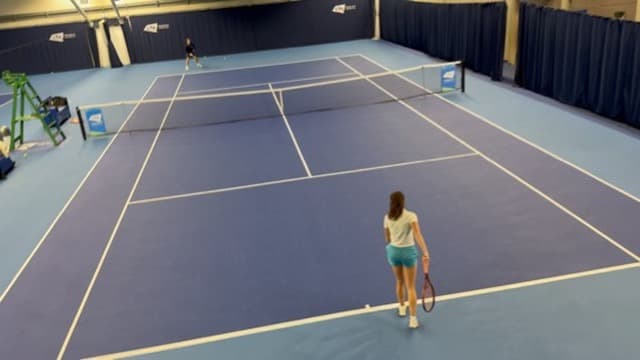
Record a rally, a session or a whole match on a single phone, or upload a clip you already have.
No tripod, no wearables, no special angle. However you can film your tennis, from wherever you can film it, is enough to start.
Behind the scenes, your game is rebuilt in 3D.
You never set this up, and you never see it. Once a clip is in, computer vision detects and normalises every position and rebuilds the point as a simulated, virtual scene: a 360-degree view of you on the court, the same whatever angle the clip was filmed from.
Every shot is then read from that reconstruction the same way every time, which is what lets one rating compare players who never shared a court.
Each dimension captures a different part of how you play.
Power
How much pace and weight you put on the ball.
Ball speed at contact, banded and set against the field.
Control
How cleanly you strike, shot after shot.
Preparation, contact and follow-through, averaged into a stroke rating.
Variety
How much you change the ball.
The spread across your shot types, measured as selection entropy.
Movement
How well you move into each shot.
Agility and footwork, read on every ball.
Initiative
How often you dictate rather than respond.
Offensive, neutral or defensive intent, netted across your shots.
Composure
How well your game holds when it gets messy.
The same stroke rating, counted only when the ball is chaotic.
Each score is read from your own shots, weighted toward recent play. Below a confidence threshold a dimension reads as building, never a guess.
The proof is in every shot you play.
Each one is read on its own, scored for what it was and how well it came off, and folded into the dimensions it belongs to.
No two players have the same fingerprint.
Ends points early behind the serve and forehand.
Absorbs pace and outlasts the rally.
At home at the back, at the net and in between.
Forces the issue forward off the serve.
Heavy, repeatable balls that wear opponents down.
Takes the ball early and flat, for winners and errors.
Active research
The work spans capture, biomechanics and game modelling.
Calibration from uncontrolled views
Court calibration breaks down on steep, low, moving or partially occluded cameras, where line features are sparse and the player leaves frame. We are working on self-calibration that holds across a clip and degrades gracefully on the angles a phone actually produces.
Load estimation and injury risk
Joint torques and ground reaction forces can be estimated from monocular motion, but their accuracy and their clinical meaning are open. We are studying which longitudinal load signals separate normal adaptation from injury risk, and how to attach honest uncertainty to them.
Fine-grained mechanics and strategy
Most shots are common; the decisive ones are rare. We are after stroke representations that capture contact dynamics, spin and ball shape, and tactical representations that hold across players and surfaces, without the long tail of important events being averaged away.
Rally simulation and action value
Treating a rally as a sequence of states lets us ask what each shot was worth, what the alternatives were, and how pressure propagates. We are developing counterfactual valuation over reconstructed points, toward simulators a player can train decisions against.
Next-generation capture
A single consumer camera loses the ball at speed and the body under occlusion. We work on high-frame-rate contact and small-object tracking, multi-view and volumetric reconstruction, and on-device inference, to capture the signals tennis actually turns on.