How to hit a kick serve
How to hit a kick serve: the grip, the toss, the swing path, and what makes Sinner and Alcaraz's second serves so hard to attack.

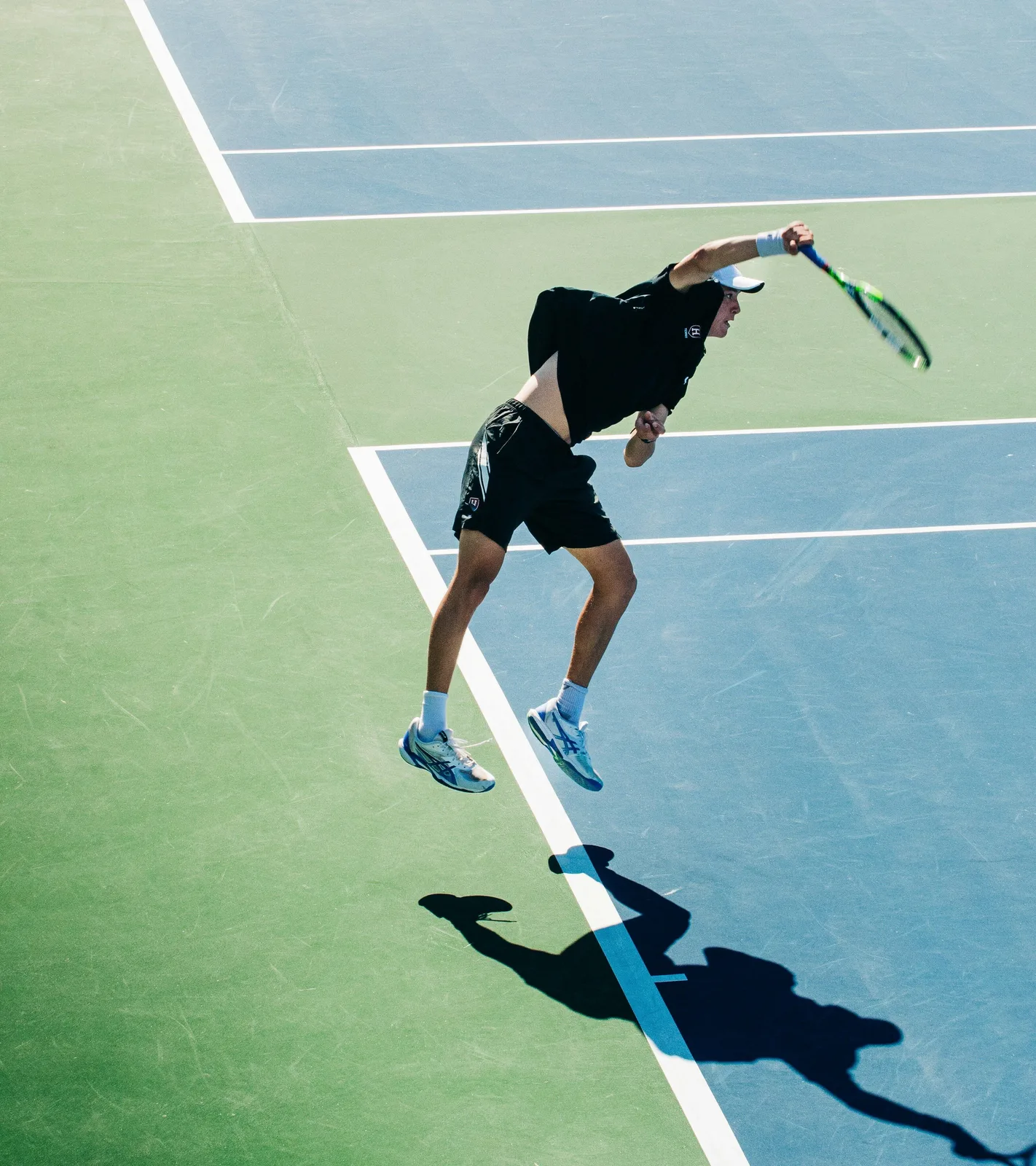
How to hit a kick serve is the question every serious club player asks once they stop double-faulting on second serves and start losing points on flat, sitting-up returns instead. The kick serve is the answer, and the reason it is the answer is worth understanding before you learn the mechanics.
A kick serve arrives at the receiver with three properties that make it hard to attack. High net clearance, which lowers your own double-fault risk. Heavy topspin, which pulls the ball down into the court. A high bounce off the surface, which pushes the receiver back and forces them to strike the ball in their shoulder zone rather than their power zone.
Those three properties are produced by three mechanical choices: a continental grip, a toss behind the head, and a swing path that brushes up and across the ball rather than driving through it. Get any of the three wrong and the serve does not kick.
The grip
Continental. Base knuckle of the index finger on bevel two of the racquet handle. If you do not know what bevels are, our piece on the three forehand grips every serious player should know has the full bevel diagram and orientation guide.
The continental grip is the only grip that works for a kick serve. An eastern or semi-western grip does not allow the wrist to pronate through contact the way the kick requires, and it produces a flat-faced strike rather than the brushing action that makes the ball spin. If you serve with a semi-western forehand grip because that is what you use for groundstrokes, your first job before you learn to kick is to change your serve grip. It is uncomfortable for a week and then becomes automatic.
The toss
Behind your head and slightly to your non-dominant side. For a right-handed server, that means the ball goes above and slightly to the left of your head. A useful check: if you let the toss drop without hitting it, the ball should land behind your left heel, not in front of you.
The analogy most coaches use is that the toss goes into an imaginary chimney positioned above and behind your left shoulder. Not far behind, not far to the side; roughly over the crown of the head, angled back and left. If the toss goes out in front of you (where a flat serve toss goes), you cannot brush up on the ball, because it will already have started falling.
Why the toss placement matters more than the swing: your body has to arch backwards to reach a behind-the-head toss, and that arch is what allows you to swing up at the ball. If you toss forward, your body cannot arch; if your body cannot arch, you cannot swing up; if you cannot swing up, the ball will not kick. Everything downstream depends on the toss.
The contact point
Think of the face of the ball as a clock. Twelve o'clock is the very top of the ball; six o'clock is the bottom. A flat serve strikes the ball squarely, effectively at twelve o'clock, straight through the middle. A slice serve strikes at three o'clock, cutting across from the outside. A kick serve strikes at seven or eight o'clock for a right-hander (four or five o'clock for a left-hander), on the lower-left face of the ball, and brushes up and across toward one or two o'clock.
Put another way: at the moment your racquet meets the ball, you are not trying to hit through the ball toward the service box. You are trying to brush the ball as if you were painting it upward, from the lower left to the upper right. The forward power that sends the ball into the court comes almost entirely from the upward brush and the pronation of the forearm as the strings meet the ball, not from a straight-through impact.
The visual test: if you filmed your serve motion from the side and stopped the frame at contact, the racquet face on a kick serve should be moving more upward than forward. On a flat serve it should be moving more forward than upward. That difference is what separates the two shots.
The swing path
The kick serve swing path is often described as throwing the racquet up at the ball rather than throwing it at the service box. The racquet accelerates from the back-scratching trophy position (racquet head low behind your shoulder blade) directly upward toward the ball, brushes it, then finishes across your body toward the opposite side.
The finish position for a right-hander is not the classic serve finish across the left hip. It is more like a finish across the right hip, with the racquet coming down on the same side as the serving arm. This is the physical evidence that you brushed rather than drove: the racquet followed the ball's rotation path rather than the ball's flight path.
The kinetic chain that makes it work runs upward from the legs. A strong leg drive, pushing up from a coiled knee bend, feeds energy into the hip rotation, which feeds into the shoulder rotation, which feeds into the arm and wrist and pronation. The kick serve without leg drive is a wrist-and-shoulder serve, and a wrist-and-shoulder serve produces exactly the arm and back injuries the section below warns about. Legs first, always.
The pros to watch
The kick serve on the modern tour is a second-serve weapon rather than a first-serve trick. The players who use it best treat it as the reason they can serve at eighty percent of maximum on the second delivery without punishment.
Jannik Sinner. Sinner's kick second serve on hard courts is among the most difficult second serves to attack on tour. In the 2024 Australian Open final against Djokovic, Sinner used the kick to save multiple critical moments on the ad side, forcing Djokovic to strike returns in his shoulder zone rather than driving through them. If you want to watch what a technically clean kick serve looks like from the receiver's perspective, watch the ad-side second serves in that match.
Carlos Alcaraz. Alcaraz's kick serve becomes a genuine weapon on clay, where the higher, gritier bounce amplifies the kick effect. His pattern on clay is a kick out wide to the backhand corner on the ad side, which pushes even elite backhand returners into a stretched, over-shoulder strike position. The same serve on grass barely kicks; the same serve on clay ends the point.
Novak Djokovic. Djokovic's kick second serve is one of the reasons his second-serve points-won percentage has been among the best in the history of the men's game. His technique is textbook: heavy back arch, deep leg bend, contact well behind the head, obvious upward brush at contact. His kick is the model most coaches point to when they want to show a junior what the finished technique looks like.
The four mistakes most players make
Toss too far forward. The single most common cause of a flat, non-kicking kick serve. If the ball is out in front of you, your body cannot arch, so you cannot swing up, so you cannot brush the ball. The fix is toss discipline drilled without hitting: toss ten balls, let each one drop, check where each lands. If they land in front of your baseline you are tossing forward. Adjust until the drops all land behind your left heel.
Trying to hit hard. The kick is a spin serve, not a power serve. If you try to swing hard through the ball you flatten the brush, lose the topspin, and end up with a slower flat serve that goes into the net. Racquet-head speed matters, but the speed is angled upward, not forward. Swing at eighty percent of your effort and let the brush do the work.
Skipping the leg drive. Players who learn the kick serve as an arm motion produce a serve that kicks slightly and hurts a lot the next day. The energy of a kick serve should come from the legs. A useful cue: feel the push from the front foot into the ground before the racquet accelerates upward. If the push is missing, the arm compensates and the shoulder pays the price.
Giving up too early. The kick serve takes longer to develop than any other serve variation. Six to twelve months of daily practice is the honest range before it becomes reliable under pressure. Most players give up in month two, revert to a slice second serve, and never build the shot. The kick is worth the time; commit to a full six months of practice before you judge whether it is working.
The back note
The kick serve puts more stress on the lower back than any other serve. The behind-the-head toss forces a back arch that flat and slice serves do not require, and a repeated back arch under load can produce disc and facet-joint issues over time.
Two things reduce the risk. A strong leg drive that shares the load across the whole kinetic chain, so the arch is not doing all the work; and a serious core-strength routine, particularly around the transverse abdominis and the lower-back stabilisers. Players with a kick serve who develop back issues almost always share a common profile: they arch aggressively, they do not drive from the legs, and they do not train the core.
If you have a history of lower-back issues, learn the kick under supervision of a coach who watches your posture and can catch over-arching before it becomes a habit. If you have current back pain, do not learn the kick until it resolves.
When to use it in a match
The kick is your second serve. That is the primary use, and once it is reliable, the second-serve percentage swings favourably: your double-fault risk drops (because the higher trajectory clears the net comfortably) while your second-serve points-won goes up (because the receiver cannot attack a high-bouncing ball as easily as a flat medium-paced one).
Two secondary uses are worth knowing. First, the kick as a change-up first serve to a returner who has been standing in and taking the ball early; the sudden high bounce disrupts their timing more than an extra ten miles per hour would. Second, the kick in doubles, particularly on the ad side, where the high bounce forces the returner to hit up on the ball and gives the serving team's net player an easier poach.
Before you commit six months to this
If you would like a properly rated read on your current serve before you commit to a technical rebuild, All Court exists for exactly that. You put your phone against the back fence, film a session, and upload it. You get a "talking head" session inside your own video from a touring professional. Plus the AI-enabled platform compares those ratings against thousands of shots from hundreds of players graded by the same touring pros and elite coaches. The output is a personalised coaching session on your footage and an All Court Rating for each shot you hit and a cumulative All Court Rating that compounds every time you film more of your play, so that you can see whether the kick serve is the right technical investment for your game or whether a smaller adjustment to your existing serve would produce more points won. There is no nominator, no joining fee, and no waitlist that closes inside a generation. Join the waitlist at allcourt.club/join.
Related reading
The three forehand grips every serious player should know, the pillar piece with the bevel diagram you need to identify the continental grip.
Djokovic vs Sinner: two roads to a Wimbledon semi-final, our read on two of the modern game's best kick-serve technicians and what separates their serve games.
Late contact: why it happens and how to fix it, because a kick serve begins with the toss and everything you do downstream is trying to make the timing work.
Related posts
João Fonseca and the coach who has been saying the same thing for seven years