Federer, Nadal, Djokovic, Alcaraz, Sinner: five forehand grips, five different shots
Federer, Nadal, Djokovic, Alcaraz, Sinner: five forehand grips, five different shots. Coach breakdowns from Mouratoglou, Ferrero, Cahill and Toni Nadal.
Patrick Mouratoglou ranks Rafael Nadal's forehand as the greatest of all time. He puts Fernando Gonzalez second. Roger Federer third. Pete Sampras fourth. Juan Martín del Potro fifth. The list is worth staring at for a minute, not because it settles the argument (it does not) but because it forces a question that any club player thinking seriously about the game eventually has to answer. How can five of the best forehands ever hit look so different at contact, and produce such different balls, when the target is the same target and the racket is essentially the same racket?
Most of the answer is the grip. The palm's position on the handle, one bevel at a time, changes everything about what the ball does after it leaves the strings. This piece is a five-player pro forehand grips comparison, from the classical eastern-plus of Federer to the modern hybrid of Alcaraz to the current world number one's version of semi-western. We've included coach commentary throughout, because a Mouratoglou or a Juan Carlos Ferrero notices things about their own player that no analyst can see from the stands.
A quick refresher on the bevels
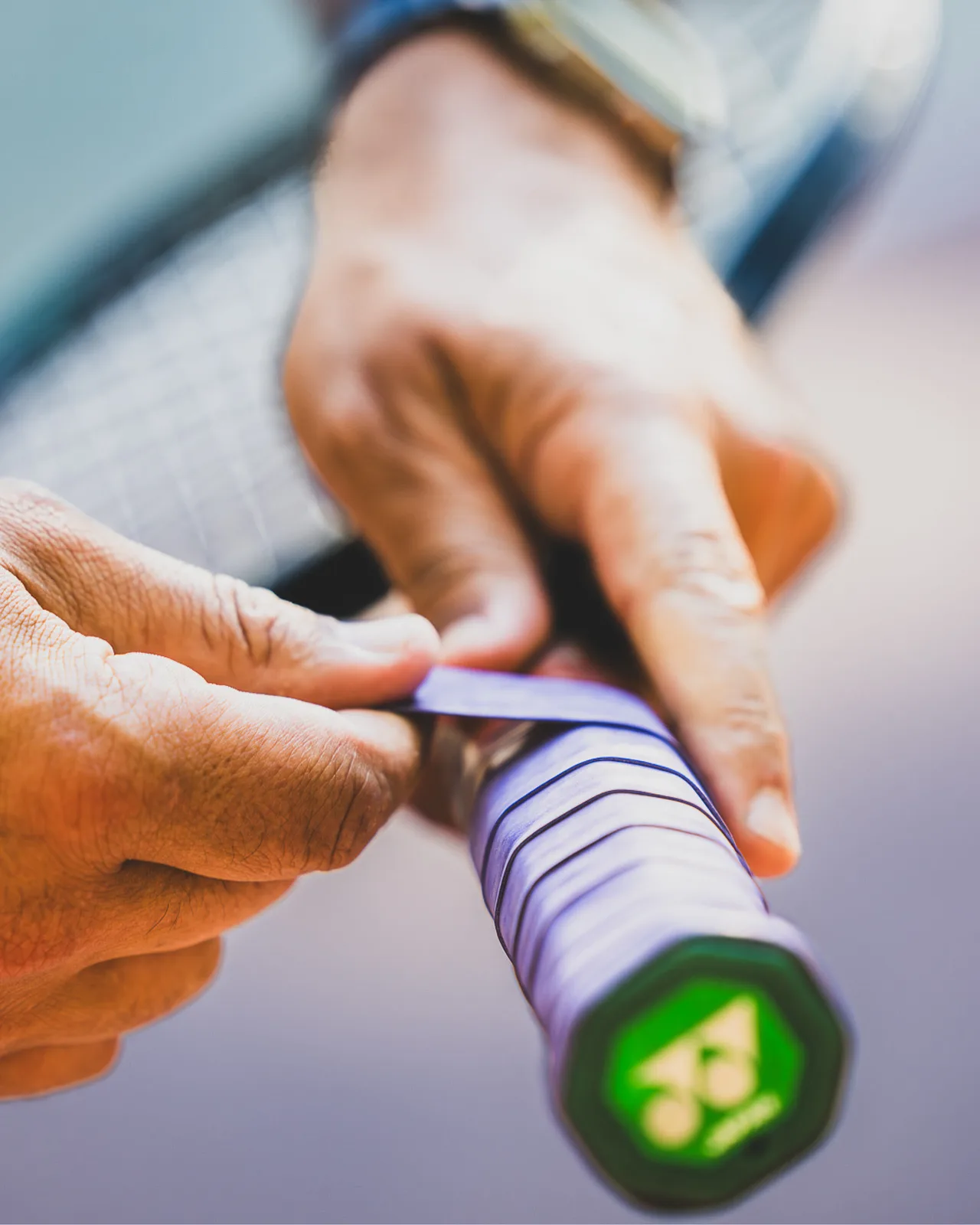
A racket handle is an eight-sided octagon, and each of the eight bevels is numbered. Bevel two is the continental, the grip for serves, volleys and slices. Bevel three is the eastern. Bevel four is the semi-western. Bevel five is the full western. Beyond bevel five is the extreme western, sometimes called the Hawaiian. The three forehand grips flagship has the full diagram and reference.
Five players. Five grips. All within a narrow band of the octagon and yet, as you will see, producing five distinct forehands.
Roger Federer: the eastern-plus, and the head that never moved
Federer's forehand grip sat between eastern and semi-western, closer to bevel three than to bevel four, in a position most coaches call an eastern-plus. It is the flatter of the two dominant modern grips, and the one that produced the low, driving ball flight that defined his game. If you want the fuller reading on this specific grip, we've published a piece dedicated to the eastern forehand .
Mouratoglou's observation about what actually made the Federer forehand distinctive is not the grip itself but what Federer did with his head at contact. "He was the first one to have his head turned to the right side while hitting it," Mouratoglou has said. "He was keeping his head in that position after the ball left his racket, like golfers." Which is to say: everything below the neck rotated through the shot; the head stayed still, eyes on the contact zone. It is a small technical detail with an enormous consequence. The ball is met cleanly, at the same spot in space, over and over, because the head does not chase it.
The eastern-plus gave Federer the flatter ball flight. The static head gave him the timing. And behind the serve, the forehand was the finishing shot: an incredible number of winners came in the second stroke of the point, before the opponent had recovered. Mouratoglou ranks his forehand third all-time. Some of us, maybe a lot of our readers, would put it higher.
Rafael Nadal: the moving grip, and the finish his uncle initially disliked
Nadal's grip is described in the analyst literature as sitting between semi-western and full western, and drifting deeper toward western on clay. Some sources call it a semi-western; others a full western; the truthful answer is that it moves, and the movement is deliberate. Nadal is one of very few players who consciously adjusts the depth of his grip by surface. Deeper toward the western on clay, where the ball sits up and the extra topspin margin buys him time and pushes the opponent back. Shallower toward the semi-western on faster surfaces, where the flatter drive is worth more than the shape.
The forehand also has the most recognisable finish in modern tennis, the lasso follow-through that whips the racket up and around the head rather than through and out to the target, although if you watch a lot of clips of Nadal, which we have, he is not lassoing every forehand at all . Yet lasso he did, and this was not, at the start, a technique his uncle Toni Nadal approved of. Toni initially believed the unconventional finish was unnecessary and inefficient. Rafa kept doing it because he needed the extra hand-speed the whip gave him against opponents who would otherwise out-hit him. The 3,200 revolutions per minute of average topspin the shot produced, with peaks near 5,000, are what the grip and the whip together deliver.
Brad Gilbert's observation on Nadal is worth remembering when you are tempted to copy any of this. "Not everybody" can frequently make the technical adjustments Nadal and Andre Agassi could make within their own careers. The Nadal forehand is a bespoke solution to a bespoke set of problems, and the grip is a decision, not a default.
Novak Djokovic: the extreme semi-western, and the sledgehammer
Djokovic's grip is often described as an extreme semi-western, sitting between bevel four and bevel five. Not as flat as Federer's eastern-plus. Not as tilted as the full western of Iga Świątek or Taylor Fritz. Right in the aggressive middle of the semi-western range, and executed with a discipline that has become the modern coaching reference. If you want the fuller anatomy of this grip, we covered it in the semi-western piece earlier this month.
What sets Djokovic's forehand apart from the other semi-western shots on tour is the way it is powered. Federer and Nadal both hit forehands the coaching literature describes as a whip: the arm accelerates ahead of the racket, the wrist and the racket-head snap through at contact, the racket finishes in an arc. Djokovic's forehand is more like a sledgehammer. The whole body rotates through the shot as a unit; the wrist stays relaxed and neutral; the racket is accelerated by timing and torso rotation rather than by arm-and-wrist snap. It looks less spectacular. It is arguably more consistent, and it is a big part of why he has been able to hit forehands in the same shape at the same quality at 37 that he hit at 27.
What os perhaps worth remembering is that in his early career Djokovic's forehand was one of the weaker parts of his game compared to his backhand and his return. The version we now treat as the textbook semi-western was rebuilt over years. The shot that his 24 Grand Slams sit on was not a given. It was work.
Carlos Alcaraz: the hybrid, coached against the Nadal comparison
Alcaraz plays a semi-western that drifts toward full western on clay. It is, in grip terms, closer to Nadal's than to Federer's or Djokovic's, and the physical similarity is much of why the Nadal comparison was fastened onto him so quickly. Juan Carlos Ferrero, his early coach, has said the comparison "was super heavy" on Carlos's back in the early years. Ferrero's own preferred comparison for Alcaraz, offered as far back as 2020 when Carlos was sixteen, was different: "If I have to say someone that I can compare him to, it's the game of Novak Djokovic or maybe Roger Federer." Not Nadal, despite the shared nationality and the surface preference. Because Ferrero saw a player whose game was going to be built on court coverage, variety and shot selection rather than on the physicality of the modern topspin-baseline default that made Nadal.
The Alcaraz forehand is, at its best, a Mouratoglou-called "short, simple preparation" that gives him time to attack. The takeback is compact. The contact is early. The grip lets him produce Nadal-shape when he wants it (which is most of the time on clay) and drop into a flatter drive when he wants that (which is most of the time on grass and on quick hard). If the modern game keeps evolving in the direction it is going, Alcaraz's grip probably the most instructive template for the next generation of top-tier forehands.
Jannik Sinner: the semi-western with a quirk, and the number-one shot on tour
Sinner plays a semi-western that most analysts categorise firmly in the bevel-four range, but with an unconventional takeback that has been described (charitably) as quirky. He is not a case study in orthodoxy the way Djokovic is with the same grip. He is a case study in what happens when a player with unusual mechanics is coached patiently by two people who know exactly which parts to leave alone.
Darren Cahill, one half of the coaching pair that has taken Sinner to number one, is direct about where the work went. "Simone has done an amazing job over the past couple of years," Cahill has said, "working on errors of Jannik's game, both transition from defence and to get some power on those in the corners." Simone Vagnozzi is the technical eye; Cahill is the strategic one. Neither has tried to rebuild the forehand from scratch. Both have refined its direction, its efficiency in transition, and its capacity to hurt from defensive positions. In 2024 Sinner topped the ATP's shot-quality leaderboard for both forehand (8.8 out of 10) and backhand (8.48), the first player to lead both simultaneously in the tour's tracked-data era.
The lesson Sinner offers a serious club reader is not "copy the grip." It is that a forehand is not one thing. It is a grip plus a takeback plus a swing path plus a contact point plus a follow-through, and the pieces can be non-standard and still work if the whole is coherent. Sinner's grip is orthodox. His mechanics around it are not. Together they hit a ball that no one else on tour is currently hitting.
What the five grips tell you about your own
The temptation, when you read a piece like this, is to look for the winning grip and switch to it. That is the wrong lesson.
The right lesson is that even at the very top of the sport, five of the best forehands in the world are five different shots, produced by five different grips, chosen by five different coaching decisions in five different bodies for five different tactical purposes. Federer's eastern-plus is not better than Djokovic's extreme semi-western; each solves a different problem. Nadal's moving grip is not a template; it is a bespoke tool for a bespoke career. Alcaraz's hybrid is being coached deliberately to avoid becoming the second Nadal. Sinner's shot is being sharpened at the edges, not remade.
Your own grip choice sits inside the same logic. What is your court diet? What is your physical ceiling on racket-head speed? What is the tactical problem your forehand needs to solve inside your point patterns? If you have never sat down and answered those three questions with a coach who has actually watched you play, changing your grip is guessing. If you have, and the answers point to a change, the pieces in this cluster (the three grips flagship, the eastern deep-dive and the semi-western piece) will help you make it.
A note for the reader who has read this far
If you would like a proper answer to the three questions above before you change anything about your forehand, All Court exists for exactly that. You put your phone against the back fence or net post, film a session, and upload it. You get a "talking head" session inside your own video from a touring professional. Plus the AI-enabled platform compares those ratings against thousands of shots from hundreds of players graded by the same touring pros and elite coaches. The output is a personalised coaching session on your footage and an All Court Rating for each shot you hit and a cumulative All Court Rating that compounds every time you film more of your play, so that you can see which parts of your game are improving and which want more work. There is no nominator, no joining fee, and no waitlist that closes inside a generation. Join the waitlist at allcourt.club/join.