What pros do with their non-dominant hand that amateurs never notice
Watch a professional player long enough and you stop watching the dominant hand. The dominant hand is doing the obvious thing. The other hand is doing four less obvious things, all the time, on every shot. Most amateurs leave the other hand dangling.

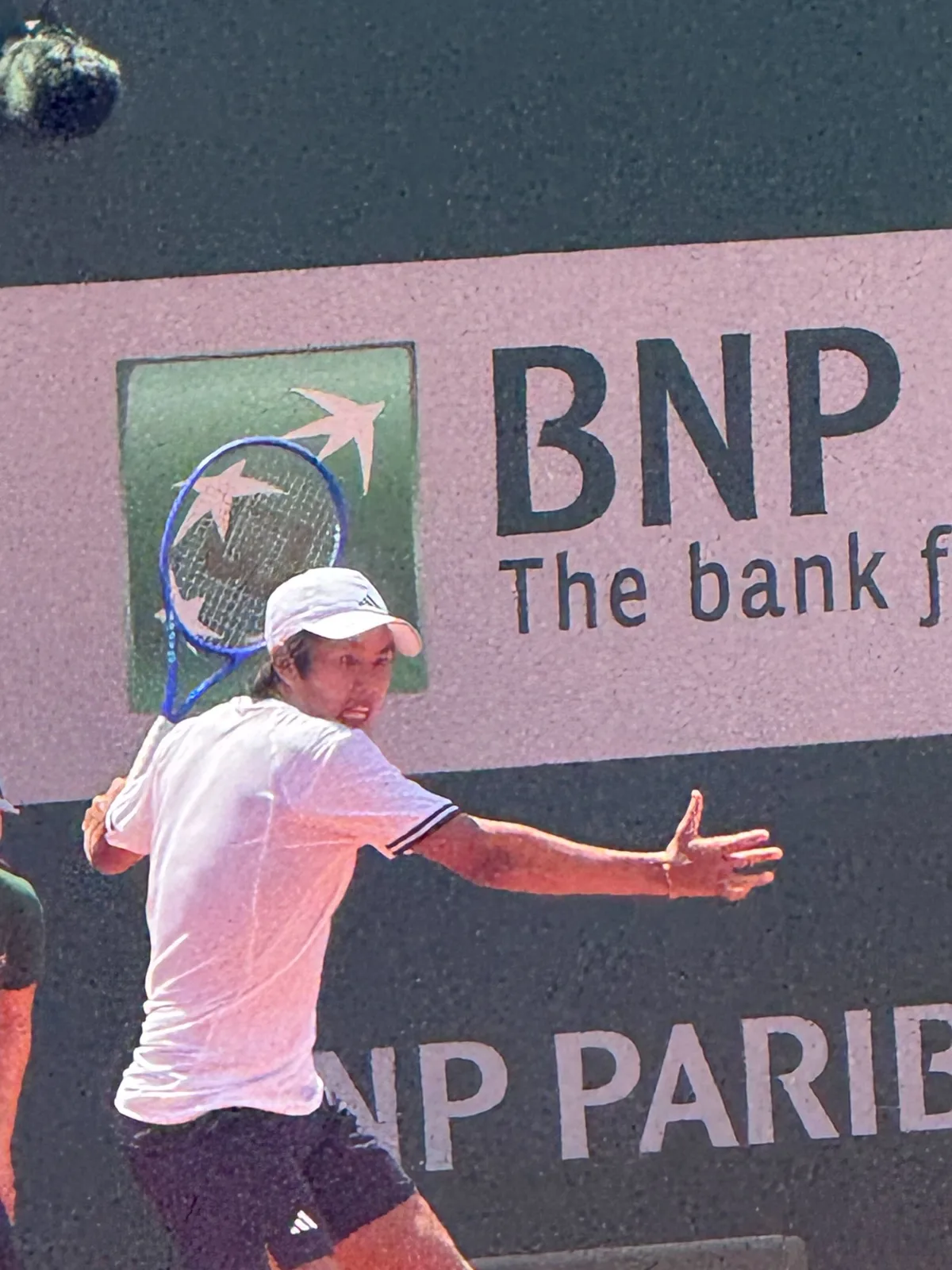
Stand behind a club court for an hour and watch the players' dominant hands. You will see roughly what you expect to see. Forehands, backhands, serves, volleys, the racket moving in patterns you have seen a thousand times. There will be moments of competence and moments of failure, and they will mostly happen for the reasons you would predict.
Now stand behind a professional practice court and watch only the other hand. The non-racket hand. The left hand on a right-handed player and vice versa, as in the shot of Brandon Nakashima above. Suddenly the picture is different. The hand is busy. It is doing four or five small jobs you had not registered before, on every shot, with the precision of an instrument you cannot quite hear. It is doing them because that is what makes the dominant hand work.
One of the single most useful pattern-recognition exercise you can do as an amateur watching pro tennis is to stop watching the dominant hand and start watching the other one. Here is what it does, by shot, and what amateurs almost universally do instead.
The forehand: the support hand sets the racket
On a professional forehand, the non-dominant hand sits on the throat of the racket through the entire preparation. It is not a casual hold. It is steering the racket head, controlling the angle of the strings, taking some of the weight, and timing the release.
The release is the part most amateurs miss. The support hand stays on the racket until the moment the unit turn is complete and the racket head is at the top of the take-back. Then, and only then, the support hand lets go. The dominant arm now has a perfectly-positioned racket to swing through; the rest of the swing happens cleanly because the setup was clean.
What amateurs do instead: the support hand falls off the racket early, often before the unit turn has even completed. The dominant arm is now alone, holding a racket that is wobbling in the take-back rather than settled. The swing path that follows is less consistent because the starting position varied. This is the single most common forehand fault visible to anyone watching, and it has nothing to do with the dominant arm.
The serve: the toss arm is the other half of the serve
Tennis pedagogy has, for decades, talked about the serve as a one-arm motion. The dominant arm tosses, then the dominant arm hits. This is not how a good serve works. A good serve is a two-arm motion in which the non-dominant arm (the toss arm) does three jobs that the dominant arm cannot do for it.
First, the toss arm sets the contact point. The ball is placed in space — not thrown — and where it goes determines where contact has to happen. Inches matter. The toss arm is, in mechanical terms, calibrating the geometry of the swing that follows.
Second, the toss arm provides the rotational engine. As the dominant shoulder drops back into the trophy position, the non-dominant arm extends upward and stays up. The asymmetry of one arm up and one arm dropping is what produces the shoulder-over-shoulder rotation that, on a good serve, generates more racket-head speed than the arm ever could on its own.
Third, the toss arm provides the balance counterweight. When the dominant arm whips up and through, the toss arm tucks down and across the chest. The body does not fall forward, because the counterweight has caught the motion. Without this, the player either falls into the court (which is fine if they meant to) or topples sideways (which they almost never did).
What amateurs do instead: the toss arm drops the moment the ball leaves it. By the time the dominant arm is firing, the non-dominant arm is at the player's side, contributing nothing. The serve becomes a one-arm motion, the player loses both the rotation and the counterweight, and the kinetic chain breaks at the trunk. The arm now has to generate everything by itself. The shoulder problem that follows is not random.
The two-handed backhand: the non-dominant hand is the engine
This one is the most surprising to amateurs, because the assumption — fair, on the surface — is that the dominant hand drives the backhand the way it drives the forehand. It does not. On a two-handed backhand, the non-dominant hand is the engine and the dominant hand is the stabiliser. The shot is, in mechanical effect, a forehand hit by the non-dominant arm with the dominant arm along for the ride.
Watch a pro hit a two-handed backhand in slow motion and watch the non-dominant elbow. It leads the swing. It is what pulls the racket through. The dominant hand is firm on the grip but it is not generating force; it is providing direction and stability.
This explains, by the way, why right-handed players with a two-handed backhand often have a stronger backhand than forehand under pressure. They are effectively hitting a left-handed forehand on the backhand side, and the left arm is doing what it was built to do without the years of overuse that the right arm carries.
What amateurs do instead: they treat the dominant hand as the driver and the non-dominant hand as a passenger that sometimes wakes up. The backhand becomes a one-handed shot with an extra hand on the grip for show. It works at moderate pace and falls apart under heavy balls, because the engine that should have been firing was idling.
The volley: the non-dominant hand is the ready position
At the net, the non-dominant hand has two specific jobs. First, it holds the throat of the racket during the ready position, taking the weight and keeping the racket up where the player can see over it. Second, on the high volley specifically, it can be used to support the racket head at contact, almost like a second grip.
The third, less talked-about job: the non-dominant hand catches the racket on the follow-through to bring it back to ready quickly. The recovery between volleys is fast because the non-dominant hand is doing the catching.
What amateurs do instead: they let the non-dominant hand hang at their side in the ready position. The racket weight is now entirely in the dominant arm. The arm tires faster, the ready position drifts down between points, and by the time the player is at full-stretch on the third volley of a doubles point the racket is already too low. The whole net game gets harder than it needed to be.
How to spot it in your own game
You cannot watch your own non-dominant hand during a point. The same proprioceptive blind spot that makes the grip hard to feel makes the other hand even harder. The only reliable diagnostic is video, and even then most players have to be specifically told what to look for.
The shortcut, if you do not have video: ask a hitting partner to watch one of your hands during a five-minute knock-up. Not the dominant one. The other one. They will probably notice three things in five minutes — the support hand falling off the forehand prep early, the toss arm dropping the moment the ball leaves, the non-dominant hand hanging at the side in the volley ready position. None of those will be conscious choices on your part. All of them will be visible to someone who knows what they are watching for.
Get a pro to watch your non-dominant hand specifically
This is one of the rare things that is genuinely faster to diagnose than to fix. A pro watching your forehand for ten seconds can tell you whether the support hand is doing its job. They cannot tell you, in ten seconds, how to retrain the habit — that takes weeks of deliberate practice — but they can tell you, immediately, which of the four patterns above is the one costing you the most.
Upload a clip at allcourt.club/intake and a pro from the All Court network will watch your non-dominant hand across a couple of rallies and your serve, and tell you which of the four it is. Most players are surprised, because they have spent their entire tennis lives looking at the other arm.
What this is for, in the end
The dominant arm gets all the attention because it does the obvious work. The non-dominant arm does the work that makes the dominant arm's work possible. Once you can see it, you cannot stop seeing it. Watch the next ATP or WTA match with the other hand in mind for a set. By the end of it, the pros will look like they are playing a slightly different sport. They sort of are.
Related posts
How to play your best tennis on clay