Djokovic vs Sinner: two roads to a Wimbledon semi-final
Two players, five rounds each, wildly different routes to the Wimbledon semi-final. Sinner has walked. Djokovic has grafted. The numbers set up a match that will be decided by whichever of them can impose the shape of the tournament they have been playing so far.

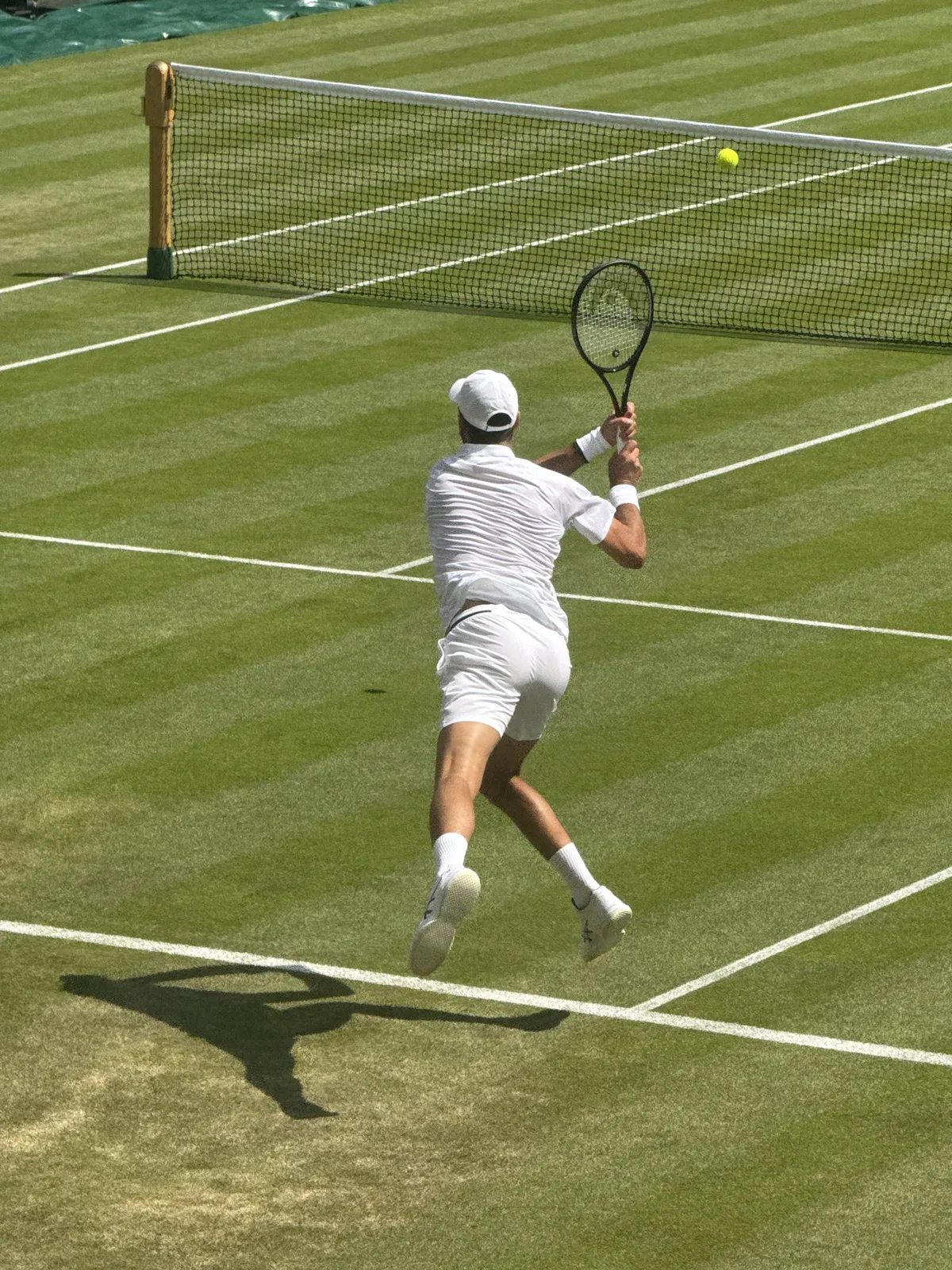
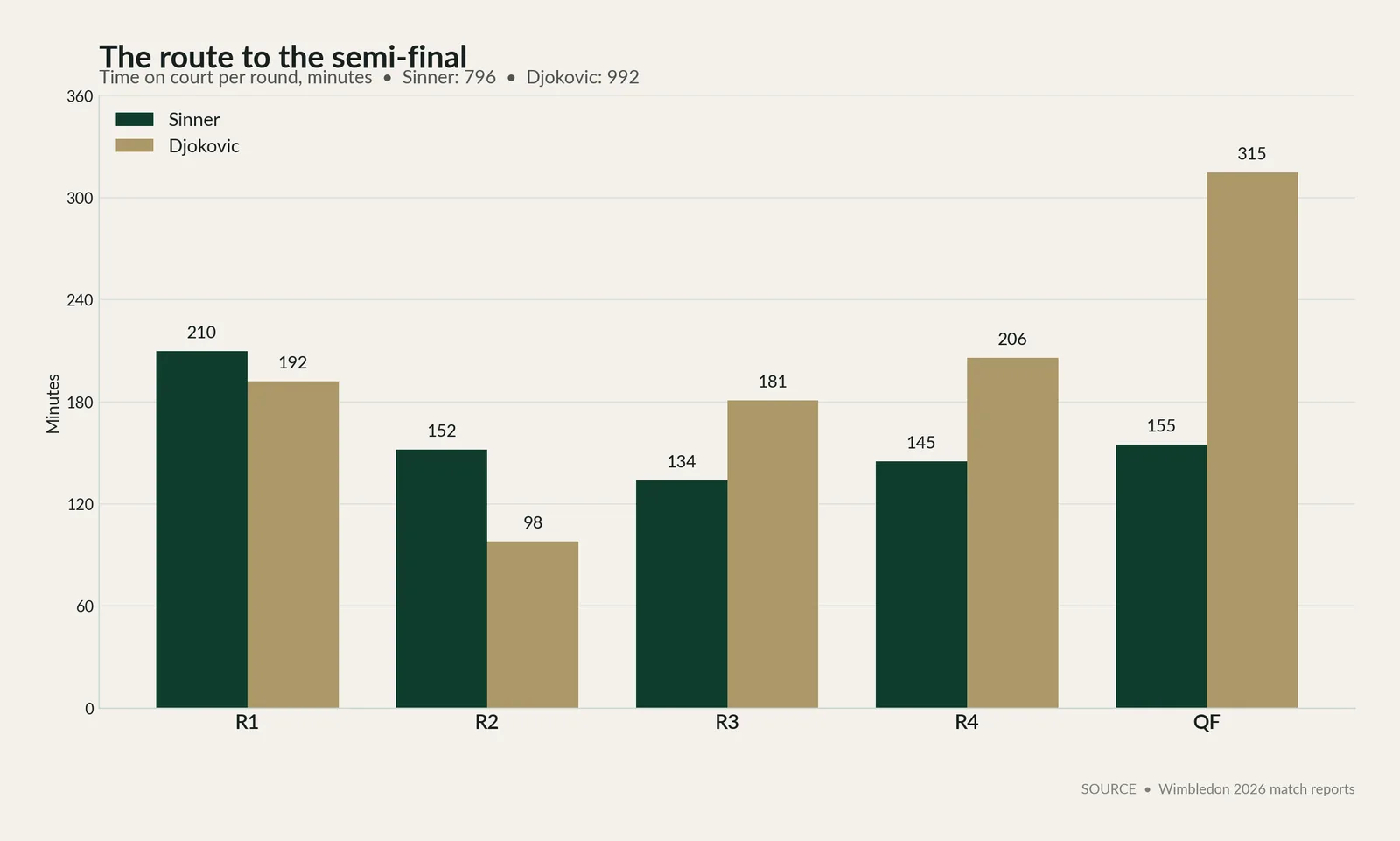
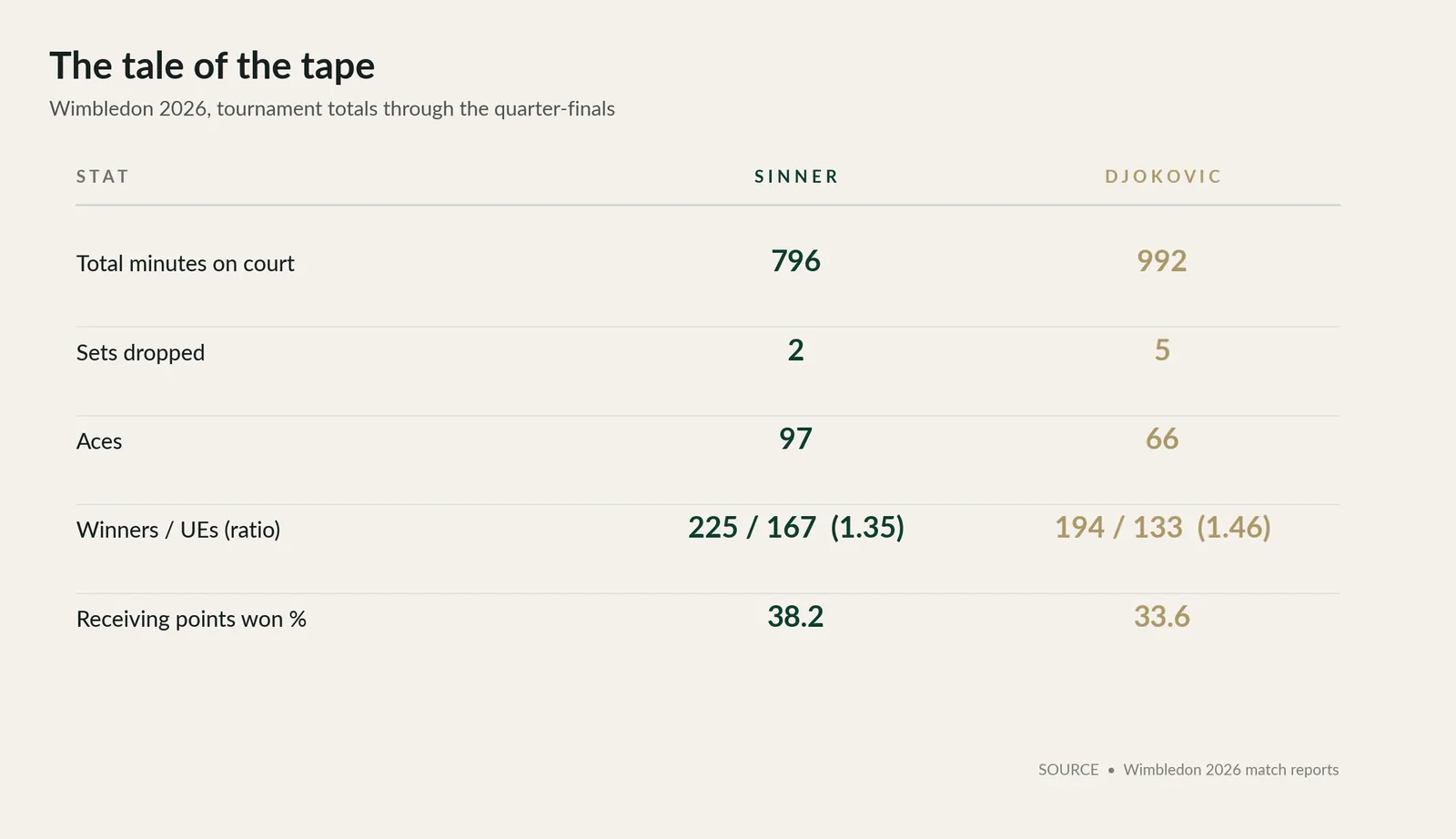
Two men will walk out onto Centre Court at some point on Friday afternoon to play the Wimbledon semi-final that most of tennis had already circled on their calendars while the draw was still being read out. One of them will have spent 796 minutes on court to get there, dropped two sets, and hit 97 aces. The other will have spent 992 minutes on court, dropped five sets, hit 66 aces, played the longest quarter-final in Wimbledon history, and taped an ankle after Tuesday's five-hour epic. They are, by any reasonable read of the numbers, playing two entirely different tournaments. On Friday afternoon those two tournaments meet, on the same lawn, at the same net height, and for a place in the final.
What the numbers tell us about how they got here is what makes this semi-final interesting. Not who has been more impressive, which is easily answered. But what each of them has spent the past ten days practising, and whether the tournament they have been playing so far is the tournament the other one will let them play on Friday.
Sinner's route, in numbers
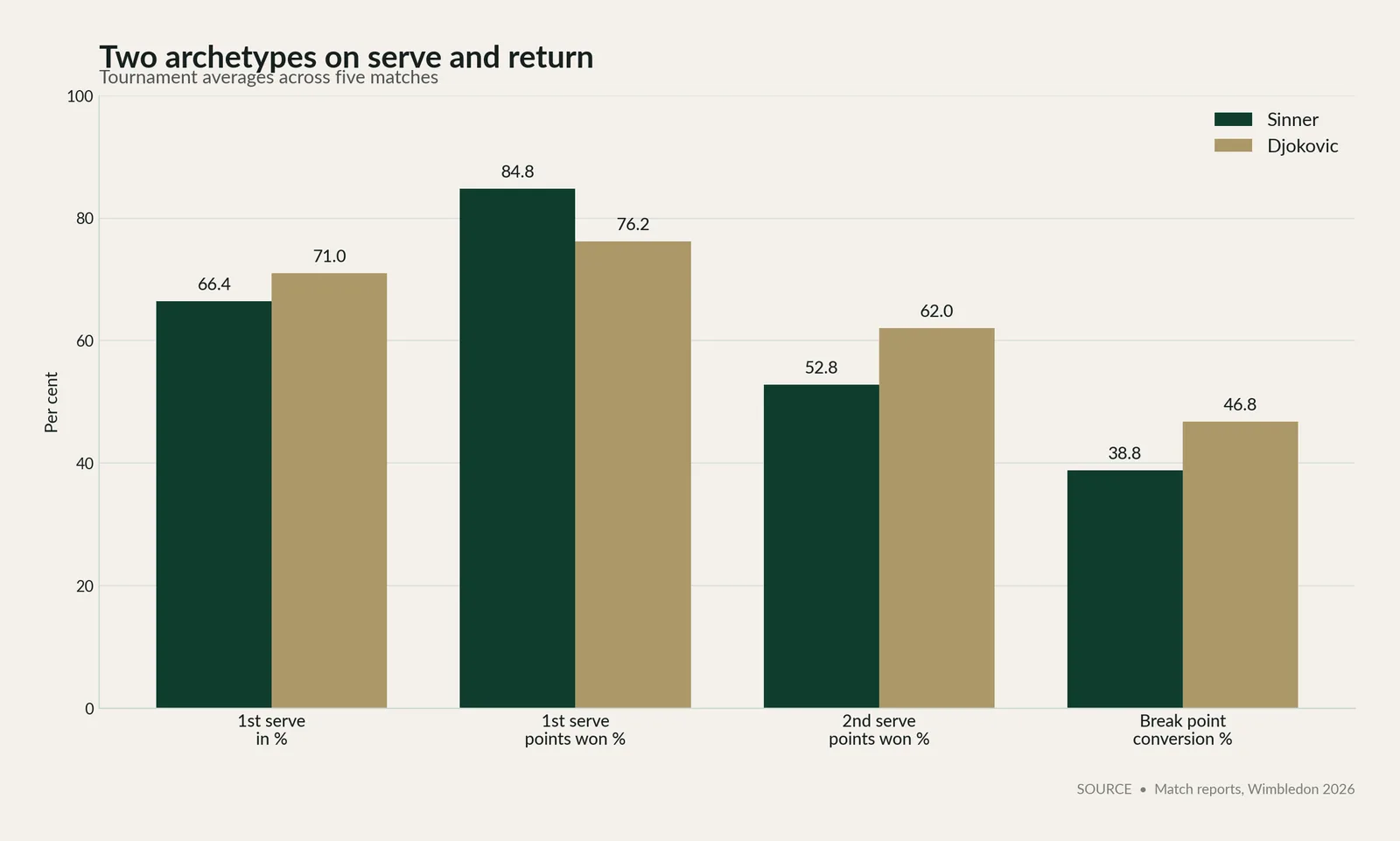
Jannik Sinner is the defending Wimbledon champion, the world No. 1, and, if his first five matches are any guide, a player who has arrived at this fortnight with a serve that has been landing where he wanted it and a return that has been finding second serves early. Ninety-seven aces across five matches is a rate of just under twenty per match, which on grass is an extraordinary number. His first-serve-in percentage sits at 66.4 across the tournament so far. The percentage of first-serve points he has won is 84.8. Both of those numbers, read together, describe a player who is not landing a huge number of first serves but is winning the vast majority of the ones he does. That is the profile of a first-strike server on a fast surface, and it is the profile Wimbledon has always rewarded.
His return has been quieter but no less effective. Receiving points won at 38.2 per cent. Break-point conversion at 38.8 per cent. Neither number stands out on its own. What they describe, in combination with the serving profile, is a player who does not need to break serve to win sets, because he is holding his own so cleanly that a single break is enough. That is why Sinner has spent only 796 minutes on court across five matches. He has closed sets in tiebreaks when he had to, in straight sets when he could, and in one three-hour, thirty-minute five-setter against Miomir Kecmanovic in the first round that stands out on his stat line as the only match this tournament that got away from him for any length of time.
The Struff quarter-final on Tuesday, 7-5, 7-6(4), 6-3, was Sinner playing at a canter. Two hours and thirty-five minutes on Court One. Sixteen aces. Sixty-five per cent first serves in. He conceded the first-set break points he faced, held them off in the second-set tiebreak, and closed the third comfortably. There was very little in the match that suggested a player anywhere near the edge of his capabilities.
Djokovic's route, in numbers
Novak Djokovic has done it differently. He has played 992 minutes of tennis over five matches, which is 196 minutes more than Sinner. That is close to the length of a full extra fourth-round match on his stat sheet. He has dropped five sets, including two in his three-hour Yibing Wu opener, one to Arthur Rinderknech in the third round, and two to Auger-Aliassime in the quarter-final on Tuesday. He has hit 66 aces to Sinner's 97. His first-serve-in percentage is 71, higher than Sinner's 66.4, but his first-serve-points-won percentage is 76.2, meaningfully lower than Sinner's 84.8.
Those two serving numbers, read together, describe an entirely different profile. Djokovic is landing more first serves but winning fewer of them. He is holding by working the point, not by ending it. This is the Djokovic pattern that has won him seven Wimbledon titles and, quietly, earlier this fortnight, the record for the most career match wins in Wimbledon history. Federer had it before him, at a hundred and five, and looked as though he might keep it. It is not a first-strike game. It is a grinding game, built on serve placement rather than serve speed, on return depth rather than return violence, and on the extraordinary discipline of a player who has been converting his break points at 46.8 per cent of the tournament. Sinner's break-point conversion is 38.8. Djokovic's Winner-to-Unforced-Error ratio is 1.46. Sinner's is 1.35. When Djokovic gets a chance, he takes it. When he does not, he waits.
The quarter-final against Auger-Aliassime on Tuesday was the extreme version of the Djokovic game. Five hours and fifteen minutes on court, seven-six in the first, three-six in the second, six-three in the third, six-seven in the fourth, and seven-six in the fifth deciding tiebreak. The longest quarter-final in Wimbledon history. Djokovic tweaked his left ankle at 5-4 in the first set, took a medical timeout on the changeover during which the trainer tested the ankle and massaged the calf, and told the umpire, when the roof closed at the end of the second set at 7:40 in the evening with the sky still perfectly light, that Wimbledon was an outdoor tournament. He won the match anyway, the way he tends to when a Slam is running to five sets on grass. But he arrived at Wednesday's rest day 196 minutes deeper into the fortnight than Sinner, and with the physical bill for that particular kind of win coming due on Friday.
The physical bill
The physical bill is what no stat sheet quite captures. Djokovic will be thirty-nine on Friday afternoon, fifteen years older than Sinner. He has covered 11,762 metres of grass over five matches, compared with Sinner's 11,359, and 3,565 of those metres came in one quarter-final on Tuesday. The recovery of a thirty-nine-year-old between Tuesday and Friday is not the recovery of a twenty-four-year-old, and the medical staff around Djokovic will have spent the past forty-eight hours doing a great deal of quiet work that nobody televises.
The question is not whether Djokovic will play the semi-final. He will. It is whether he can play the version of it his stat sheet describes so far: the grinding game, the deep exchanges, the deuce points converted at 46.8 per cent. That version requires the legs to still be under the swing at the two-hour mark. On Friday afternoon Djokovic will have played eight and a half hours of tennis in the previous nine days on his existing ankle. Sinner will have played six.
The tactical question
The match Sinner will try to play, if the past ten days are any guide, is short. First serve to a body target or a wide slice, look to end the point inside three balls, get the break point when Djokovic misses one of his 71 per cent first serves, and hold the rest. On a grass court that has been playing quickly and low all fortnight, the strategy is aggressive because the surface rewards it. Sinner's 84.8 per cent first-serve-points-won number tells you the strategy has been working.
The match Djokovic will try to play is long. Serve for placement rather than pace, keep the returner honest with the second-serve kicker, extract errors on the fourth or fifth ball of a rally, and lean on the higher break-point conversion when the chance arrives. His game against Sinner has been built on the fact that the Italian's forehand, at its highest gear, is one of the shots the tour cannot handle, but that the shots leading up to that forehand can be complicated for him. Djokovic complicates points better than anyone alive.
The place the match is likely to be decided is the second-serve return. Sinner has been winning 52.8 per cent of his second-serve points across the tournament. Djokovic has been winning 62. That is a ten-point gap on the shot that most decides tight tennis matches at this level. If Sinner's serve is on and the second-serve column stays up around 60 per cent for him, he can absorb the fact that Djokovic is the better break-point converter. If it dips into the forties, Djokovic's return is one of the great returns in tennis history, and he will find the way in.
The history worth remembering
Sinner and Djokovic have played eleven times on the ATP tour. Sinner leads six-five. Their most recent meeting was the Australian Open semi-final in January, which Djokovic won three-six, six-three, four-six, six-four, six-four, a match on which Djokovic hung by his fingernails through the first three sets before doing what he does in the deciding sets of Slams.
The more important match, for anyone trying to read Friday, was the Wimbledon semi-final between them a year ago. Sinner won it in four sets. He went on to beat Carlos Alcaraz in the final and take his first Wimbledon title. That match will be watched again on Friday morning by both camps, for the same reason it was watched last week by Sinner's camp before Wimbledon started and Djokovic's camp before the draw came out. It is the match on which the current version of the Sinner-Djokovic rivalry turns, and the changes each of them will have made since then are what will define the next ninety minutes of tennis this fortnight has left in it.
Three numbers to watch on Friday
If you want to watch the semi-final through one lens, watch the ace count on the Sinner side. Twenty aces would be a routine day for him this fortnight. If he is on twenty-five by the end of the third set, Djokovic will not have found a way onto the Sinner serve, and the match becomes very difficult for the older man to save.
If you want a second lens, watch Djokovic's second-serve-points-won percentage set by set. The 62 per cent number he has averaged so far is high. The 52.8 per cent Sinner has averaged is normal. If Djokovic's second-serve number sits at 60 or above through the first two sets, he is playing his match. If it drops to 50 or below, Sinner is playing his.
The third lens is the first set. Djokovic has been broken in the opening set of three of his five matches this tournament, and has still won the set in two of them. Sinner has not been broken in the opening set of a single match. If Djokovic gets to a first-set tiebreak, the whole match opens up in a way it does not if Sinner takes the first set six-three or six-four in under forty minutes.
The lens for Friday afternoon
The stat sheet is not the match, and never is. Two men will walk out onto Centre Court at some point on Friday and one of them will find something the other has not been able to find in the past ten days, and the outcome will be decided by that. What the numbers give you is the shape of what each has been trying to do so far, and the shape of what the other will now try to prevent. Sinner has been winning cheaply and Djokovic expensively; on Friday afternoon, one of them will find a way to keep doing what he has been doing, while the other will have to find something else.
If you want a touring professional to watch your own tennis the way the Centre Court coaches will be watching Sinner and Djokovic on Friday, for the tendency rather than the shot, the All Court waitlist is the way in. Access is opening in batches. There is no nominator, no joining fee, and no fifteen-year wait. Join the waitlist at allcourt.club/join, and when your batch opens a touring pro watches your session back, tags every shot, and gives you the same read of what your game is actually doing that Sinner and Djokovic will have been given all week.
Related posts
Where to play tennis in London during Wimbledon