US Open: the tennis fan's field manual for Flushing Meadows
The tennis fan's field manual to the US Open at Flushing Meadows: dates, tickets, the LIRR, the outer-court trick and the 2026 storylines to watch.

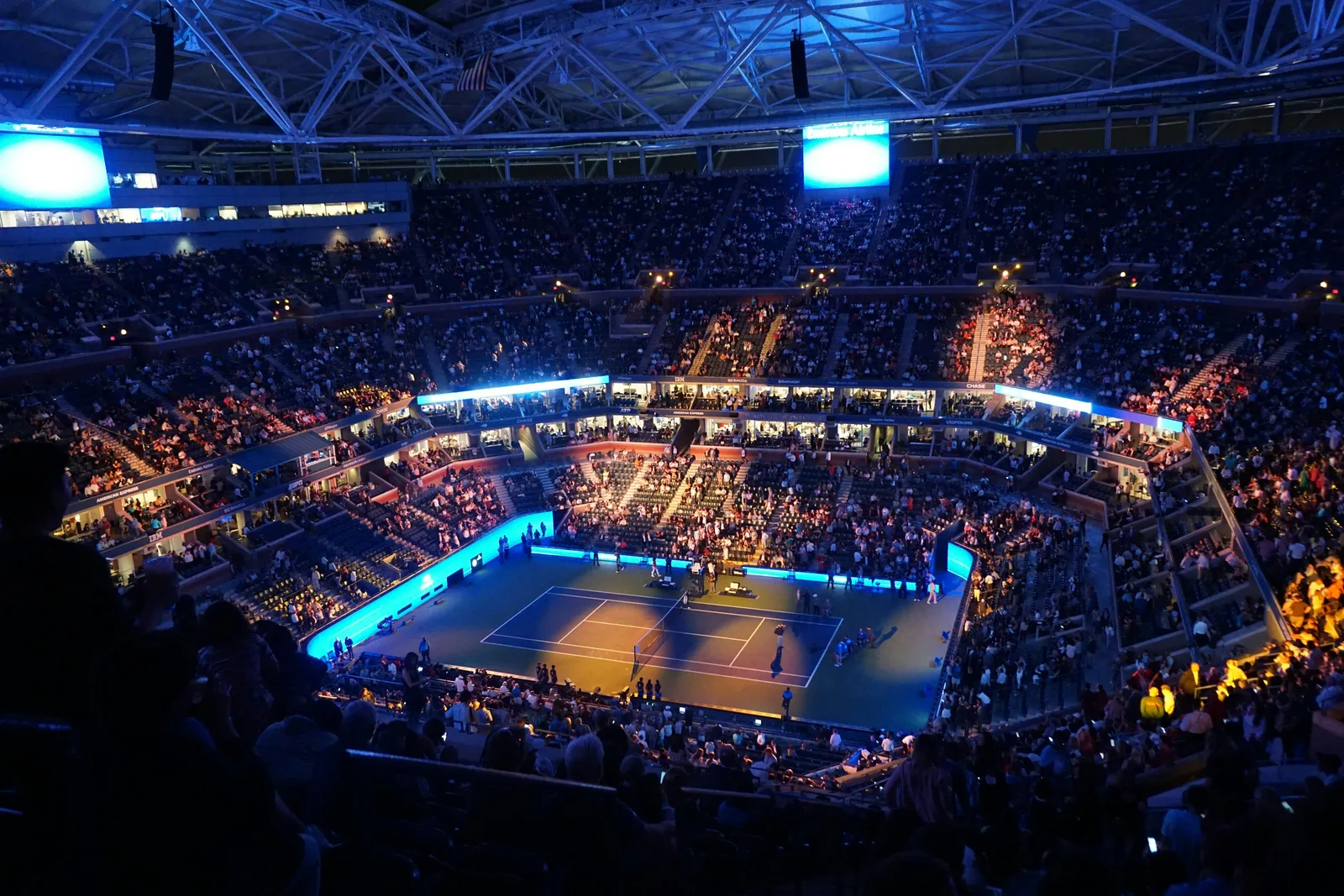
The last time I was at the US Open I watched Andy Murray lose to Grigor Dimitrov on Arthur Ashe. Grigor sliced his backhand for three sets straight and Murray never found a rhythm. I spent most of the match talking to an American film director now based in Paris called Vince Duque, who I had first met a few days earlier at the All Court Tennis Club event we hosted with the Bryan Brothers at The West Side Tennis Club in Forest Hills. Vince had come along to our event and then taken one of the tickets we had organised for members going on to the Slam. Years later we are still friends, he's helping me on producing documentaries for All Court Productions and he introduced me to an elite coach that is calibrating our All Court Rating on our video performance platform (more on that at the end of this article). The tennis community is like that.
This is a US Open guide for the reader who wants a bit more than dates and ticket prices, and the field manual I wish I had before that first trip. What to buy, how to get there, where to eat, the outer-court trick most first-timers miss, and the 2026 storylines worth planning your fortnight around.
The dates
The 2026 US Open runs from Sunday 23 August to Sunday 13 September at the USTA Billie Jean King National Tennis Center, Flushing Meadows, Queens.
Fan Week is 23-29 August. Main draw begins Saturday 30 August. Women's singles final is Saturday 12 September. Men's singles final is Sunday 13 September. Twenty-two days of tennis in total, eight of them with free grounds admission.
The three ticket types and how they work
The US Open sells three ticket types and they do not overlap in the way most first-timers assume.
Fan Access Pass, free, Fan Week only (23-29 August). The best value in tennis, and the section most people who have never been to the Open miss. A free Fan Access Pass gets you into the grounds during Fan Week, when qualifying is played on outer courts, the top seeds practise on P1 to P5 with almost no crowd, and the reimagined Mixed Doubles Championship runs on Grandstand. Farhad Roshanaie, an All Court pro mentor, USTA-accredited coach at the historic Frederick Johnson courts in Harlem and the subject of the forthcoming All Court film The Jungle, who put me right on a lot of this, rates Fan Week above the main draw for a serious fan: fewer people, freer movement around the grounds, and much easier access to the practice courts and to the players themselves. If you can be in New York for it, go.
Grounds Pass, main-draw week 1 into week 2. All non-Ashe courts, first-come first-served. Best value in the first week when every outer court has a full match card. Value drops as the tournament advances, because from the quarter-finals onwards most of the high billing matches move to Ashe.
Arthur Ashe day session or night session. These are separate purchases. A day-session Ashe ticket does not get you into Ashe for the night session. Day sessions start at midday with two singles matches on Ashe and general admission to Armstrong and the outer courts included. Night sessions start at 7pm and carry the atmosphere spectacle: the lights, the celebrity boxes, and almost always the top seed on court.
One note on price and availability. Face-value primary sales for the biggest sessions sold out within minutes when the tournament went on sale earlier in the year. Most of what remains as the tournament approaches is on the verified resale market at prices considerably above face. If you are booking now, check Ticketmaster for what is actually available and set a limit before you look at the numbers.
The thing first-timers rarely think about when they book. Which side of the stadium the sun ends up on. Farhad's steer: pick the seat that keeps the sun out of your eyes, and mind the direction the sun tracks between about 11am and 5pm.
Two practical rules follow from that, and they are worth knowing before you buy.
Arthur Ashe Stadium runs on a north-west to south-east axis. During a day session the sun sits south of the stadium and swings from south-east at lunchtime to south-west by five o'clock. If you want shade, book the west side upper deck. The roof overhang and the west stadium wall block the afternoon sun coming from the west, and sections 329 to 333 are the reliable ones. If you would rather be in the sun but with the sun behind you, book the south-east side lower tier: you face north-west and the sun stays behind your shoulders through the whole session. The seats to avoid on a day-session ticket, if you have an option, are the north-east upper stands, which face directly into the setting sun from about three o'clock onwards.
Louis Armstrong sits on almost the same orientation as Ashe, immediately to the south-east, and the same rule applies: west upper deck for shade, south-east side for sun-at-your-back. Grandstand is rotated slightly more clockwise, but the same principle holds: the west stands are where the shade is, the north-east stands are where the sun ends up.
Getting there
The 7 train from Manhattan to Mets-Willets Point is the classic. About $3 and 35 to 45 minutes from Midtown, then a half-mile walk over the boardwalk to the gates. It runs frequently, it is easy, and on match days the MTA lays on extra trains.
The Long Island Rail Road is the upgrade. Port Washington branch out of Penn Station or Grand Central Madison, about 19 minutes to Mets-Willets Point, $5 to $7. Farhad's take, which matches mine: the LIRR is faster and more comfortable than the 7, for a few dollars more and considerably less time. The catch is that trains do not run as often as the subway. Miss one and you can wait forty minutes for the next.
Do not drive. Parking is expensive, the traffic out of Flushing Meadows at midnight is punishing, and the last thing you want after a five-set night session is to be in a queue on Grand Central Parkway for an hour.
The single most common transport mistake. Planning the trip in and improvising the trip back with 23,000 other people at midnight. Buy the LIRR return before you leave the flat. If you are catching a flight out of JFK the same night as a session, book a car in advance. I have done the get-a-taxi-at-Flushing-at-midnight version once and only just made JFK back to London in time.
What to bring
Farhad's kit list, which reads like it was written by someone who has done a full Fan Week in ninety-degree heat, which he has:
Your own sunscreen, and particularly a face sunscreen you actually like the feel of. The kiosks at the grounds do occasionally hand out samples but you cannot count on it.
Sunglasses and a hat with a wide brim or, better, a cap with fabric that covers the neck. The Ashe upper deck faces south for most of the day and the concrete radiates.
A portable fan. Small, USB-rechargeable. On a ninety-degree afternoon on Ashe, it makes the difference.
A refillable water bottle. There are refill stations across the grounds and you save yourself the queue for the $6 Poland Spring.
The outer-court trick
This is the bit that separates a first-timer from someone who knows the grounds.
Practice courts P1 to P5 are inside the main gate. On any Fan Week morning and most main-draw mornings you can watch top-ten players hitting with their coaches at almost arm's length. Alcaraz, Sabalenka, Sinner, Gauff, Fonseca on a good week. No stadium seat gets you that close.
Practice courts P6 to P17 are outside the perimeter of the tennis centre, in Flushing Meadows-Corona Park itself. They are open to the public and you do not need a US Open ticket to watch. If you cannot get a Fan Access Pass sorted, walk into the park, find P6, and you can watch touring pros hit for free.
The outer show courts are courts 4 through 17 during Week 1. First-come, first-served. Doubles matches and early-round singles on outer courts give you sideline views that no reserved Ashe seat can match. On an outer court in 2023 I heard the rifle-cracking shotmaking and the chants and boos of a partisan American crowd before I saw the player. I walked over to find an eighteen-year-old wild card called Alex Michelsen playing his first-ever Grand Slam match. He beat Albert Ramos-Vinolas in straight sets and lost to Nicolas Jarry the next round. He now sits inside the world's top forty.
That is what the outer courts are for, and it is not a one-off. Farhad has been going to the Open long enough to have seen the pattern. Jannik Sinner played his first US Open in 2019 aged eighteen, out of qualifying, unknown to any casual fan, and lost a first-round four-setter to Stan Wawrinka on an outside court. He is now the world number one and a multiple Grand Slam champion. Carlos Alcaraz arrived at his first US Open in 2021 aged eighteen and ranked outside the seeds; by the third round he had beaten world number three Stefanos Tsitsipas in a four-hour five-setter and become the youngest man to reach a US Open quarter-final in the Open era. He is now the world number two, another multiple Grand Slam champion, and the man Sinner is measured against. Both were watchable from a few feet away on outer courts weeks before the wider world caught on.
Get there around 10am rather than at gate open. The first-hour queue thins out fast, the outer courts are almost empty for the first two matches, and the practice courts still have space.
Stay for the night side courts. After the day session ends and the main crowd migrates inside for the Ashe night session, the outer courts get a different atmosphere. Lights on, temperature down, and the spectators who are still there are the ones who wanted to be. Late-finishing doubles matches and long five-setters that started in the afternoon run out under floodlight, and it is often the best tennis of the day per square foot of seating.
What to eat
The tennis centre has 5 restaurants, 70 concession stands and 78 portable carts. Almost all of it is edible and some of it is properly good.
New in 2026. Enrique Olvera's Cosme, doing duck carnitas. Salt Hank's, the West Village French Dip that had queues around the block last year on prime rib, caramelised onions, horseradish aioli and provolone. Eyal Shani's Miznon, doing the green beans in a lemon-garlic vinaigrette that come in a bag.
Returning heroes. Carnegie Deli pastrami on rye. Pat LaFrieda's Black Angus steak sandwich. King Souvlaki gyros. San Matteo's Neapolitan pizza. If you are going for three sessions across a week you can eat something different every visit and none of it wastes the ticket.
The Honey Deuce. The tournament's signature drink, Grey Goose over lemonade with honeydew balls, about $23. Worth ordering once. By early evening the Honey Deuce has done its work: it carries more sugar and more vodka than the casual drinker registers, and the concourses get noticeably rowdier as the day session gives way to the night crowd. That is part of the atmosphere, but plan accordingly.
Outside the gate. The move most first-timers miss: after a day session, stay on the 7 train one more stop past Mets-Willets Point to Flushing-Main Street. That is Flushing Chinatown, one of the largest and most authentic Chinese neighbourhoods in New York, and much less touristy than the version in Manhattan. Dumplings, hand-pulled noodles, hot pot, Sichuan, Korean, Uzbek, Malaysian, take your pick. Dinner there beats almost anything inside the tennis centre and costs a fraction of the price.
What to watch, 2026
Men's draw. Jannik Sinner is the defending champion and tops the entry list. He is coming off a Wimbledon title over Alexander Zverev and is the closest thing the men's game has to an immovable object right now. Carlos Alcaraz is entered but returning from a four-month wrist injury that took him out from Barcelona through Wimbledon. He looked untouchable in the first three months of 2026 and has a Grand Slam in the bank from Melbourne, but nobody knows what he looks like at best-of-five on hard courts after that long a break. Novak Djokovic is chasing history yet again. And Joao Fonseca, in what will be his first US Open as a genuine main-draw threat, is the teenager to watch on the outer courts before he moves permanently to Ashe.
Women's draw. Aryna Sabalenka is the two-time defending champion, going for a third straight, which nobody has done at the US Open since Serena Williams from 2012 to 2014. She has reached three consecutive US Open finals and at least the semi-finals in each of the last five editions, with a 29-3 tournament record since 2021. Four other former champions are in the field: Coco Gauff (2024, and the subject of our recent piece on the coaching rebuild that got her back to New York), Iga Swiatek (2022, and the more interesting question of whether she has rediscovered her level), Naomi Osaka (2018, 2020) and Emma Raducanu (2021).
A note for the reader who has read this far
If you would like a properly rated read on your own tennis before you plan your own Flushing Meadows fortnight, All Court exists for exactly that. You put your phone against the back fence, film a session, and upload it. You get a "talking head" session inside your own video from a touring professional. Plus the AI-enabled platform compares those ratings against thousands of shots from hundreds of players graded by the same touring pros and elite coaches. The output is a personalised coaching session on your footage and an All Court Rating for each shot you hit and a cumulative All Court Rating that compounds every time you film more of your play, so that you can see which parts of your game are improving and which want more work. There is no nominator, no joining fee, and no waitlist that closes inside a generation. Join the waitlist at allcourt.club/join.
Related reading
Related posts
Coco Gauff and the US Open her rebuild was designed for