Queen's Club, London: what it is, why the tour is here, and how getting in actually works
Queen's Club, West Kensington: the second-oldest surviving multi-sport members' club in the world, home to the ATP 500 and WTA 500 grass-court championships each June, and the club whose full tennis membership has been closed since 2019. An insider's read on what it is, why the tour ends up here, and the three routes that still get you inside.

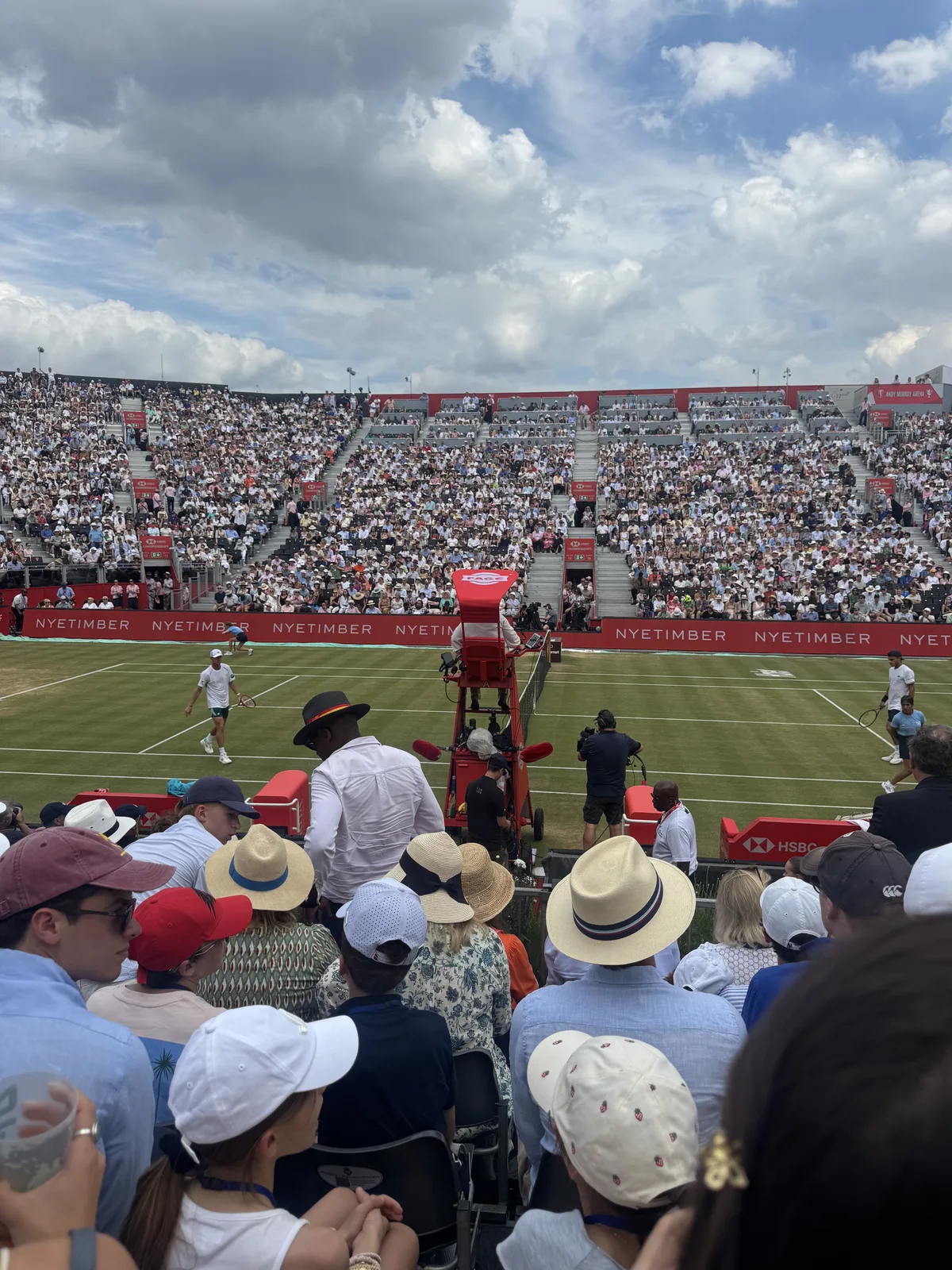
You take the District or Piccadilly line to Barons Court, turn right on the way out of the station, follow the road until it ends, and there is the Queen's Club. Boom barrier for the car park, attended gatehouse, red brick, tall gables above the wall. On a June morning during the tournament, the marquees behind the wall are already awake and the queue at the barrier is a mix of umpires walking in, journalists in lanyards, and a handful of hospitality guests trying to look like they belong. The other fifty weeks of the year, the barrier lifts for the members' cars and almost nobody else.
Queen's has been sitting behind that wall since 1886. It is the second-oldest multi-sport members' club in the world, and, following the retreat of Prince's Club to Knightsbridge a century ago, the oldest surviving one. Named after Queen Victoria, the club's first patron, it was built for real tennis, rackets, lawn tennis, football and rugby, though it has since hosted, at various points, as many as twenty-five different sports, including ice-skating and baseball. It is currently the national headquarters of real tennis in the United Kingdom, home to the British Open every year that is not a pandemic, and one of only a handful of venues in the world with two active courts of the old, pre-Wimbledon game.
That is not what most of the fifty thousand people who Google "Queen's Club" each month are here to read about.
The tournament people actually mean
For most of the tennis-watching world, "Queen's" is shorthand for the week that Andy Murray Arena is packed to its 9,000-seat capacity every afternoon and the sponsors' boxes disgorge a rotation of men in linen suits carrying flutes of Nyetimber. It is the grass-court ATP 500 played the week before Wimbledon, formally titled the HSBC Championships since the bank took over from cinch in 2025, though nobody outside a marketing meeting calls it that. Everyone calls it Queen's.
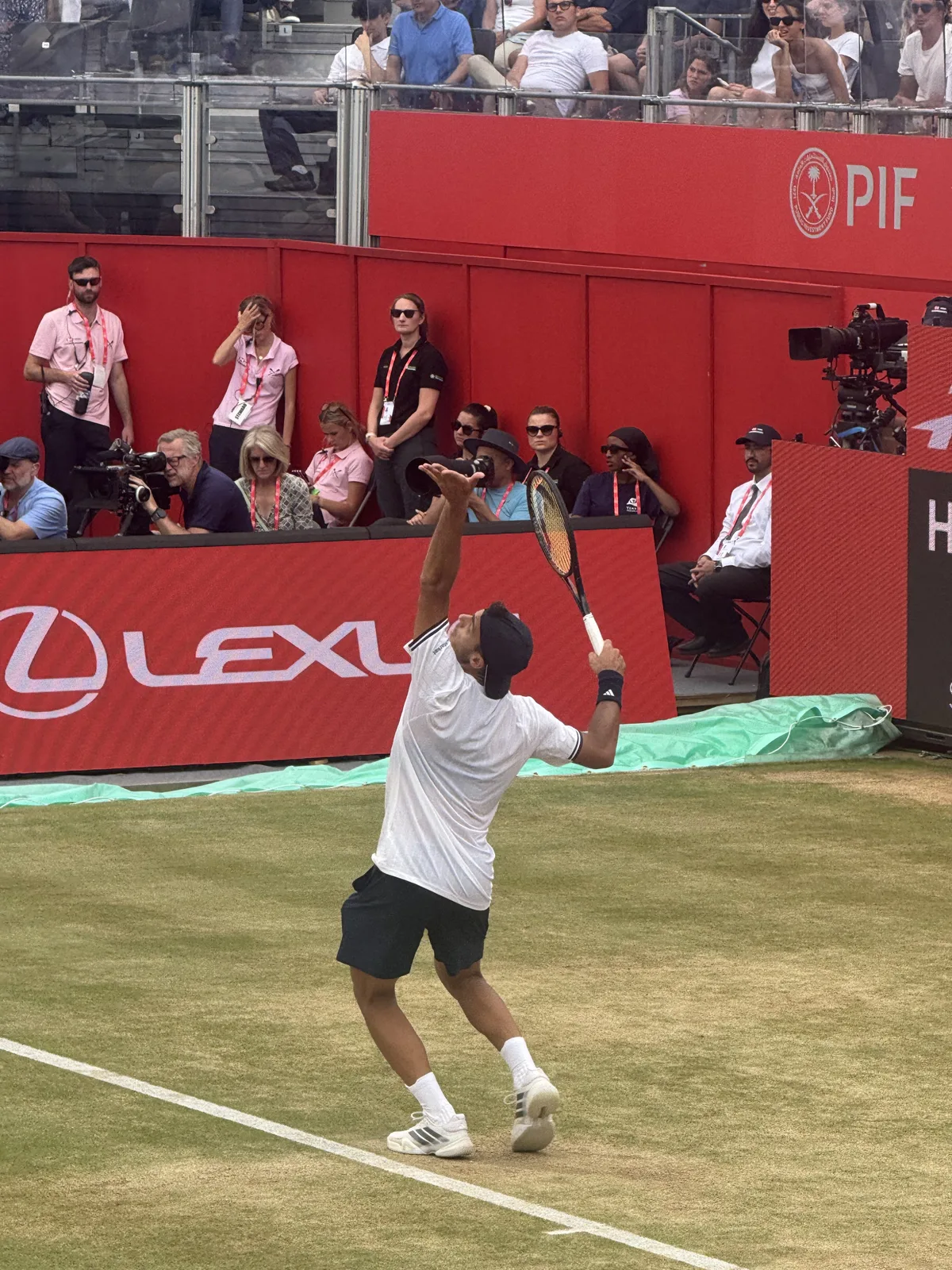
In 2026 the ATP week ran 15 to 21 June. Francisco Cerundolo, an Argentine clay-court specialist who had lost his previous three Queen's matches on grass, arrived without expectations, played the tournament of his life, and beat Tommy Paul 6-7(4), 6-4, 6-3 in a Sunday final that took three hours and two minutes. It was the first ATP 500 title of his career, and the largest cheque of it: €483,145 from a total purse of €2,583,330.
The week before the men played, from 8 to 14 June, the women played too. This is new. The WTA 500 at Queen's launched in 2025, after a fifty-two-year absence of women's tennis from the club, and the 2026 women's final was one of the sharpest of the grass-court season: Donna Vekić beat Emma Raducanu 6-0, 7-6(8-6) for her first WTA 500 title. The champion's cheque was $294,445, from a $1,915,000 purse. The Lawn Tennis Association has committed to equalising the two prize funds by 2029.
Both events feed the same set of narratives. The tour is on grass for four fast, injury-heavy weeks. The players who go deep at Queen's are typically the players you want to bet on at Wimbledon. It is one of the most useful tune-up weeks in the calendar, watched by roughly the last generation of tennis fans who can remember what a proper serve-and-volley point looked like, and by a new generation who cannot but suspect that Roger Federer is somehow still involved in it.
If you go, know that the stands sit on the sun side of the court, and unless you have booked into the members' area you are in it all afternoon. If you cannot wear a wide-brimmed hat at Queen's, when can you.
The other fifty weeks
Take the marquees down on the Monday after the final, wheel the media trucks out of the West Kensington end, hose down the champagne stains from the members' terrace, and Queen's reverts to being what it has been for most of its life: a private members' club with a Victorian dining room, a wine list that has opinions about itself, and a set of grass, hard, indoor and clay courts that its members book, quietly, most weeks of the year.
There are 28 outdoor tennis courts, 10 indoor courts, two real tennis courts (the 1888 Bickley pair, East and West), rackets courts, and squash courts. The clay is held under a bubble year-round. The indoor surfaces are hard and carpet, and the carpet is a small kindness to any player north of forty whose knees have started filing quiet complaints. The pro shop is decent and stocks a lot of things with the Queen's emblem on them, which most members eventually acquire in some quantity. The dining room does an actually good club sandwich, and has, over the last few years, made a noticeable jump in the ambition of the menu without becoming the sort of place that describes its bread on the card.
The route from the members' area to the indoor courts is a set of low tunnels that would function as passable evidence for anyone who wanted to argue that the internet's obsession with backrooms began in West Kensington. First-time guests get lost. Second-time guests get lost more slowly. The locker rooms are as you would expect, dark wood and pegs, and on any given Sunday you will hear at least three conversations about the current state of the cottage market in the Cotswolds, which is a running index of the membership that no independent survey has ever needed to measure.
The best thing about the club, if you have been lucky enough to get inside it as a guest, is what happens after the tennis. You take the paper, order something, sit in the lounge for an hour with the Sunday Times and whichever Premier League match Sky has decided is the flagship, and the walk home through Barons Court in late afternoon light is one of the more agreeable things London does at that latitude. On a Tuesday in October you can walk past the Grade II listed clock tower on the outside and hear the specific, unforgettable sound of a real tennis ball hitting a Bickley wall, which is closer to a rifle crack than to any noise made in the lawn game.
Getting in: the version most of the internet is out of date on
Here is where the piece diverges from what an SEO agency would write.
For most of the past twenty years, the received wisdom about joining Queen's has been: two existing members recommend you, you go on the waitlist, you wait somewhere between a decade and two. The recommendations part is still true. The waitlist part is not.
Applications for full tennis membership at Queen's have been closed since 2019, when the waitlist reached fifteen years and the club stopped accepting new applications. That has not changed at time of writing (August 2026), and there is no publicly signalled intention to reopen it. The number of times a version of "just get two members to recommend you" has been written by lifestyle magazines since 2019 is a running joke among the small number of people who actually track this. It is not, at present, a route to membership.
What still exists are three limited routes that most of the internet forgets to mention.
The first is the sport-specific memberships. Real tennis, rackets and squash all have their own membership rolls, and those waitlists move at nine to eighteen months rather than a decade. There are also intermediate, age-restricted and off-peak tiers that the membership office will discuss with anyone who calls. The fee structure, as of the 1 October 2025 update: £250 non-refundable registration on application, £2,000 annual subscription for full members, plus a £15,000 redeemable share that funds the club's capital account and is repaid on resignation.
The second is the corporate events programme. The club's public events page runs occasional pro-ams, invitational company days, industry-sector cups and hospitality experiences during and around tournament week. There is nothing stopping anyone with the shape of a business behind them from proposing their own. If your day job sits at a Canary Wharf or Mayfair name of any weight, invent a finance cup, put a team of eight together, phone the events office and ask. The worst answer you can get is no.
The third is the Association of Centenary Tennis Clubs reciprocals. Queen's is a member of the CTC, which is the loose global federation of tennis clubs founded before 1900 or thereabouts: Real Club de Tenis Barcelona 1899, Kooyong, Tennis Club Milano, Racing Club de France, Fitzwilliam Dublin, Cumberland, Roehampton, Edgbaston Priory, Philadelphia Cricket Club, Longwood, Newport's International Tennis Hall of Fame, and roughly forty others. If you already belong to one of them, a letter of introduction, sufficient notice, and a request through your club's secretary is the standard route to a hit at Queen's. If you do not belong to one of them, this door is not exactly easier than the front one: membership at the CTC's other British clubs is, in most cases, only marginally more accessible than at Queen's itself.
None of the three is a hack. All of them require patience or connections or both.
What the tour thinks of the place
Every touring pro who has hit at Queen's over the last decade will tell you the same two things about the courts. The grass is faster than Wimbledon in the first few days and slows to something close to Wimbledon by the semi-finals. And the low bounce is a specific technical test that separates the players who know grass from the players who play on it four weeks a year and hope for the best.
Watch a rally from Cerundolo's run this year and you will see it. The margin above the net gets thinner. The forehand does not sit up the way it does at Roland Garros; it stays low, punished for topspin, rewarded for depth. The second serve loses about ten per cent of its bounce-height compared with a hard-court kicker, which is why the best returners in the world find themselves suddenly hitting cramped, backhand chip-returns off shoulder-high balls they thought they had a clean read on.
This is one of the reasons the top All Court mentor pros describe grass-court tennis as "the closest the sport gets to squash." Court geometry does not change; ball behaviour does. A tour-level player who understands grass is playing a different geometry problem than a tour-level player who does not.
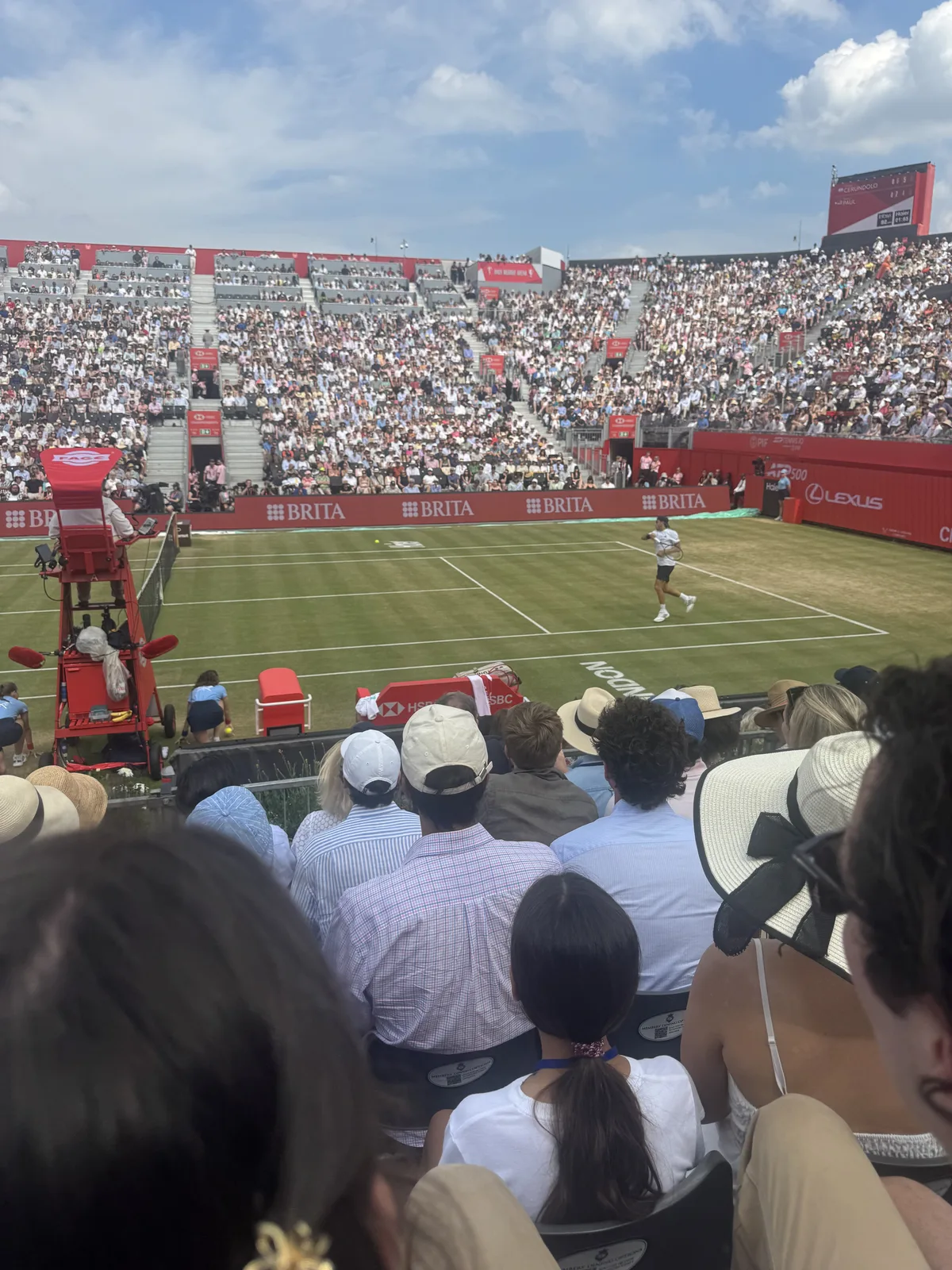
Here is a rally from this year's Queen's tournament, analysed by Millen Hurrion inside the All Court platform, exactly as if the footage had come in from a customer session:
If you would like a properly rated read on your own tennis before the grass-court season becomes something you only watch on television, All Court exists for exactly that. You put your phone against the back fence, film a session, and upload it. You get a "talking head" session inside your own video from a touring professional. Plus the AI-enabled platform compares those ratings against thousands of shots from hundreds of players graded by the same touring pros and elite coaches. The output is a personalised coaching session on your footage and an All Court Rating for each shot you hit and a cumulative All Court Rating that compounds every time you film more of your play, so that you can see which parts of your game are improving and which are the ones the tour would tell you to fix first. There is no nominator, no joining fee, and no waitlist that closes inside a generation. Join the waitlist at allcourt.club/join. If you are in London looking for other tennis clubs worth knowing about, our guide to playing tennis in London covers the full range from public courts to private members' clubs.
The place worth walking past
The best time to walk past Queen's, if you are the kind of person who wants to look at a place without needing to be inside it, is late September. The tournament infrastructure is gone, the tree-lined roads on the Palliser Road and West Kensington side are quiet, and the light hits the west façade of the clubhouse the way it does at Wimbledon before qualifying. You can hear the specific sound of a real tennis rally from the pavement if the courts have the windows open. Somewhere inside, on courts you cannot see, someone will be practising a slice serve against grass that has not been rolled since the Sunday final in June. The pub around the corner is the Curtains Up, which is a good place to sit outside with a pint and pretend, for an hour, that you were on the other side of the wall all afternoon.
It is a Victorian sports club that has continued being a Victorian sports club, quietly, for a hundred and forty years, in an era when most of them have not. That is what people are actually searching for when they type "Queen's Club London" into Google, whether or not they know it yet.
Related posts
The Wimbledon education of Arthur Fery