The New York examination of Arthur Fery
Six weeks ago we set Arthur Fery three tests for his hard-court transition. His US Open first round against Lorenzo Musetti gave us the numbers.

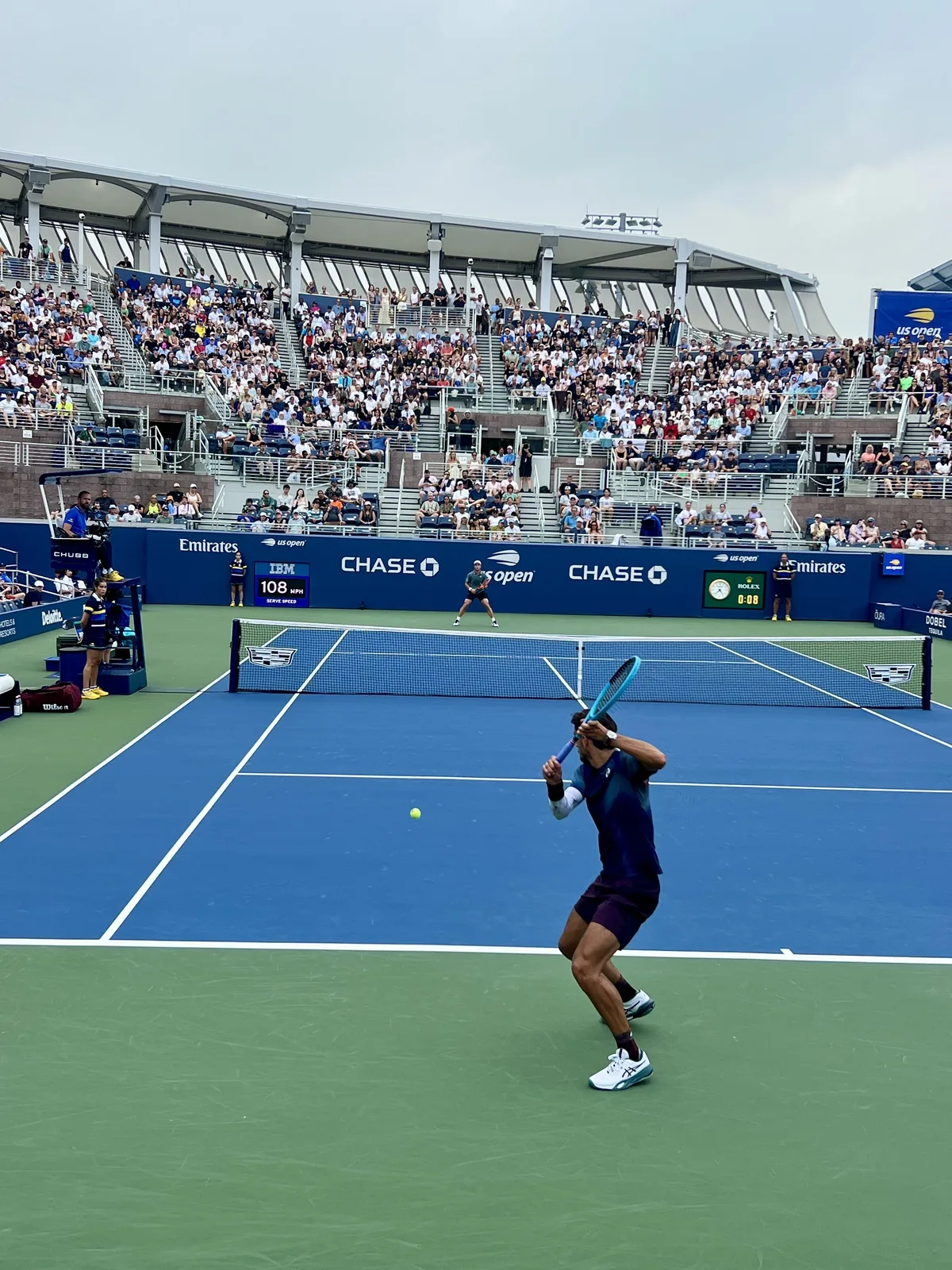
Two days before Arthur Fery walked out onto the Grandstand at Flushing Meadows on Tuesday afternoon, he had been on court in North Carolina losing his first ATP final to a twenty-two-year-old Peruvian called Ignacio Buse. The score at Winston-Salem was 6-3 6-2. Buse became the youngest champion in the tournament's history. Fery, on the losing side of that Saturday, took the plane to New York with the biggest week of his hard-court life in his legs and forty-eight hours to reset before the first round of a Grand Slam.
He drew Lorenzo Musetti, the thirteenth seed, world number fourteen, in the first round.
The match lasted two hours and nine minutes. Musetti won 6-3 6-3 7-5. Fery did not embarrass himself. He also did not, on the numbers, do what he had done at Wimbledon.
The eight matches in between
Between the Wimbledon semi-final on the tenth of July and the Musetti first-round match on Tuesday, Fery played eight hard-court matches in a fortnight and a bit.
He came back on court on the fifteenth of August at Cincinnati, five weeks after Zverev had put him out at Wimbledon. He beat James Duckworth in the first round in three sets, 6-4 2-6 7-6(4). In the second round he drew Alex de Minaur, the world number eight and one of the sport's most complete hard-court players, and took him to two tiebreaks before losing 5-7 6-7(3). Two tiebreaks against a top-ten hard-courter, five weeks off the back of a Wimbledon semi. The first sign the grass game had a hard-court answer.
He went straight to Winston-Salem the following week. Cruz Hewitt, the eighteen-year-old son of Lleyton, 6-1 7-5 in the first round. Mees Rottgering, ranked three hundred and eighty-nine in the world, 6-3 6-3 in the second. Aleksandar Kovacevic from a set down, 3-6 7-5 6-3 in the quarter-final. Duckworth again in the semi, retiring in the second set with Fery a set up. Then the final on the Saturday afternoon against Ignacio Buse, going down to the Peruvian 6-3 6-2. It was Fery's first ATP tour final in any format.
Then the flight to New York and, forty-eight hours later, Musetti on the Grandstand.
Six weeks ago we wrote here about Fery’s fortnight in July, based on six IBM SlamTracker match sheets across his semi-final run, and we ended that piece by setting three specific tests for the hard-court transition. First: whether his attack index would hold above twenty against a top-fifty opponent. Second: whether his unforced-error differential would stay in his favour, on the argument that error discipline is a surface-agnostic mental skill. Third: whether his first-serve-points-won percentage would hold above the low seventies.
The Musetti match sheet lets us mark all three.
Test one: the unforced-error differential
At Wimbledon the pattern was consistent across five wins. Against Bergs in the third round Fery made 42 unforced errors to Bergs’s 65. Against Dimitrov in the fourth he made 33 to Dimitrov’s 59. The differential was often in Fery’s favour by twenty errors or more.
On Grandstand it went the other way. Fery made 43 unforced errors. Musetti made 28. The differential was fifteen the wrong way. Fifteen forehand unforced, fourteen backhand unforced, the rest scattered across the shot types. Musetti hit twenty-two winners; Fery hit seventeen. Five winners up, fifteen errors down.
The test fails. Musetti at seed thirteen sits a step above the peer bracket we set the marker against. The marker went the wrong way anyway.
Test two: the first-serve-points-won percentage
At Wimbledon Fery was hitting between seventy-five and eighty-one per cent on first-serve points won. Against Dimitrov in the fourth round he touched eighty-one against an ex-world-number-three serving nineteen aces on the other side of the net.
Against Musetti he landed forty-seven of his eighty-nine first serves (fifty-three per cent) and won twenty-nine of those forty-seven (sixty-two per cent). Musetti landed forty-eight of seventy-nine first serves (sixty-one per cent) and won thirty-seven (seventy-seven per cent). Fery’s number dropped from the mid-to-upper seventies at Wimbledon into the low sixties in New York. Musetti’s stayed exactly in the range Fery had been living in on grass six weeks earlier.
Second test: fails.
Test three: the attack index
The public SlamTracker view didn’t publish an attack index for this match. If it turns up later, we’ll know whether the fusion mode Fery found against Cobolli at Wimbledon is portable. From what the sheet does show, the fusion mode wasn’t on court against Musetti in the way it had been in the quarter-final. Fery came forward often, twenty-one wins from thirty-five approaches at sixty per cent, a very high frequency and a decent conversion. Musetti went to the net thirteen times and won seven. The difference was elsewhere. Musetti passed. At Wimbledon Fery ate opponents’ passes. On Grandstand Musetti ate his.
Three passing-shot forced errors against Fery on backhand, four in total.
What Fery said about it afterwards
Fery went to press saying “I know what I have to work on. “I got a lot of ideas coming straight off the court of what I have to work on to do better.” He described Musetti in the language of someone who had just been given a specific lesson: “He makes you really work for points, exposes weaknesses, but I was getting better and better as the match went on. I slowly started to get used to the conditions and play better tennis until a really bad game at 5-5 in the third set.” It's poingant to note that in that last set, including at 5-5, Fery broke Musetti twice, only to be immediately be broken back, unable to take advantage.
Then, on the elephant in the room, the two days between a tour final and a Slam first round: “Would I sign for these past two weeks? Probably, to be honest. It’s a lot of ranking points, it’s a first ATP final, so it’s good. Even though it meant that my preparation for the US Open was not great.”
That sentence reframes the three tests. He would sign for the fortnight that, he feels, may have produced the failure against the metrics we are measuring.
The next hard court
Two of the three tests fail on the Musetti sheet and perhaps the Winston-Salem week frames the failure. Tired legs, wrong opponent, too soon.
Fery is in the Great Britain Davis Cup team to face Ecuador on 19–20 September, alongside Norrie, Patten and Glasspool. After that comes the Asian hard-court swing that he named himself after Wimbledon as his plan for the autumn: Tokyo, then Beijing, then Shanghai, at world number thirty-three going in. The next hard-court match after a normal week of preparation is the one we are watching.
The Wimbledon education stands. The New York examination is the exam the calendar handed him before he had time to revise. He walked off the Grandstand court on Tuesday afternoon saying, in his own words, “I got a lot of ideas.”
We will keep reading the numbers.
Related posts
The six qualifiers to follow at the US Open: from the teenager who beat his retiring hero to a 16-year-old prodigy against an Olympic champion in round one