The Wimbledon education of Arthur Fery
Only twice in the Open Era has a wildcard reached the men's singles semi-final at Wimbledon. Six IBM SlamTracker match sheets from Arthur Fery's fortnight say the second one was not the hot streak most of tennis has written it as. It was a tactical education happening in real time on Centre Court, and by the quarter-final Fery was playing a game that reads on the numbers like a top-thirty player's.

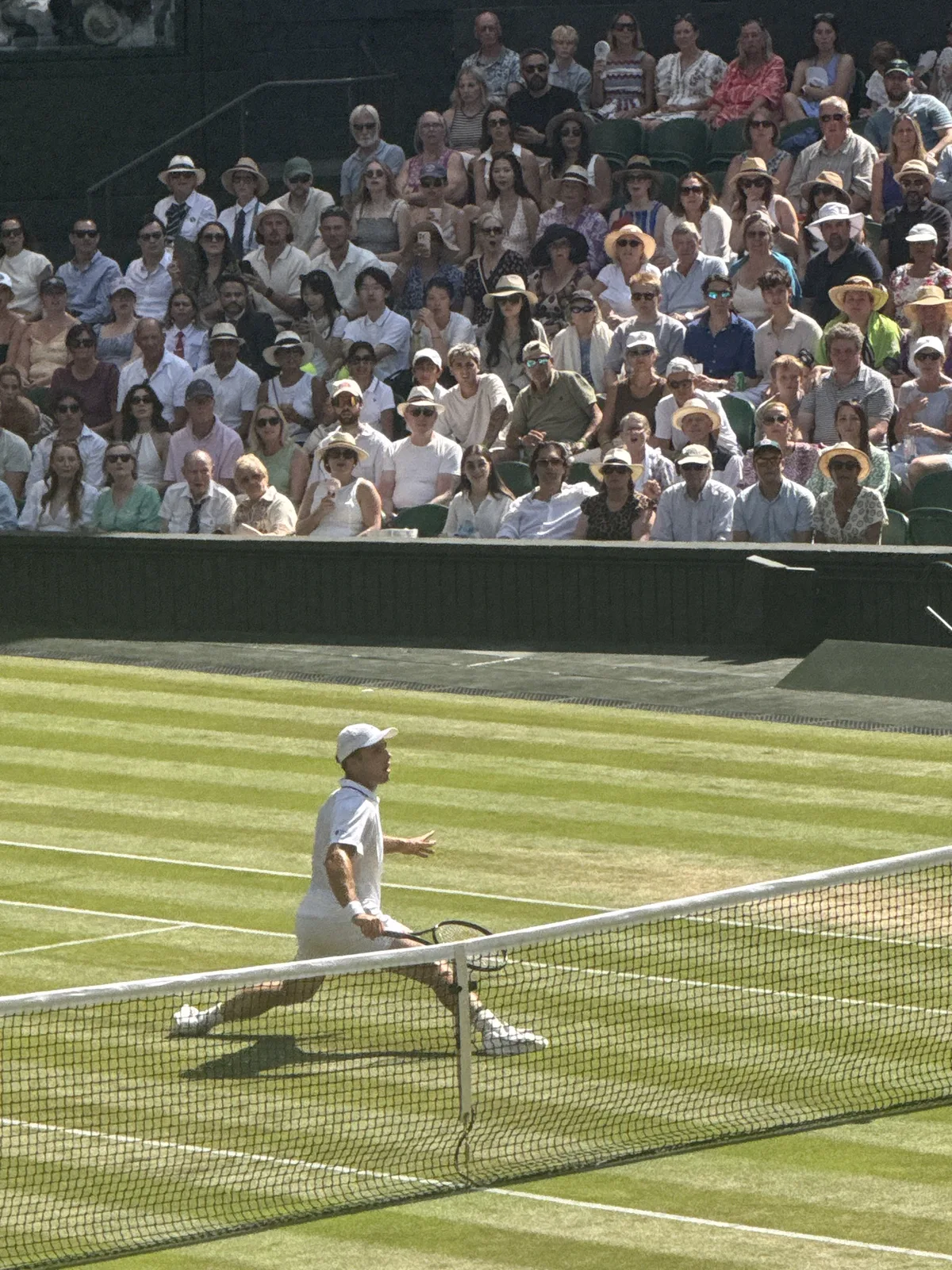
Only twice in the Open Era has a wildcard reached the men's singles semi-final at Wimbledon. The first was Goran Ivanisevic in 2001, who went on to win the tournament. The second was Arthur Fery, this July, who lost his semi to Alexander Zverev in straight sets but had already, by the time he walked onto Centre Court on Friday afternoon, played five matches of a very peculiar kind.
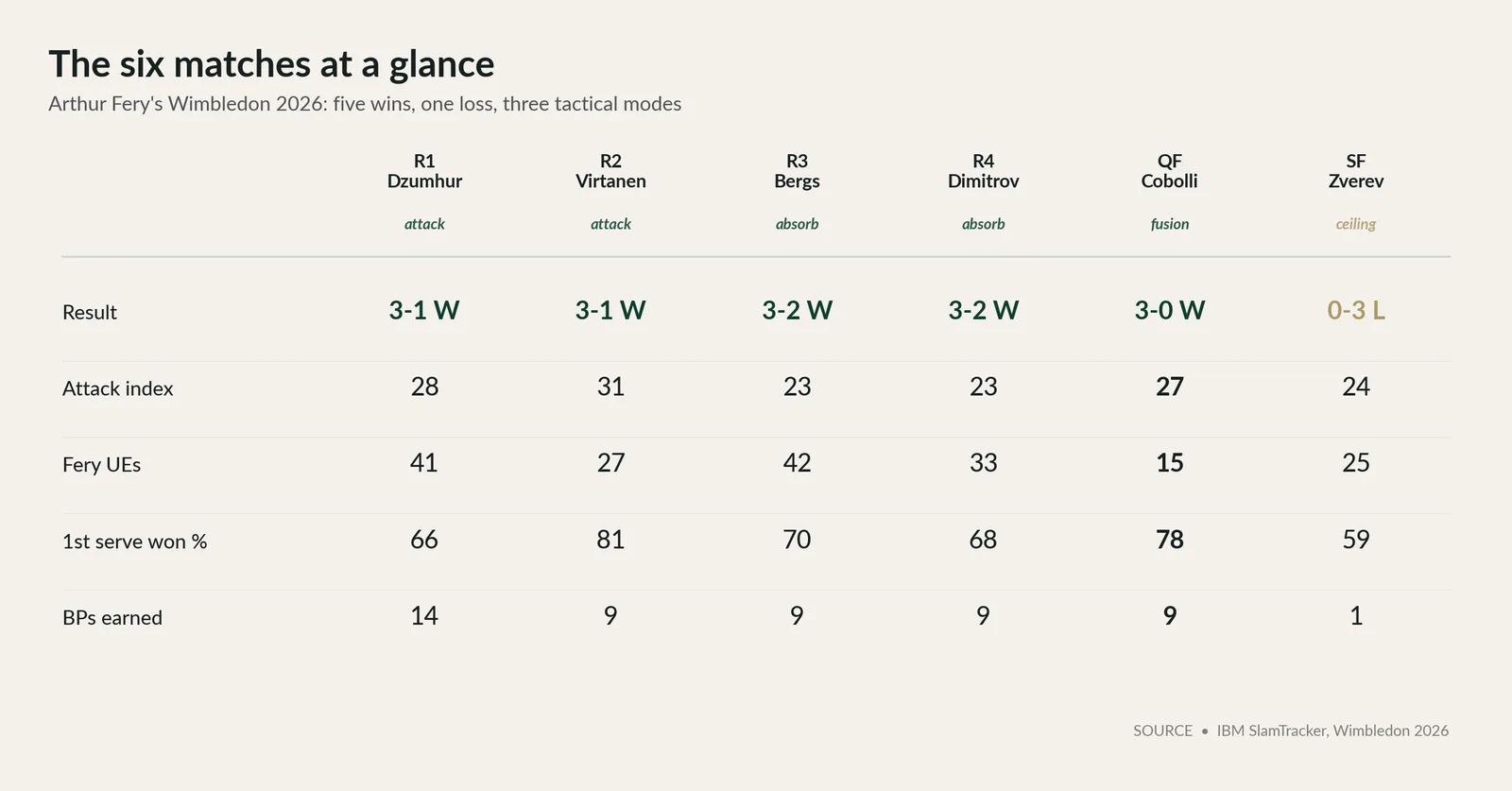
The story of Fery's fortnight has been written by most outlets as a wildcard hot streak that ran until the semi-final and stopped. Six match sheets from the IBM SlamTracker system say something rather different. Fery, ranked No. 114 going in, was not riding a streak. He was running his own tactical apprenticeship in real time. By the quarter-final he was playing a game that reads on the numbers like a top-thirty player's, and by the semi-final he was losing to the tournament's second-best player, and doing very little wrong himself.
The numbers are worth reading, because they are the story.
The attack mode: rounds one and two
Fery arrived with a specific game. Aggressive baseliner, first-strike serve for placement rather than pace, and a net game that comes forward more often than anyone else on the tour is doing right now. In the first two rounds he played it in its purest form.
Against Damir Dzumhur in the opening round, Fery won three sets to one across four sets on court. He hit six aces to Dzumhur's none. He landed only 60 per cent of his first serves but won 66 per cent of the points on the ones he did land. He came to the net 56 times in the match, winning 64 per cent of the points he approached on. He hit 37 winners to Dzumhur's 20, made a similar count of unforced errors, and covered slightly more court over four sets. Dzumhur led the match briefly in the middle of the second set on the live-likelihood plot the IBM system publishes for every Wimbledon match; from the third set on, Fery was above 50 per cent the whole way, and by the fourth-set changeover the graph had all but flatlined at the top of the axis.
Round two, against Otto Virtanen, was the same shape rendered even more cleanly. Virtanen had knocked out the fourth seed Ben Shelton in the first round, saving a match point in a five-set marathon. Against Fery he found nothing that had worked against Shelton. Fery came in 54 times and won 72 per cent of those approaches. His first-serve-points-won percentage climbed to 81. His unforced-error count dropped to 27, against Virtanen's 45. The live-likelihood chart shows the same signature: Fery ahead early, a dip in the middle of Set 2, and a dominant Set 4 close that reached 100 per cent well before the tiebreak was resolved.
The tactical portrait after two matches was already unusually specific. Fery was not a hitter for hitting's sake, and he was not, despite the aces, a serve-bomber. He served for placement, landed the first-shot combination early in the rally, and finished at the net at a rate few players in the men's top thirty currently match. The version of grass-court tennis he was playing looked more like Edberg's than like anything the last decade of Wimbledon has produced.
The absorb mode: rounds three and four
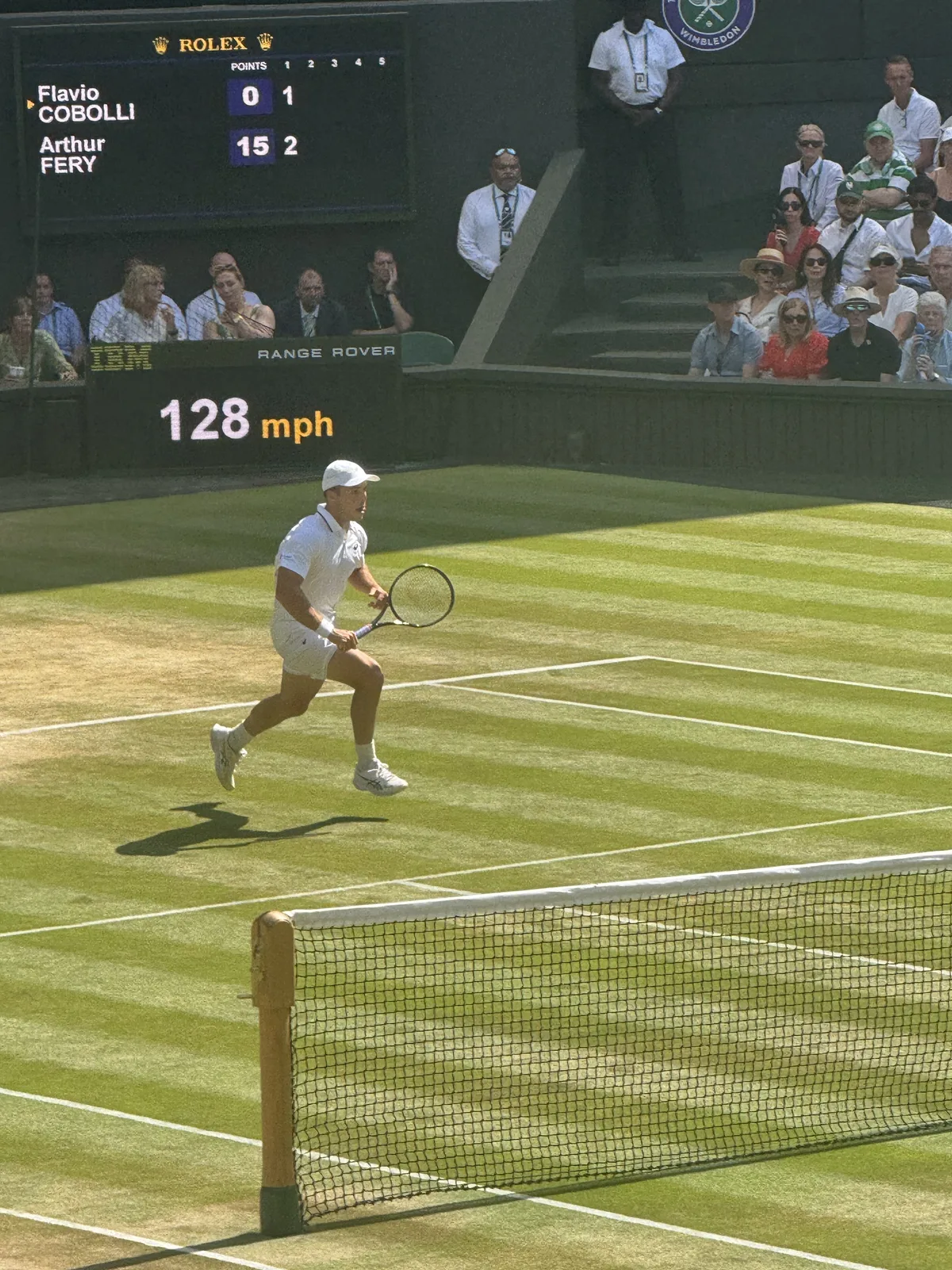
Then he ran into someone who could actually beat him at grass-court tennis. Zizou Bergs had won Eastbourne the week before. He is not the highest-ranked player on the tour, but he is one of the four or five best pure grass-court players in the world when he is on form, and he was on form when he walked out to face Fery in the third round.
The stat sheet from that match is fascinating and, on first read, misleading. Bergs out-hit Fery 68 winners to 35. Bergs won more points at the net (46 to 23), converted more break points (62 per cent to 56), and finished with more total points won (183 to 176). Bergs's attack index, the IBM system's measure of how aggressively a player is constructing points, was 30 to Fery's 23. Bergs was, by every conventional measure of who imposed himself on the match, the winner.
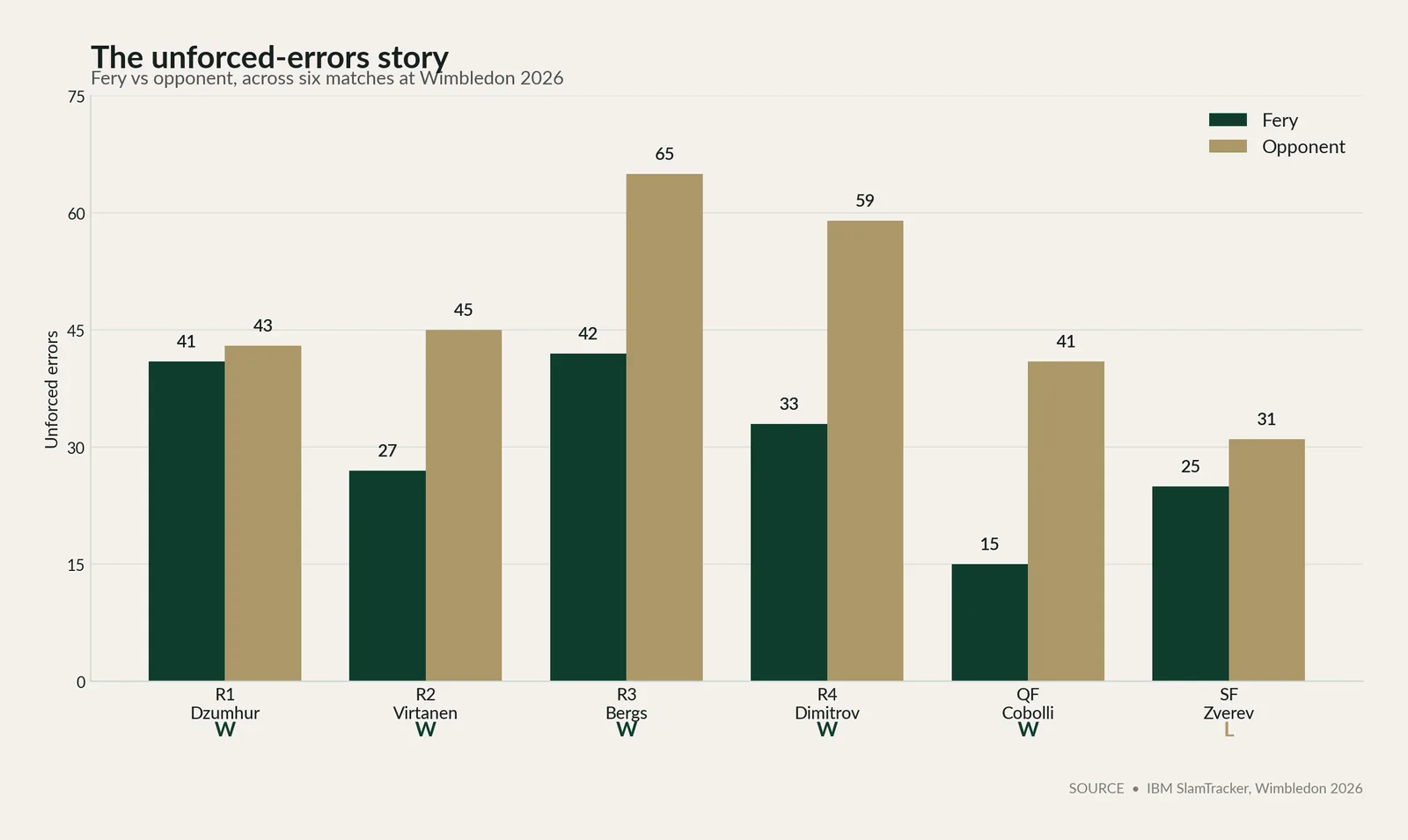
Fery won it anyway. He won it in five sets, closed on a deciding-set tiebreak, and won because he made 42 unforced errors to Bergs's 65. That is a 23-error differential in Fery's favour over five sets against a peer-level grass-court player, and it is what happens when a young player with a game plan meets a superior grass-court player and consciously refuses to try to out-hit him. On the live-likelihood plot Bergs led through the middle of the match, peaking well above 70 per cent in the fourth set, before Fery clawed the fourth back and then held his nerve in the fifth-set breaker.
Round four, against Grigor Dimitrov, was the same lesson refined. Dimitrov, the former world No. 3, hit 19 aces to Fery's seven. Dimitrov's first-serve-points-won percentage was 81, one of the highest numbers of the entire tournament. He led Fery on winners 72 to 36 and on total points 169 to 158. Fery came into the match unable to dictate on serve and unable to dictate in the rally.
He hit zero double faults. Zero, in five sets, against an ex-world-No. 3 hitting 19 aces on the other side of the net. He made 33 unforced errors to Dimitrov's 59. He ran further than the older man, covering 3,520 metres to 3,361. The live-likelihood chart tells the same story as the Bergs plot, with a slightly different peak: Fery ahead through the first two sets, Dimitrov clawing Sets 3 and 4 back and peaking near 90 per cent, Fery closing the fifth. Twenty-six unforced errors below Dimitrov, in five sets, against a top-thirty player at full extension. That is not a wildcard riding luck. That is a game plan working exactly as it is supposed to when the version a player arrived with runs out.
The fusion moment: the quarter-final
By the time Flavio Cobolli walked out for the quarter-final, Fery had two modes: attack when he could dictate, absorb when he could not. What he had not yet done in the tournament was play both at once.
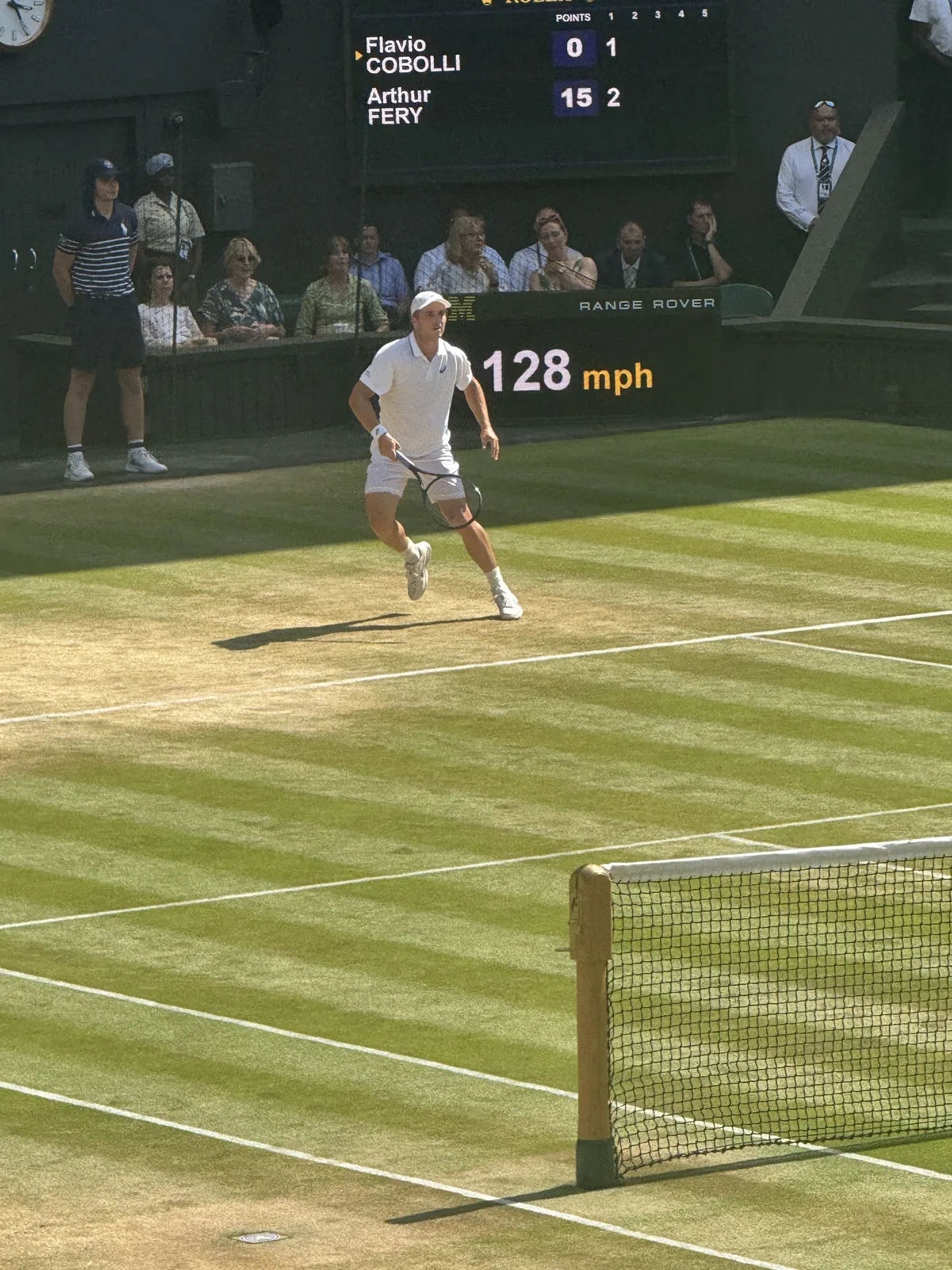
Cobolli was the ninth seed, the French Open runner-up from a month earlier, one of the form players of the season. On paper it was the hardest match of Fery's life. On court it was the cleanest three sets he had played in the fortnight. Fery won 6-4, 7-6(7), 6-0. He hit eight aces to Cobolli's six. His attack index was 27, back up to the R1-R2 range. His first-serve-points-won percentage was 78. His net-points-won percentage was 76 across 29 approaches. His break-point conversion was 56 per cent to Cobolli's 25.
He made fifteen unforced errors.
Fifteen, in three sets, on Centre Court, against a Grand Slam finalist from a month earlier. Cobolli made 41. The live-likelihood chart from the match shows Cobolli briefly ahead in the opening exchanges of the first set, then Fery taking the lead in the middle of Set 1 and never surrendering it. The chart never dipped back towards 50 per cent for the rest of the match. It is the only one of Fery's six live-likelihood plots this fortnight that has that shape. Every other win, apart from the R2 canter against Virtanen, had a mid-match dip that had to be recovered. The Cobolli match had one seizure of control and no relinquishment.
What that hides, until you read the stats alongside it, is that Fery arrived in this match with the confidence of the attack mode from Rounds one and two and the error discipline that had been forged in Rounds three and four against Bergs and Dimitrov. Fifteen unforced errors is not a hot-streak number. It is a discipline number. Twenty-seven winners is not a hot-streak number either. It is the mark of a compact aggressive baseliner playing with total conviction. On any given day this fortnight, Fery had shown one of those things but not both. Against Cobolli he showed both, and the ninth seed lost the third set 6-0.
The Zverev semi-final as the honest ceiling
Then Zverev happened.
Zverev is the reigning French Open champion. He arrived at Wimbledon on a nine-match Grand Slam winning streak, five weeks after his first major. He is one of the four best players on the men's tour. Fery, by the quarter-final, was playing at a level no one had a right to expect a No. 114 to reach. Zverev, on the day, played at his own level. The margins are what the margins are.
The stat sheet is a study in what happens when the system you have built runs into a player without the exploitable weaknesses of Bergs or Dimitrov or Cobolli. Zverev hit 44 winners to Fery's 16. Zverev won 82 per cent of his second-serve points. Fery won 43 per cent of his. Fery earned exactly one break point in three sets, and converted it. Zverev earned eight and converted four. The live-likelihood chart shows Fery between 20 and 35 per cent for most of the first set and never rising above 40 for the rest of the match. It is the only chart in his six-match Wimbledon that never gives him a lead.
What Fery did in this match, worth naming, is that he still only made 25 unforced errors. His error discipline, forged across the Bergs and Dimitrov matches, held against the second-best player in the tournament. Zverev did not run him into a mistake pattern. Zverev simply did not miss himself. Zverev made 31 unforced errors, the lowest count any opponent produced against Fery in the whole fortnight. Every other opponent handed Fery between 41 and 65 unforced errors to work with. Absorb mode requires an opponent who eventually cracks. Zverev did not crack.
The one break point Fery earned across three sets is the number that tells the truth about the loss. When your absorb mode does not create break-point chances, and your attack mode meets a returner as good as Zverev, the ceiling on the match is what happened. Fery did not fail. He met the man who is going to lose the final to Jannik Sinner.
The player under the story
Arthur Fery is twenty-three years old, and if you look closely at him in his player-box interviews from the fortnight, or in the after-match camera shots on Centre Court, you can see that he still looks slightly surprised to be there. He grew up in Wimbledon, London. He was born in Sèvres, in the western suburbs of Paris, and moved with his parents to the United Kingdom when he was one month old, which makes him technically French by birth and functionally British by upbringing.
His mother, Olivia (née Gravereaux), played the main draw women's doubles at Roland Garros in 1991. His father, Loïc, is a French businessman who runs a hedge fund and owns the Ligue 1 football club FC Lorient. Fery started playing tennis at the age of five, was coached at Westside Tennis Club until he was twelve, and then moved to Sutton Tennis Academy. He is currently coached by the Dutchman Jeroen Benard and the Frenchman Benoît Foucher. As a junior he won five singles titles and five doubles titles on the ITF World Tennis Junior Tour, which is the sort of trophy count that suggests a mainstay of the top hundred is on the way, even before the wildcard run at Wimbledon this July.
The point of the biography is that Fery is not, in the Cinderella-story sense the wildcard framing invites, an unknown quantity. He was always going to be a tour-level player. What was less predictable was the specific tactical profile he brought to a Grand Slam draw in July, and the maturity of the mode-switching he showed in real time between the third round and the quarter-final. Those are things you cannot see coming from a junior record. You can only see them when a player exhausts the game he arrived with and starts drawing on parts he has not yet used.
What this fortnight actually was
Most tennis writing this month has framed Fery's run as a story about the ranking system being wrong, or about wildcards deserving more slots, or about British tennis needing to look past Jack Draper. The stat sheets from his six matches suggest a more specific reading.
The fortnight was a tactical education happening in real time on the biggest stage in tennis. Fery arrived at Wimbledon with one game. He left it with three modes and a working knowledge of when to run each one. The Bergs and Dimitrov matches were not survival wins. They were lessons about a game plan he had not needed to run before, executed under match conditions and completed successfully. The Cobolli quarter-final was the moment those lessons produced a synthesis. The Zverev semi-final was the honest ceiling on where the synthesis can take a player still ranked outside the top hundred.
What the piece is not is a prediction that Fery is a future Slam winner. The world does not owe most talented young players a Slam, and the tour is unusually crowded with players in his exact bracket. What it is is a case that most of the outside coverage of his fortnight has under-read what he actually did. He did not surf a wave. He built a game, in ten days, in front of the cameras, one match at a time. The next tournament he plays, he starts from where he finished. And where he finished, on the evidence of the Cobolli quarter-final, is a considerable distance above where his ranking put him going in.
What to watch at the US Open
Fery walked off Centre Court on Friday as the ATP Tour's Mover of the Week. The 750 points from the fortnight lifted him from No. 114 to a career-high No. 36 in the PIF ATP Rankings, a jump of seventy-eight places. The US Open's direct-entry cutoff for the 2026 tournament was set at No. 101 using the rankings from the 20th of July, which means Fery is in the Flushing Meadows main draw on his own ranking, no wildcard required. The tournament runs from the 30th of August to the 13th of September. Whether the game he built at Wimbledon travels to hard court is the question that decides how this run compounds.
Hard court is not grass. The bounce is higher and the ball sits up in a way that reduces the value of a first-strike net approach and gives the passer more time to construct a pass. The 44-to-56 net-approaches Fery was running per match at Wimbledon are unlikely to be the right frequency at Flushing Meadows. What matters is whether the underlying decision-making transfers.
Three things worth watching when Fery plays his first hard-court match after the fortnight. The first is his attack index: if it holds above 20 across a match against a top-fifty opponent, the fusion mode he found against Cobolli is real. The second is his unforced-error differential: error discipline is a surface-agnostic mental skill, and if Fery continues to make fewer unforced errors than his opponent on hard court, the second mode he built at Wimbledon is banked and portable. The third is the first-serve-points-won percentage: if it drops from the mid-to-upper 70s he was hitting at Wimbledon into the low 70s or below on hard court, he will need to earn more holds through second-serve construction, which is where every player is eventually tested.
None of these numbers will tell you whether Fery is a future top-thirty player after the year is out. Only the tour tells you that. What they will tell you is whether the tactical education of ten days in July was surface-specific, or the beginning of a proper apprenticeship. We will know in about six weeks.
The touring pros All Court works with watch matches the way this fortnight's data has read Fery. Not for the score, but for the tendency underneath it, and for the specific mode a player is choosing to run when the match is going against him. If you would like a touring professional to read your own tennis the way the Centre Court coaches were reading Fery from the box across ten days at Wimbledon, the All Court waitlist is the way in. There is no nominator, no joining fee, and no waitlist that closes inside a generation. Join the waitlist at allcourt.club/join, and when your batch opens a touring pro watches your session back, tags every shot, and names the tendency that is quietly deciding your matches.
Related posts
Djokovic vs Sinner: two roads to a Wimbledon semi-final