Medvedev was defaulted. Michelsen wasn't. The tennis rulebook starts at the moment of harm.
The China Open semi-final ended with Daniil Medvedev defaulted for hitting a spectator in the face with a ball. Novak Djokovic, defaulted himself at the 2020 US Open, said he knew exactly how it felt. The match stats, ten incidents in three decades, and why the rulebook starts at the moment of harm, not the moment of contact.

The point that ended Daniil Medvedev’s China Open semi-final, and with it his best run of the back half of 2026, began with a Djokovic winner he never had a chance to touch. The score was 7-5, 5-3, 15-15. Djokovic was serving for the match on the Diamond Court in Beijing, three points from a seventh China Open final. His cross court winner rebounded off the advertising hoardings at the back of the court, back toward where Medvedev was still motoring in the follow-through of the chase he had lost. He flicked it up in frustration, probably thinking he'd bounce it off that same advertising backboards. The ball flew into the front row and struck a male spectator in the face. The spectator crouched over and held his face in his hands a long while. Stewards helped him from his seat and took him to hospital. Mohamed Lahyani, the chair umpire, came down from his chair, spoke to the tournament supervisor at courtside, and defaulted Medvedev where he stood. Djokovic walked to the net and shook hands as the public-address announcement went out that his opponent had been disqualified.
The match that didn’t finish
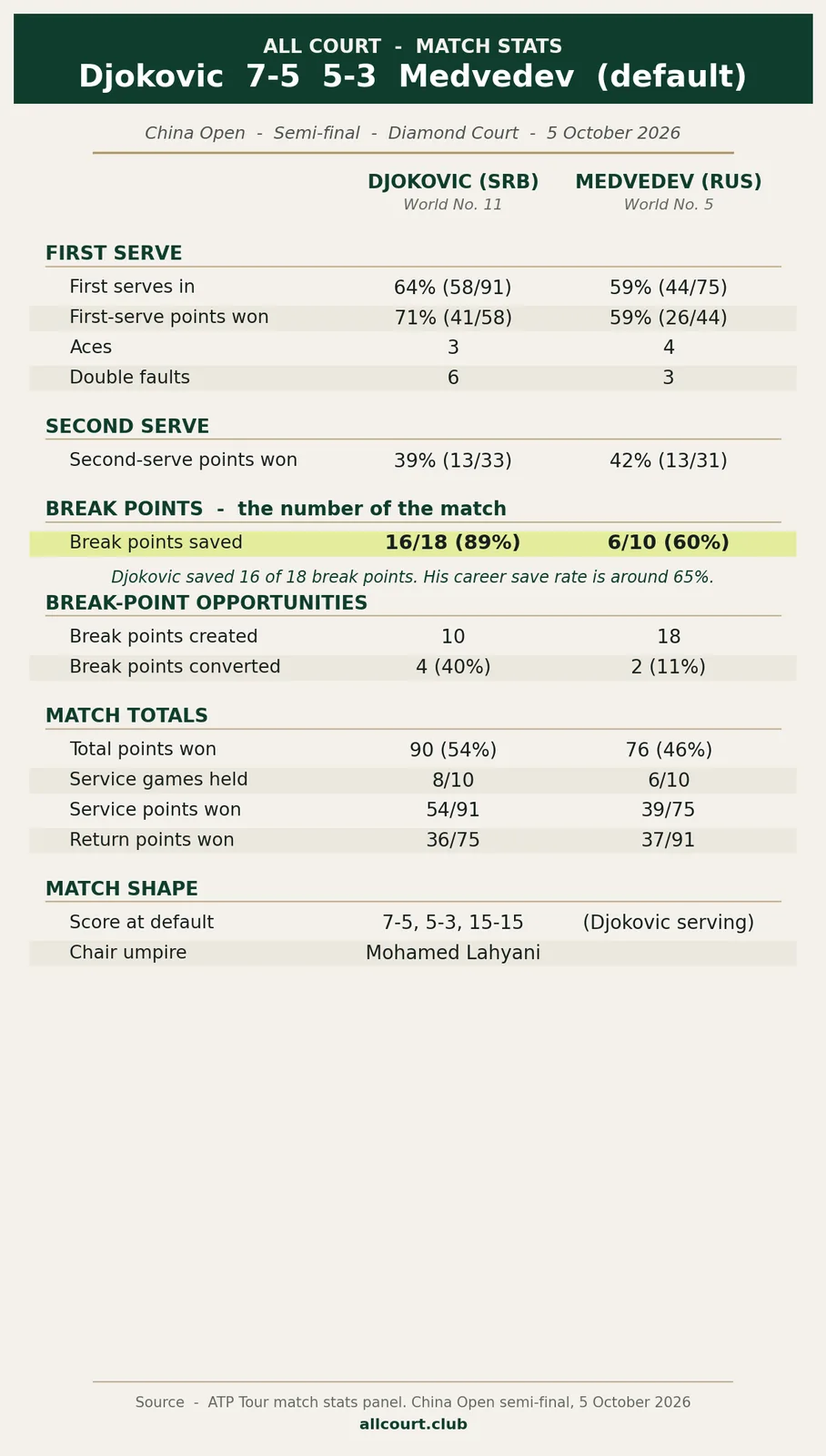
For all the drama of the ending, the fuller stat picture already told a story about why the semi-final was most likely going to go Djokovic's way anyway. Medvedev had thrown eighteen break-point attempts at Djokovic and converted two of them. Djokovic, given ten in reply, had taken four. The Djokovic's save rate under pressure continues to astound. Over a 20-year career the Serbian saves break points at a rate of around 65 per cent, which is the standard the rest of the tour has been chasing for decades. On Monday afternoon in Beijing he saved sixteen of eighteen, 89 per cent. The 39-year-old is no longer the world number one, and now sits at eleven in the live rankings, but in every match he plays, that number remains the one his opponents cannot find a way around.
The service numbers underneath were less dramatic but also told a compelling story for Djokovic's to prevail as although the number of first serves landed were close, Djokovic won 71 per cent of his compared to 59 per cent for Medvedev. The difference in the match, across 166 points, was fourteen points and two breaks of serve. By the time Medvedev was called to the chair, there was nothing in the stats to suggest the match would not have ended with a Djokovic hold and a routine straight-sets scoreline. The match was much closer than that however, and was a belter, with many rallies lasting for fifteen or more shots. The crowd was treated to phenomenally clean, and deep, ball striking which often left Djokovic doubled over in exhaustion (leading to a couple of time violations). Once or twice, toward the end of the match, Medvedev seemed to mimic this behaviour, somewhat sarcastically, perhaps feeling that his opponent was engaging in a "wounded bird" routine since, come the next point, Djokovic would somehow grind again, sliding into corners and chasing down short balls.
What Djokovic said
Djokovic spoke publicly about the default afterwards. His first words were for the spectator. His second were for the player who had just been thrown off the court he was still standing on.
A bit of a shock, to be honest. Sorry for the person [who got hit]. I honestly didn’t see what happened. I hope that person is not badly injured. On the other hand, I also feel sorry for Daniil, because I know exactly how he feels to be disqualified in a big match. I was disqualified at the 2020 US Open in similar circumstances. I am sure that Daniil didn’t want to do this intentionally. It just happens.
Djokovic has been through the same ruling. In the fourth round of the 2020 US Open, trailing Pablo Carreño Busta by a set and a game, he struck a ball in frustration which caught line judge Laura Clark in the throat. Clark went down. She was helped from the court and had trouble breathing. Djokovic was defaulted on the spot by the chair, John Blom, and the tournament supervisor Soeren Friemel. Carreño Busta went through to the first Grand Slam semi-final of his career. Six years on, Djokovic saw the player on the other end of a near-identical ruling and recognised him.
The record of defaults
The written rule under which Medvedev was defaulted has been on the ATP books in one form or another since the early 1980s. The language around the ball-abuse clause reads, in the current code, that a player may not intentionally or recklessly hit a ball out of the enclosure of the court, hit a ball dangerously or recklessly within the court, or hit a ball with disregard of the consequences. A separate general-conduct clause adds that no player may violently, dangerously or with anger hit, kick or throw a tennis ball while on the grounds of the tournament site except in the reasonable pursuit of a point. The sanction schedule underneath reads as an escalator for successive offenses in the same match: warning, point penalty, game penalty, default. The chair umpire holds discretion at every rung, including the last. The code also contains a separate immediate-default provision which lets the chair, in consultation with the tournament supervisor and referee, skip the lower sanctions and default a player for a single offense that they judge sufficiently serious. The code does not name physical harm to a spectator or official as what triggers that call. In practice, across 30 years, physical harm is almost the only thing that has.
At Wimbledon in 1995, Tim Henman and Jeremy Bates were trailing Henrik Holm and Jeff Tarango 1-2 in a fourth-set tiebreak of a first-round men’s doubles when Henman, between points, pulled a ball from his pocket and swiped it in anger out of the service box. It struck a 16-year-old ball girl, Caroline Hall, in the side of the head. The referee Alan Mills walked onto Court 14, consulted the umpire and defaulted them both. It was the first default of the Open era at Wimbledon.
Twenty-two years later, at the Davis Cup tie between Great Britain and Canada in Ottawa, Denis Shapovalov was 17 years old and playing the deciding rubber for his country against Kyle Edmund. He had just lost his serve to go 2-1 down in the third set when he turned and smashed a ball in frustration which struck the French chair umpire Arnaud Gabas directly in the eye. Gabas was helped from the chair and later needed surgery for a fractured orbital bone. Shapovalov crossed the net to apologise and was defaulted. Britain took the tie. Gabas returned to the tour to continue umpiring and curiously was involved in ajudicating a similar incident years later.
Then we have the Djokovic case at the US Open and now Medvedev. Those are the four completed cases of the clause being enforced to its ultimate penalty on an ATP or Grand Slam court in a stretch of a little over three decades.
The record of non-defaults
Running alongside the four defaults, across the same stretch of years and under the identical clause of the identical code, is a longer and less-discussed set of cases in which the same mechanics have produced a different outcome. In each one, a ball or racket struck(or thrown) in anger or frustration has struck (or narrowly missed) an official or spectator but in each one, the chair umpire has given a code violation and the match has continued.
Stefanos Tsitsipas was already losing to Nick Kyrgios in the third round at Wimbledon in 2022 when, down a break in the third set and in the middle of a running argument with the chair about Kyrgios’s underarm serve, he turned at the baseline and hit a ball flat at the Court 1 stand. It missed a spectator’s head by what the chair later estimated as a foot and lodged in the netting behind the box. The violation (and later fine) was given but the match continued (Kyrgios won in four).
Two years later, at the Winston-Salem Open final in 2024, Alex Michelsen was trailing Lorenzo Sonego 0-3 and down a break point in the first set when he mishit a routine half-volley at the net, pulled a ball from his pocket, and swatted it into the stand behind the baseline. It struck a woman sitting three rows up. The chair umpire, Aurelie Tourte, climbed down to the court, walked to the stand, asked the woman whether she was alright, received the answer that she was, climbed back up, and gave Michelsen a warning for ball abuse. The match continued. Sonego won 6-0, 6-3. Michelsen was not defaulted and was not publicly fined, and the decision drew public criticism at the time from Martina Navratilova, Nick Kyrgios and, pointedly, Denis Shapovalov. The ATP did not issue a follow-up statement.
A year later again, at the 2026 US Open, Belinda Bencic struck a spectator with a ball during her second-round match against Yulia Putintseva. The chair umpire was, again, Arnaud Gabas, by now a nine-year veteran of the sport’s conversation about ball abuse by virtue of being the official Shapovalov had hit at the Davis Cup in Ottawa. Gabas gave Bencic a code violation and prepared to resume play. Putintseva, approached chair while he was still writing it up, and told him he had got the ruling wrong:
Gabas: She hit the ball outside. She hit someone. Was it intentional? No.
Putintseva: But she hit someone.
Gabas: Eventually she hit someone, the person is fine. She received a code violation.
Putintseva: But the person that [Novak] Djokovic hit was also fine.
Putintseva lost the argument and the match. Bencic was not defaulted.
Earlier the same day that Medvedev’s semi-final ended, in the qualifying rounds of the Shanghai Masters a short direct flight away, Terence Atmane was playing Bernard Tomic. In the second set, Atmane turned at the baseline and hurled his racket into the stands. It missed the people in the first row and clattered off the wall behind them. He was given a code violation. The match continued.
Harm, not intent
The pattern seems to be that where a struck ball or thrown racket has caused physical injury, the chair has defaulted the player. Where it has not, the chair has given a code violation and let the match continue.
The four defaulted players had no more intent to hurt anyone than the four who were not. The difference was in the result.
Tsitsipas aimed at the stand and nobody was hit. Michelsen aimed at the stand and the woman was fine. Bencic may or may not have aimed at anything and the spectator was fine. Atmane aimed at the stand and nobody was hurt. All of them stayed on the court, played out their match, took a code violation and nothing above it.
The umpire whose eye Shapovalov damaged in Ottawa in 2017 is the umpire who, nine years later in Flushing Meadows, declined to default a player whose ball had hit a spectator who happened to be unhurt. The code was the same code. The person hit was fine. He ruled on that.
What Medvedev said
Medvedev addressed the press in Beijing an hour after the default.
Terribly sorry to the spectator, first of all. I’m trying to get in touch with him, if he wants it. Hopefully I can apologize in person and see how he feels.
Pressed on the issue, he added:
It was 100 per cent accident. You can see I didn’t hit the ball in anger. I do a lot of bad things but usually ball abuse is not my thing. When I saw the result, I felt horrible.
He is almost certainly telling the truth about the intent. Under the clause as it is written, that may have been enough to keep the match going if it either, by pure luck, didn't hit anyone or did, but no one got hurt. Under the clause as it has actually been enforced for the last three decades, he was always going to be defaulted.
The spectator
The spectator was taken to hospital after being helped from his seat and the his condition remains unconfirmed at the time of writing.
The final
Djokovic plays Alex de Minaur in the final of the China Open on Tuesday 6 October. It is his seventh Beijing final. He has never lost at the event. His record there is now 33 matches for 33 wins. Alex de Minaur has had one win over Djokovic in Perth, Australia in 2024 and suffered three losses in their head to head clashes in Wimbledon, the Australian Open and the Monte Carlos Masters. He will need to show the every bit of the fire associated with his nickname, the "Demon", to stop Djokovic winning his seventh title in Beijing.