Tennis grip size chart: how to measure and why it matters
The size of the racket handle is one of the easier things to get wrong when buying a new frame. Two ways to measure it, one chart that tells you what to buy, and what an ill-fitting grip does to your arm over time.

Elbow trouble sometimes shows up three weeks after a new racket. The strings check out, because the same string tension played fine in the old frame. The swing checks out, because it worked for a decade before the new racket arrived. The frame itself checks out on weight and stiffness, because both are close enough to the old racket that neither can be the difference. That leaves the diameter of the handle.
What grip size actually is
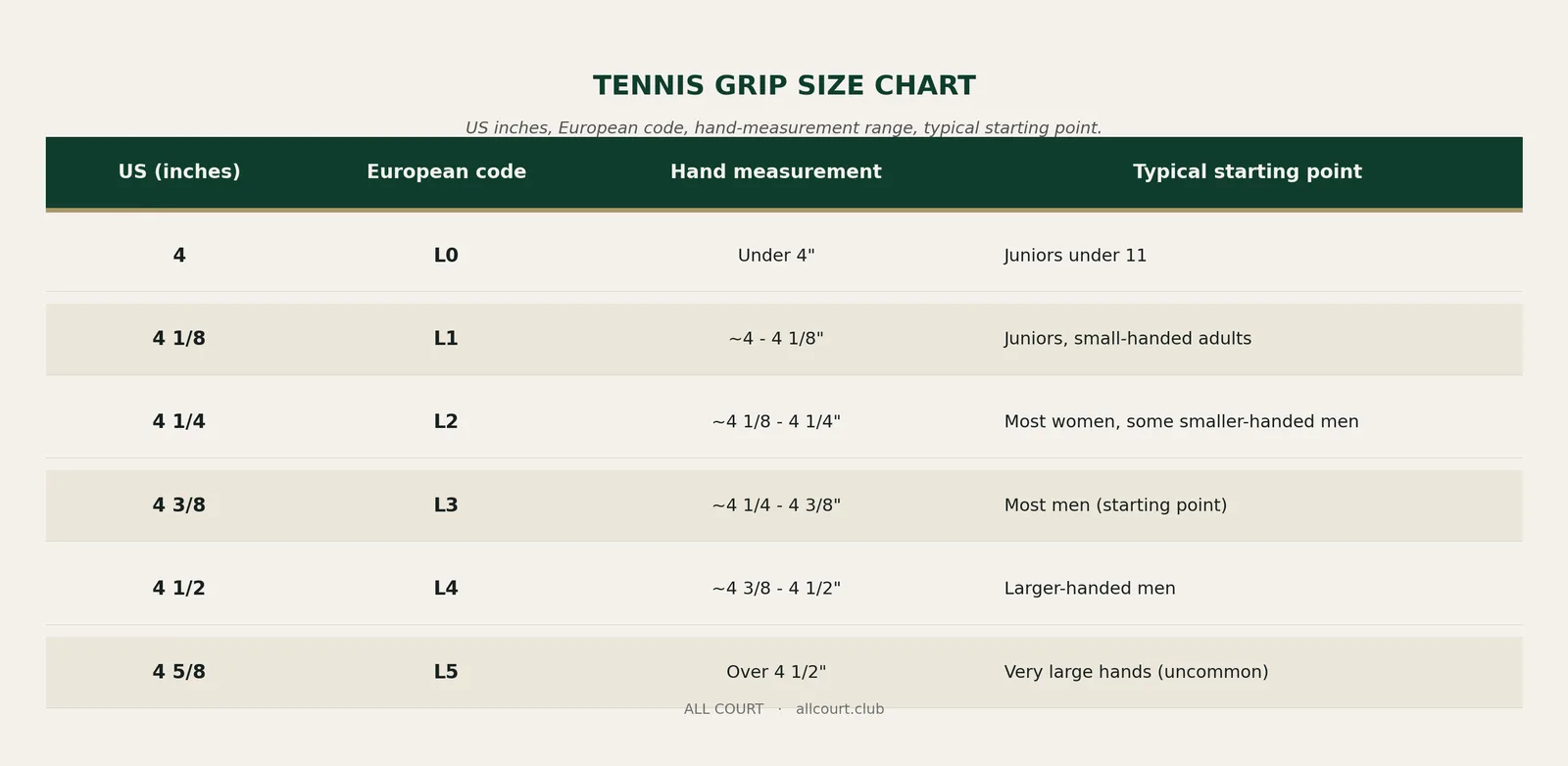
Every tennis racket handle is an octagon. Eight flat faces, called bevels, running the length of the grip, wrapped by the leather or synthetic base grip that comes on the frame from the factory. The number labelled on the racket ("4 1/4", "4 3/8", "L2", "L3") is the circumference across the flat faces at the pommel end. In the US the figure is written in inches; in Europe the same measurement is coded L0 through L5. Same sizes, two languages.
Standard adult sizes run in one-eighth-inch increments from 4 inches (L0) up to 4 5/8 inches (L5). The most-played sizes for adult men are L3 (4 3/8) and L4 (4 1/2). The most-played sizes for adult women are L1 (4 1/8) and L2 (4 1/4). The bracket above and below is available but uncommon on the shelf; L5 in particular is a special-order size in most markets.
The two ways to measure
Here are two methods to measure if a grip size is right for you and both worth doing. Use them together and you land on a size you can trust.
The ruler method. Open the dominant hand flat, fingers together. Find the bottom lateral crease of the palm, the horizontal line that runs across the base of the hand where the wrist starts. Measure from that line to the tip of the ring finger, in inches, rounded to the nearest one-eighth. That number is the indicated grip size. For most adult men the ruler will land in the 4 3/8 to 4 1/2 range; for most adult women in the 4 1/8 to 4 1/4 range. This is a starting number, not a final answer.
The index-finger test. Take a racket in a continental grip (the "shake hands with the racket" grip). Slide the index finger of the non-hitting hand into the gap between the tips of the fingers and the base of the thumb, running the finger flat across the palm at the top of the handle. The index finger should fit into that gap snugly, with no daylight either side and no compression. If the finger will not fit, the grip is too small. If it fits with room to spare, the grip is too big. When the two methods disagree, trust this one, because it is measuring the actual grip in your hand.
Comprehensive walkthroughs of both methods at Tennis Warehouse and Tennis Warehouse Europe.
The chart
What the right grip size does, and what the wrong one does
Grip size does two jobs, one on the shot and one on the body.
On the shot. The right grip size lets the racket sit in the hand with a light hold: firm enough that the head does not twist on off-centre contact, loose enough that the fingers can feel what the strings are doing. That combination is what pros call feel, and it is the difference between a controlled ball and a hopeful one. Too small a grip and the fingers curl too far around the handle, the racket wants to rotate in the hand on any contact away from the sweet spot, and the player squeezes harder to hold it steady. The squeeze kills feel, slows the swing, and dampens topspin acceleration. Too large a grip: the fingers cannot close comfortably around the handle, the wrist locks slightly, and grip changes between shots (continental to semi-western for the forehand, back to continental for a slice or volley) become slow or awkward. Fluid grip changes between strokes and generous wrist action through contact are two of the things modern tennis asks of the hand most, and both are what a wrong-sized grip prevents.
On the body. The elbow. It is always the elbow. A grip that is too small forces the player to squeeze the handle harder than the shot needs, and the squeeze runs up through the forearm extensor tendons at the outside of the elbow. Play three times a week and that load can settle into an ache that is hard to shake. A grip that is too large does the opposite: restricted wrist rotation forces the forearm and shoulder to compensate for movements the wrist should be making, and the load shows up higher in the chain, at the shoulder and the inside elbow.
The research is worth reading closely rather than at slogan level. A 2006 study in the American Journal of Sports Medicine (ScienceDaily summary) found no direct causal link between grip size and tennis elbow in the population it studied, which cooled some of the more absolute "wrong grip equals tennis elbow" claims that had been in circulation for years. A later 2014 study identified an optimal grip diameter that reduces the grip force required during the stroke, which in turn reduces load on the extensor tendons. Grip size is not the single cause of tennis elbow, but it is one of the mechanical inputs that can either raise or lower risk over years of play. See our companion piece why tennis elbow happens (and how to reduce your risk) for the wider picture.
If you're having elbow issues, and the grip size is a size or two off what the ruler and the index-finger test agree on, it is worth changing your grip size as a way to try to stop it becoming an injury that has to be rehabbed out of.
What the pros actually play, and why the numbers differ
Grip sizes at the top of the men's game vary more than most club players expect, for two reasons: pros have different hand sizes, (like the rest of us), and their playing styles reward different tradeoffs between stability at contact and wrist mobility through it (like the rest of us). Nobody at the top plays whichever size happens to be in the shop so there is no reason we should either; every one of them has arrived at their exact number by matching hand to style.
Rafael Nadal plays a 4 1/4 (L2), small for a man of his frame, because the extreme wrist snap his topspin forehand demands needs maximum wrist mobility. Roger Federer plays a 4 3/8 (L3), a mid-range size fitting a game built on cleaner contact and quick grip changes. Novak Djokovic has been reported at 4 1/2 (L4) and 4 5/8 (L5) at different points, on the larger end for a top player, in line with a flatter, more compact ball strike where stability at contact carries more of the shot than wrist snap. The trend across the modern men's tour has moved slightly smaller than the previous generation, in line with more extreme western grips and more wrist-heavy forehand production (The Tennis Garage on the modern-pro trend).
The lesson for a club player is not to imitate Nadal. It is that smaller grips are more common at the top of the game than the shelf at your local retailer suggests, and that the correct answer for any individual player depends on both their hand and their style. Between two sizes, the smaller one with an overgrip is often a smarter buy than the larger one played bare, particularly where the forehand relies on wrist action through contact.
What to do if the grip you own is wrong
If the grip is too small, build it up. An overgrip adds roughly one-sixteenth of an inch, so an overgrip on top of the factory base grip will move the grip up by about half a size. A heat-shrink sleeve is the neater permanent fix and any stringer can apply one in fifteen minutes.
If the grip is too large, sell the racket and buy the same frame in the correct grip size. The alternatives (sanding down the base grip, unwrapping and rewrapping thinner, shaving the pallet inside the handle) all change the shape of the octagon in ways that play worse than the too-large grip did.
For the wider question of picking the frame in the first place, see our racket choice guide. And on the grip type rather than grip size question, the three forehand grips every serious player should know and the earlier grip detail most players get wrong are All Court's two companion reads.
Get a properly rated read on what your grip is doing to your game
If you would like a properly rated read on whether your grip and swing are working with your body or against it before you commit to a new frame, All Court exists for exactly that. You put your phone against the back fence, film a session, and upload it. You get a "talking head" session inside your own video from a touring professional. Plus the AI-enabled platform compares those ratings against thousands of shots from hundreds of players graded by the same touring pros and elite coaches. The output is a personalised coaching session on your footage and an All Court Rating for each shot you hit and a cumulative All Court Rating that compounds every time you film more of your play, so that you can see whether the way you are gripping and swinging is loading your arm sustainably or setting you up for the ache that arrives weeks after a new racket. There is no nominator, no joining fee, and no waitlist that closes inside a generation. Join the waitlist at allcourt.club/join.
The one-line answer
Measure the hand, take the index-finger test, cross-check against the chart above, buy the size the two methods agree on, add an overgrip when between sizes. If the elbow is already whispering to you, this may be one of the first variables to change.