Junior tennis coaching: what actually keeps a kid in the game
Not about finding the next Alcaraz. About the coach who keeps your child coming back on Monday evening for the next five years, and turns them into a competent, lifelong player.

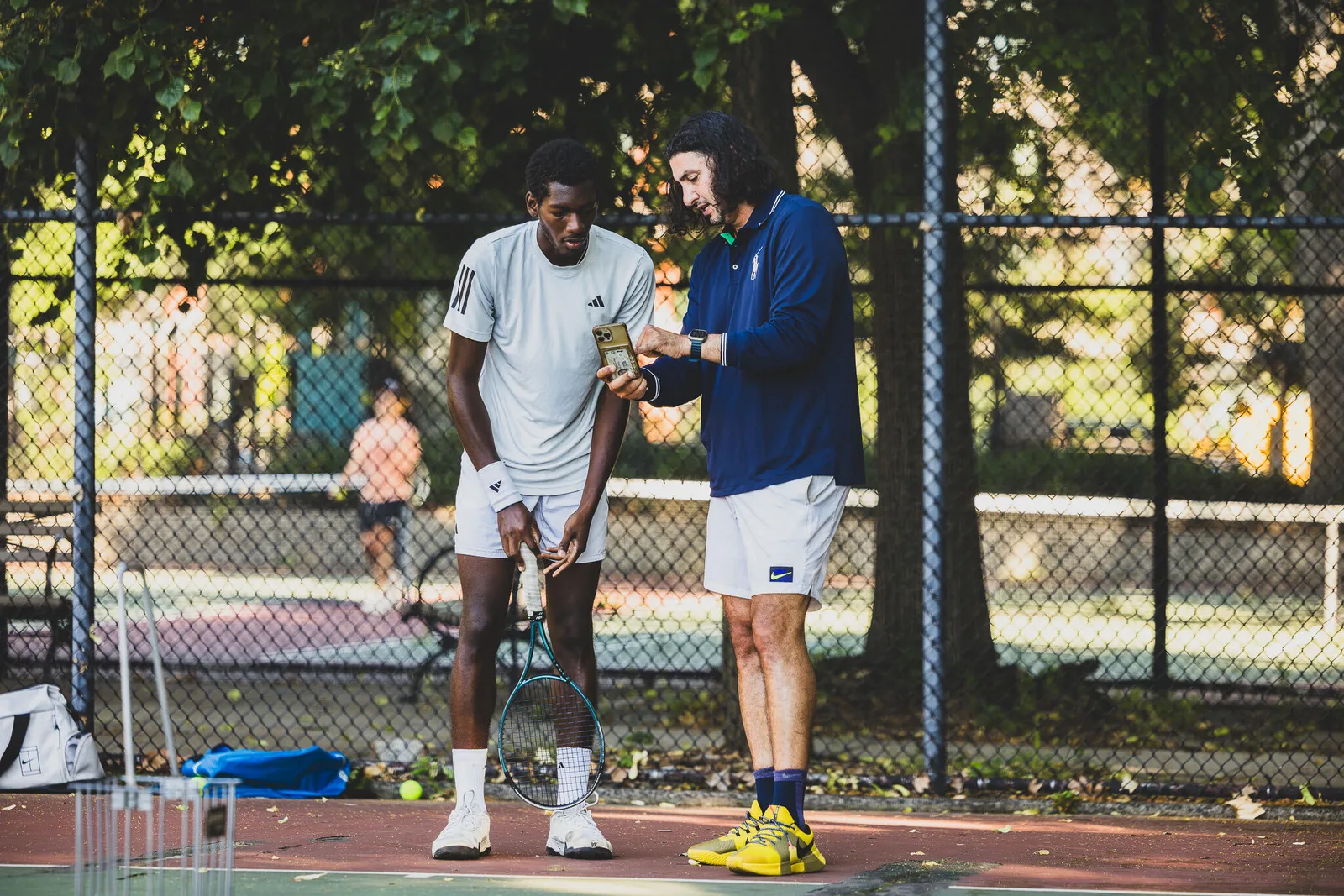
Arrive at your local club at six on a Monday evening and you can see the two failure modes on adjacent courts. On one court, eight children in a queue, a coach barking technique corrections at each in turn, and one small figure at the back of the line fighting back the wobble because they’ve missed a forehand three shots ago. On another court, three kids with rackets on the ground, three of them on phones, two gossiping at the net, and the coach also on their phone by the bench. Both blocks cost the same but neither is what you signed up for.
The parent trying to find the next Alcaraz already knows the drill. If your child is that kid, the one who will not stop asking for another hit, who quietly turns up to the club two hours early on a Saturday and hits against the wall until you drag them home, then there are academies for that, and they will find you or you will be forced to find them. The rest of us are trying to solve a different problem.
The fifty-year player
The hope is a child who is still playing tennis at forty. Competent enough to join a pick-up hit in Singapore on a work trip, to keep up with a corporate ladder at the local club on a Wednesday evening, and to still have the fitness, cardio and social benefits of the game in their middle years. The technical skills need to become natural for any of that to happen and the coach’s job, on that Monday-evening court, is to keep the child coming back on the next Monday, and the Monday after that.
Inside the group session
Most junior tennis at the club level happens in groups, and there are practical reasons for it. Group sessions are more profitable for coaches and clubs than one-to-one lessons: eight children at around £22 each brings in about £176 an hour for a court that would otherwise net £60 or £70 with a single adult on it. Block-booking a term, with payment in advance usually, secures the slot. That is how junior court time gets allocated at most well-run courts. We have written elsewhere about how coach rate cards are structured at the adult end of the game, and the group-lesson economics on the junior side is why the two rate cards look so different.
The group-size number is not only about economics. Six to eight children per court is the sweet spot for another reason. Fewer than that and the coach struggles to fill the session with variety. More than that and the balls-hit-per-child count starts to drop, the queues to step up to the baseline get long, and the wanderers start to wander. Once a couple of kids have their rackets hanging listlessly and their eyes on their friends, the session is done, whatever the coach on court is doing. The max-six-to-eight rule that well-run clubs default to is also the rule that keeps the phones in the bag. When you are shopping, ask what the number is.
Points over drills
There is a coaching orthodoxy that would tell you children need to drill technique before they can play points. Judy Murray, who has watched more junior court time than most of us will see in a lifetime, does not hold with that. “The key for any junior tennis coach,” she has said, “is to keep the kids engaged in the coaching lesson because we want them to stay in our sport.” Her method is to build games and exercises that do the teaching without a running commentary from the coach: “It’s about creating games and exercises that will do the teaching for you, so you’re not making loads of verbal, technical instructions.”
Most children learn technique inside points that matter to them, small competitive games with a score attached. A child who is losing 3-1 to their friend at a service-line rally will remember the semi-open stance the coach showed them three balls earlier, because there is something at stake in the next ball. The same child, cone-drilling forehands to nobody in particular for ten minutes, will forget the semi-open stance before they get to the water bottle.
Drill sergeant and gossip at the net
Let's start with the drill sergeant. Kids arrive at the club having been talked at from nine to three at school, and if their tennis session is another hour of technical instruction in the same register, tennis becomes another school day, and the excuses start on the following Monday morning: a stomach ache, a headache, an unfinished piece of homework that suddenly has to be done at six. The kid is not lying, exactly. They don’t want to be shouted at again.
The gossip-at-the-net coach fails in the opposite direction. You arrive to collect your child and the court is quiet: two kids on phones, two chatting by the net, and the coach also on their phone, cone in hand. Nobody is getting anything out of the £22 a head for a lesson like that. The technique that should be becoming natural over three years is not going in, because the ball is not being hit enough times. The excuses will still start, but for the opposite reason: the child is bored.
The middle path is warm, patient, structured and competitive. Herding eight nine-year-olds on a Monday evening in October is not easy, and no serious parent thinks it is. But it is the job.
Judy Murray’s rule
Our role as parents wanting our kids to become competent at tennis is important too. Judy Murray has said that “the parent will always have the biggest say, always.” “They’re 99% with the child, coach only 1%.” The coach on court for an hour or two a week matters, but a lot less than the tone the parent sets around the sport for the other 10,000 minutes of the child’s week. Murray has also written and spoken often about the parents she has watched turn tennis into a conditional-love proposition. “Children start thinking they’re only appreciated if they win. For example: ‘We’re going to McDonald’s because you won. No McDonald’s because you lost.’” A junior tennis life that runs on that fuel often does not last past adolescence.
A coach who is warm, patient and creative on court can keep a child engaged for years. The parent’s off-court contribution matters at least as much. Where both are working in the same direction, the child tends to stay in the game.
Shopping for a coach
So when you are shopping for a junior coach, the questions you are trying to answer are these. Does this person enjoy, as their primary tennis instruction, teaching nine-year-olds. Are they patient when a ball goes into the fence for the tenth time in ten minutes. Can they run a competitive game so that eight children are all getting their competitive juices flowing, and technique is being embedded inside the trying. Do they cap their court at six to eight players. Do they still love the sport on their third session of a Monday evening. Will they still be there in six months, or have they got half a foot out of the door.
The technically most demanding coach on the club roster is not always, at the junior level, the one you want. The kindest, most patient, most passionate for the sport is often the one who keeps your child playing for the next fifty years. Fifty years of tennis, played competently enough to join a pick-up hit anywhere in the world, is a much bigger prize than a junior county trophy your child forgets they won by the time they are twenty-one.
At All Court we spend a lot of time thinking about how the right coach and the right player fit. We have written about when to change your tennis coach and about how to find a coach who is right for your level. We have written about group tennis lessons vs private at the adult end, where the same trade-offs apply. The right coach at nine is the difference between a child who plays tennis for a few years and a child who plays it for fifty.
Related posts
What touring pros see in your tennis: ten cues from a hundred reviews