Group tennis lessons vs private: what each one delivers
Group tennis lessons vs private: what each format delivers, when each one works, and how to pick the right tool for the tennis you play.

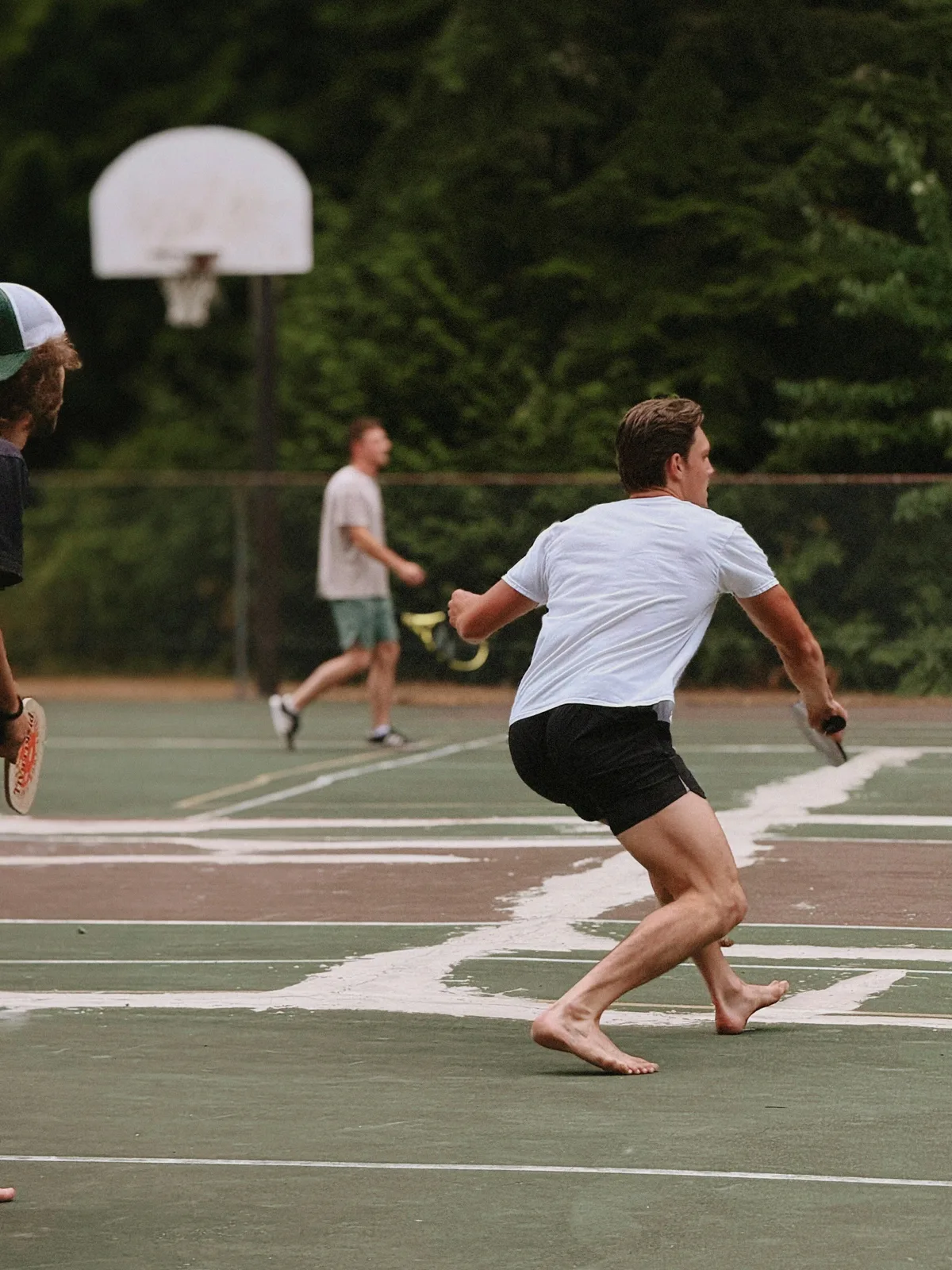
Two club players. Same coach, same club, same eight-week term, same money paid across the term. One books the group class. One books the private hour. Eighteen months later, both have moved their game measurably.
Both got lucky. Or one of them had already read this article before booking. The group player was an early-intermediate whose class happened to be four other players at almost exactly her level. The private player was an intermediate with a specific serve fault she wanted named and drilled. Each had picked the format that matched the tennis she was trying to build.
Group and private are different tools. Picking the tool that fits the specific job is what decides whether an eight-week term of coaching moves the game or fills the week.
What each format costs
Adult group coaching in the UK typically costs somewhere between ten and twenty-five per cent of an equivalent private lesson per session. As a rule of thumb, call it a fifth. Put another way, for the price of one private hour with a mid-tier coach a player can usually book five or so group sessions. Private lessons at the same tier of coach sit at a different price band entirely; the coach rate card breaks down what each tier of private hour delivers and why. Group and private are different products at different price bands.
What a group session delivers, and when
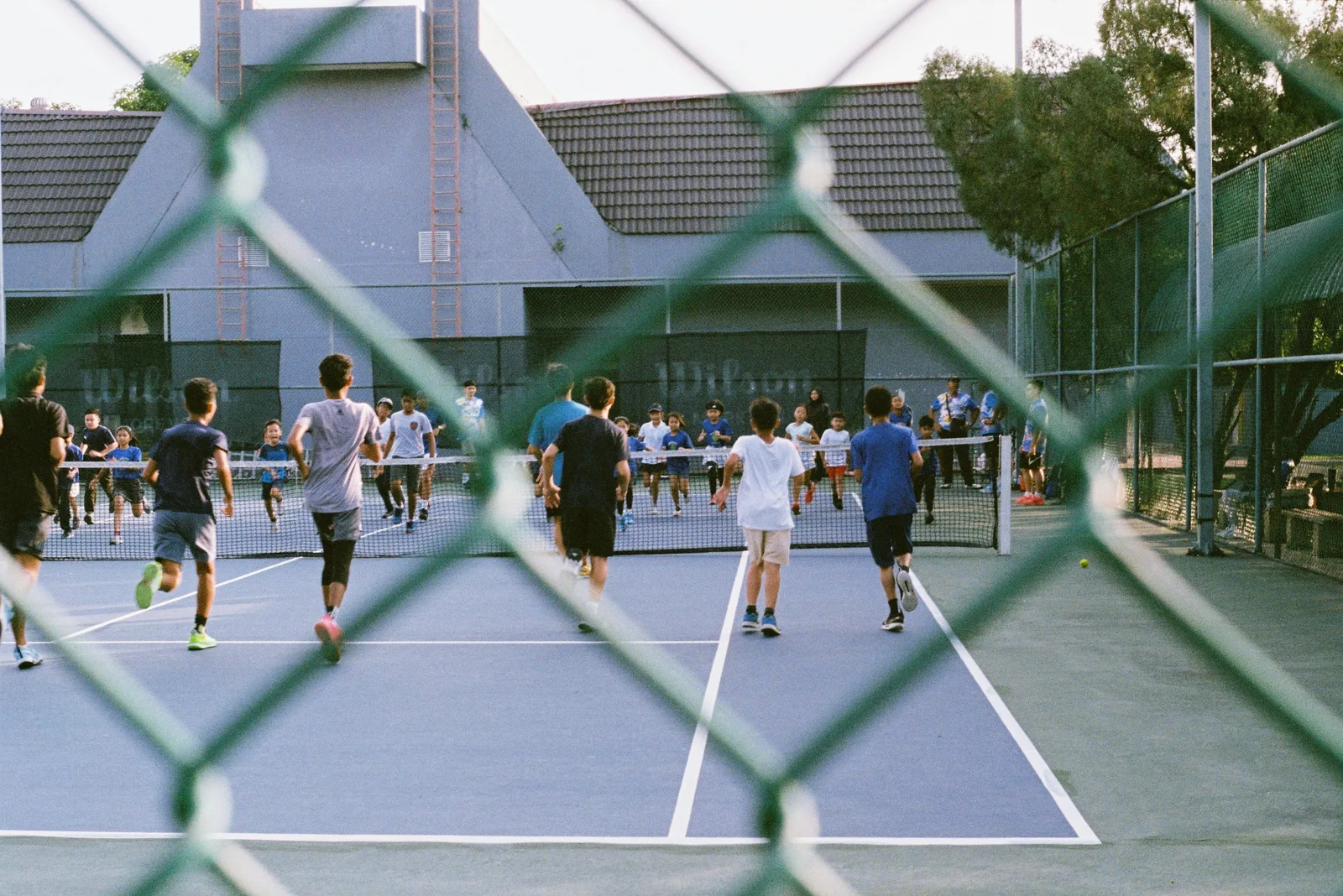
Group is essentially the right default for beginners and early intermediates. It also works at every level above that, but only under one condition: the levels of every player in the group are close to each other. When that condition is met, group is one of the most valuable coaching formats in tennis. When it isn’t, group is where a player’s game goes to plateau.
Millen Hurrion, one of the coaches on the All Court network and a touring ATP pro, defines the format plainly:
“Group sessions are better for people that need the reps to improve on the consistency of certain shots. Maybe these people will also benefit more from mixing in with a variety of different people. More open practises with live ball drills and points.”
Mihai Vasii Kolla, another of All Court's pro mentors who has coached extensively at the Rafa Nadal Academy, on why he sends players into groups:
“There’s a misconception that because tennis is an individual sport, it should be learned and trained individually. I don’t necessarily agree with that. Tennis is an individual sport in terms of competition, but a lot of a player’s development actually comes from interacting with other players, solving different problems, adapting, experimenting, and playing in realistic situations.”
A well-matched group is a laboratory of live tennis. Rally patterns played out with players of similar level. Repeated exposure to balls hit at pace by someone whose intention the receiver cannot fully predict. There is decision noise to be dealt with and recovery under time pressure vs. static drills where you know where it's coming and are looking only to hone a specific response.
In practice, that level-matched group is rarer than it should be. Two things usually go wrong. First, the coach takes whoever signs up rather than assessing each player before slotting them, and skips the second move of shifting a player into a more appropriate group after the first session has surfaced their actual level. Second, and more fundamental, there is no shared amateur rating system to slot against. Competition ratings exist but are largely irrelevant to the 99% of the 100 million-plus recreational players globally who have never (or rarely) played a competitive match inside the rating company's or governing body's tournaments. Absent a shared rating, a coach putting a group together has gut feel from a five-minute conversation and nothing else.
Mihai on the coach side of the same problem:
“The quality of a group session depends heavily on the coach. The coach’s job is not simply to give the same information to several people. It is to create the right environment, put the right players together, structure the session well, and make sure everyone is being challenged appropriately. If the levels are too different, or the group dynamic doesn’t work, the quality of the session can suffer.”
The All Court Rating (ACR) is one of the tools built to fix the rating-vacuum side of this. A rating for recreational players that travels with the player across venues, coaches and countries, so that a group can be assembled on data rather than on hope.
The other trade off for group sessions is feedback frequency. In an hour with six players and one coach, no single player receives more than ten minutes of direct instructional attention, and the coach has to pick which players to correct on which points. A specific technical fault, in a group session, can go uncorrected for weeks while the drill it is hiding in gets called practice.
The well-run, level-matched groups are the ones that sell out. In the badly-matched ones, a good coach is spread thin across four levels of player and produces four mediocre outcomes.
What a private lesson delivers, and when

A private lesson buys less of the game because it tests fewer variables and can involve one ball fed exactly where the coach wants it, with every swing watched and every needed correction named on the spot. In a group session the same fault waits for the moments the coach is looking at the right player.
Lauryn Baptiste, also an All Court pro mentor, LTA coach and WTA pro tour player, comments on when she might send a player into private:
“If the player wants to improve their technique in a controlled setting, I’d suggest individual sessions. With private lessons, specific drills can be done to benefit the player. The coach gives the player their full attention and can easily give tips throughout the session.”
Millen puts the format in mirror language to his group definition:
“Private sessions are better for more technical work, where you have more focused input from the coach in a 1-to-1 dynamic. More closed practices and specific focuses.”
Mihai adds a second layer to the private-lesson case:
“The biggest advantage is not simply that they get ‘more attention,’ but that the entire session can be built around their specific needs. This becomes particularly valuable as a player gets more advanced. At a higher level, it can be difficult to consistently find someone who can provide the right level of challenge, whereas a good coach can adapt to the player and help them work towards much more specific technical, tactical, or competitive goals.”
Which is why the private-lesson tier sorts itself over time. A hobby player books a private hour for a few weeks to fix a serve, then stops. A serious club player, or a junior chasing competitive rating points, books private hours because the group format has stopped supplying the challenge their game now needs.
Where private goes wrong most expensively is coach-player misalignment. Farhad Roshanaie, coach on the All Court network, USPTA Elite Professional and currently, in between coaching sessions, at the US Open, made the point directly:
“Players and coaches need to be on the same page. If a coach is focused on correcting or developing a player’s strokes while the player mainly wants to play matches and enjoy competing, they are out of sync. Neither goal is necessarily wrong, but the mismatch can make the coaching process frustrating for both sides.”
Frustrating for both sides is a mild way of putting the arithmetic. A private hour at rate-card money, with a coach drilling forehand mechanics for a player who came in wanting to work on how to close out a lead in a set, is the most expensive way for both people to have a bad hour. The alignment is set or missed in the first ten minutes of the lesson: a good coach opens with a diagnostic conversation, not with a drill. Private lessons are worth booking when the player knows precisely what they want the hour to be about. Absent that clarity, private hours cost more than group hours and deliver less.
Where semi-private fits
A third format sits between the two. Semi-private is a shared coach with two to four players, most often booked as a fixed pair or four who play together anyway. The per-head cost typically sits between the two, closer to private than group, often forty to seventy per cent of an equivalent one-to-one hour, depending on how many share the coach and how the club prices it. The feedback stays close to private in quality because the coach has court time to say something to each player after most exchanges. What semi-private also gives that a solo hour cannot is a live opponent. Return games, doubles patterns, angle work, cross-court rally structure, all coachable in real time rather than as an abstract instruction to remember later.
The catch is that semi-private only works if the group is the group. Two friends who play together and want to sharpen their doubles is ideal. Four strangers rotated in by a club programme is usually a group session in miniature and priced accordingly. If a club offers semi-private as a scheduled slot, ask who else is in the group and what level they play at before committing.
What tennis are you trying to build
Format follows intent. Intent is a question the player has to answer before the coach can.
Mihai:
“So when I’m reading the decision as a coach, I’m not really asking, ‘Which lesson is better?’ I’m asking, ‘What does this player need right now, and what environment will help them develop?’ The player’s goal should come before the format.”
The default read of “goal” is “technical progress.” Farhad’s read pulls the frame wider:
“Many recreational players are not primarily interested in technical development. They want to socialize, move, exercise, and sweat. For them, cardio tennis, live-ball sessions, or other play-based formats may be far more appropriate than spending significant time rebuilding their strokes.”
And on the competitive side:
“There are also many competitive league players who care about winning but still do not want to invest heavily in improving their mechanics. They may prefer to compete with the game they already have and improve through experience rather than undergo a major technical reconstruction.”
A large share of the 100 million-plus recreational tennis players want the game as movement, as social continuity, as a night out with a racquet. For that player, group is almost always the right format regardless of technical trajectory, and the level-match still matters mainly because a group ten steps above their standard is embarrassing and a group ten steps below is boring.
For a player who does want technical change, the goal has to be specific. “I want a better forehand” is not specific. “I want a topspin forehand I can hit cross-court from behind the baseline with the confidence to end a point on it” is specific and what a private coach can build a plan around. The vague version turns eight private hours into eight expensive versions of hitting some balls this week.
Lauryn on the ideal:
“In all honesty, a blend of both is the ultimate goal. Which I’d always suggest if there are no financial restrictions.”
The blend is the coaching-industry consensus for a serious improver. It works because the two formats compensate for each other’s blind spots. Group supplies the variability and live-ball reps private lacks. Private supplies the feedback density and technical focus group lacks.
Before you book
Three questions. Answer each one before booking anything.
One. What tennis are you trying to build? Movement, socialising, cardio, a night with a racquet? Group is almost always right. Match-play polish with the game you already have? Group, with maybe a private hour a month. Specific technical or tactical change? Private, with a coach who has heard the specific goal in your own words.
Two. Is the environment aligned to the goal? For group: are the four other players in the class at the same level, and if not, will the coach re-slot after the first session? For private: does the coach know the specific thing the player wants worked on, and will they design the hour around that rather than around what they normally teach? If the alignment starts to slip mid-term, there are five specific questions to ask the coach that surface whether the mismatch is fixable or whether it is time to switch.
Three. What will you turn up to for the next six months? The best coaching format is the one that survives the calendar, the budget and the winter. A Wednesday-evening group class attended for eighteen months beats a private-hour package abandoned after four weeks. Consistency is a coaching input in its own right.
If the answers are clear, the format decision is close to trivial. If any of them is fuzzy, the format decision was never the one to solve first.
Farhad has the final word: Technique gives a player the tools. Playing the game teaches them when, where, and how to use those tools. Both formats have their place. The one that moves the game is the one matched to the tennis the player is trying to build.