Doubles serve strategy: how to serve so your partner can win the point
Doubles serve strategy for the singles player: why the serve is an assist not a winner, the four placements, the signals, and the three club mistakes.

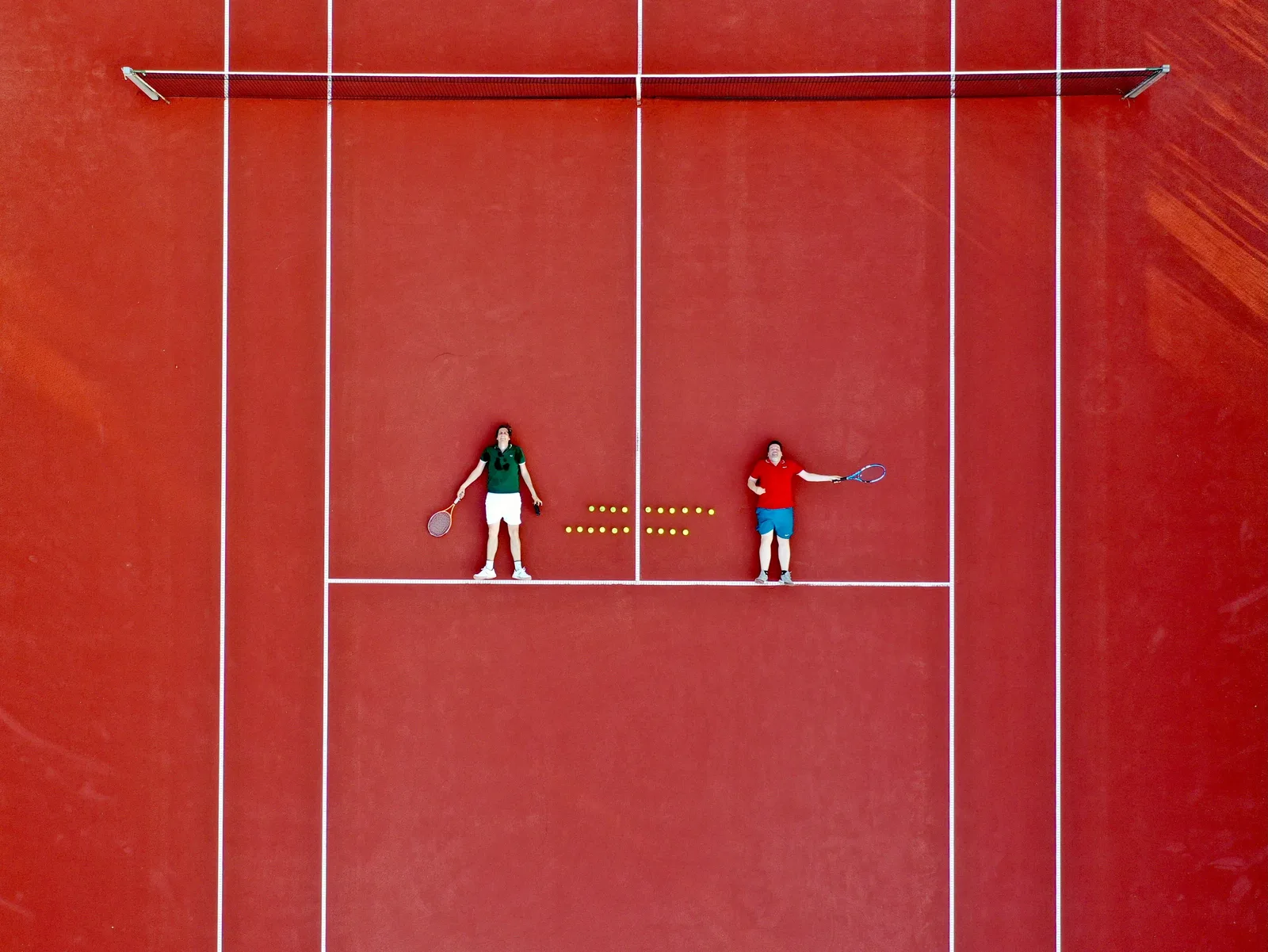
The moment a good singles player discovers that doubles is not a variant of singles usually arrives about fifteen minutes into their first proper doubles match. Their 110 mile-per-hour first serve, which in singles would have set up an easy second-shot attack, keeps getting chipped straight down the middle by the returner. The server, still standing on the baseline where singles instinct kept them, plays a late defensive half-volley back into the middle of the court. The returner's partner at the net picks it off for a winner. The singles player looks at their partner at the net. Their partner shrugs. Nobody covered the middle because nobody signalled the middle was coming.
In basketball, an assist is credited to the player whose pass sets up the scored basket. In football, a goal is only as good as the pass that created it. The doubles serve works closer to that logic. The good serve is not the one striving to go past the returner. The good serve is the one that forces the returner into a shot your partner is already moving to intercept. Everything a serious doubles pair does downstream of the serve, from where the net player stands to whether they poach or stay, depends on knowing where the ball is about to go before the toss goes up.
For the singles player starting to take doubles seriously, this is where the whole thing turns. The serve is not the shot you were trained on, and it is also the one part of tennis where a club player gets to be part of a team.
Why placement matters more than pace in doubles
The doubles court is the same width plus tramlines: twenty-seven feet in singles, thirty-six feet in doubles. The service box is the same size. But there are two returners on the court instead of one, and one of them is standing at the net . That geometry does two things to the serve.
The pace-advantage of a big serve shrinks. In singles, an extra ten miles per hour on the serve creates real time pressure on a returner standing fifteen feet behind the baseline. In doubles, that same ten miles per hour saves you almost no time against a returner who places returns down the middle because they know the net player is not covering the middle. Pace is expensive to generate and cheap for the returner to defuse with a block.
The margin for error on placement shrinks. In singles you have the whole width of the court to defend after the return. In doubles you have half of it, because your partner is defending the other half from the net. A first serve that lands three feet inside the wide corner is worth more than a first serve that arrives faster but sits closer to the middle, because the placement is what pushes the returner into a specific reply.
There is data. In ATP singles, the average first-serve win rate is around fifty-eight per cent. In ATP doubles across the 2024 and 2025 seasons, the average first-serve win rate is seventy-five per cent. The seventeen-percentage-point gap is not free power. It is what the geometry of doubles gives to any server whose placement is intentional and whose partner at the net knows where the ball is going. The body serve, incidentally, is measurably the worst placement in professional doubles despite being frequently used, particularly on second serves. Placement is not just important; it is quantifiable, and the wrong placement is quantifiably wrong.
The four placements per side, and what each one gives you
Every service box has four practical placements. On the deuce side and the ad side the geometry mirrors, but the effect on a right-handed returner is different on each side.
T-serve. Down the middle line of the court. On the deuce side this arrives on a right-handed returner's backhand and forces a defensive chip or a rushed drive up the middle. On the ad side it arrives on their forehand, but unless they constantly risk a down the line drive, usually elicits a flat drive down the middle (poachable) or a hard-to-hit cross court to the tram line out wide for the server to track down. In the ATP doubles data over the last two seasons the T-serve is the most-used first serve on both sides of the court and it is 1.9 per cent more effective than the wide serve on the deuce side. It is the highest-percentage placement for setting up a middle-poach by the net player, because the returner's reply is geometrically constrained.
Body serve. Straight at the returner's hip. Awkward on both sides regardless of dominant hand, because the returner has to decide forehand or backhand and move the racket out of the way at the same time. The body serve is the worst option for a big power server (the ball arrives too easy to time), but it is badly underused at the club level and reliably produces short, weak returns that the net player can put away.
Wide serve. Toward the doubles alley. On the deuce side this pulls a right-handed returner off the court onto their forehand, opening the entire court for the partner at the net. On the ad side it stretches them onto their backhand and often draws a slice. The wide serve is the highest-value placement for creating court space, but requires accuracy to justify: a wide serve that misses by two feet is a fat first serve into the middle, which is a gift. Worth noting: the ad-court wide serve is the one placement where the wide beats the T in the ATP doubles data, by 1.1 per cent, which is why touring pros go there more heavily under pressure.
Slice-wide serve. A slice serve aimed at the wide corner that curls further out. Slower than a flat wide serve. Harder to defend because the ball is moving away from the returner after the bounce. Requires a proper slice motion (continental grip, brushed contact across the ball, not a flat drive), and every doubles specialist learns it because it opens the alley without requiring pace.
None of these are the "right" first serve on every point. The right serve is the one you and your partner have decided is the right serve for this point, before the ball is tossed. Which brings us to signals.
The signalling problem, and why club players almost never fix it
Every touring doubles team signals. The net player uses the hand held behind their back, so the returner cannot see it, to tell the server where the serve should go and what the net player is going to do about it. The system is standard across the tour and has been for decades.
Direction signals from the net player, right hand held low behind the back. Same hand in the same physical position each time, palm facing away from the returner. The finger patterns below flip between deuce and ad because the geometry of which finger points inward toward the T changes with the side of the court.
T-serve. The finger pointing inward toward the middle of the court. On the deuce side that is your pinky; on the ad side it is your thumb.
Body serve. Middle finger, both sides.
Wide serve. The finger pointing outward toward the doubles alley. On the deuce side that is your thumb; on the ad side, your pinky.
Then the net player signals their movement after your serve.
Open hand. The net player is going to move across to try to intercept the return (a poach).
Closed fist. The net player is going to stay in their half of the court.
The server sees the signals and confirms with a small nod or a "yes"; if they cannot execute the called serve on this point they shake it off and the net player either signals again or defaults to a pre-agreed pattern. That is the entire system. Ten minutes to learn and a lifetime of doubles improvement can follow.
Club players almost never use it. The two reasons are usually the same: nobody thinks to introduce it, and it feels awkward at first for even suggesting it. Both reasons dissolve within a week of doing it. The moment a serve-plus-poach combination lands cleanly for the first time because both players knew where the ball was going and what the net player was going to do next, (and the returner did not), the awkwardness is over. From that point onwards not signalling feels like the strange thing.
The Australian formation piece covers the more radical positional variant on the same idea. The doubles positioning piece covers where the net player should actually be standing when the serve arrives. Both compound on the signalling habit; none of them work without it.
Three club-player serve mistakes worth naming
Mistake one: serving for pace instead of placement. The 110 mph first serve that lands in the middle third of the box is worth less than the 85 mph first serve that lands two feet inside the wide corner. Club-doubles points are decided by whether the returner is stretched out of position, not by whether the ball arrived fast. Take fifteen miles per hour off the first serve if the trade buys you two feet of accuracy.
Mistake two: treating the first serve and second serve as the same conversation with your partner. The first serve is where the poach lives. On a first serve the returner is defending a bigger, faster shot and their return is geometrically more predictable, which is exactly what the net player needs to intercept. On the second serve the returner is stepping in and looking to attack, and the poach is much riskier. Signal differently for first and second serve, or default to "stay" on second-serve points and let the return play out.
Mistake three: serving to the returner's forehand because it feels safer. The forehand return is usually the returner's more aggressive shot. Serving to it hands them the shot they want to hit. Against a right-handed returner, that means the wide serve on the deuce side and the T-serve on the ad side both land on their forehand and both look "safer" to the server (you can see the return coming back) while actually feeding the returner their power shot. Serving to the backhand even if at first it feels less comfortable, is one of the single biggest improvements a club-doubles player can make.
Serve-and-volley is the doubles default, not an option
In singles, serve-and-volley has effectively disappeared from the tour. In doubles it is still the default choice on first serves at every level from club to Grand Slam. The reason is simple: on a doubles serve the server has the middle of the court to close down alongside a partner already at the net, and the returner has half the court to hit a return that will hurt. Coming forward turns the point into a doubles point immediately.
Most club players stay back on the first serve because they were taught to in singles. This is the wrong instinct. If your first serve lands in the box, close the net. If you cannot get to a good first-volley position because your serve is too slow to buy you the time to move forward, take a lesson on mid-court first-volley footwork as the compounding effect of both players pushing forward after the serve is as valuable as serve placement improvements.
Under pressure, pros go to what they trust
Break-point serve data from the ATP tour makes the placement-over-power argument in one clean number. In non-break-point ad-court situations, tour players serve wide about ten per cent more often than they serve down the T. On break points, that gap doubles: pros go heavier to the placement they trust most, which in the ad court is the wide serve. Novak Djokovic in particular takes his first-serve percentage up by 4.2 percentage points on break points while his average first-serve speed drops by 2.8 kilometres per hour. Placement over power, in his own numbers, on the point that matters most.
Take the lesson to your own doubles break points. This is not the moment to try the flat 110 mph body serve you have been practising. It is the moment to serve wide-ad with confidence, or T-deuce with confidence, and let the placement do the work while your partner knows which one is coming.
Where a club player actually gets to be a teammate
The reason doubles matters to a serious club player is that it is the one part of tennis where you get to be part of a team. The professional tour is a solo circuit. Prize money, ranking points, media coverage are all built around individual singles careers. The exceptions are the moments the sport gives itself over to team formats: the Laver Cup in September, when Team Europe plays Team World across three days. NCAA college tennis in the United States, where every serious American junior aspires to a scholarship spot and a team locker room. And the new short-form leagues, most visibly INTENNSE, the six-week team format that launched out of Atlanta in 2025 with three teams and expanded through 2026 with a college draft on the way.
Even for touring pros in their thirties, doubles is often where the second career gets built. Marcus Willis, whose 2016 Wimbledon run to a Centre Court date with Roger Federer became one of the great British singles fairy tales, has quietly moved into a proper doubles comeback in the last two years, winning tournaments in France and Spain with Scott Duncan and then arriving at the 2026 Australian Open with a Swiss partner and winning a first-round match on a show court against a former AO doubles champion. The specifics matter less than the shape: it is easier to prolong a serious tennis career by adding a partner than by trying to add pace to a thirty-five-year-old serve.
Although none of that is available to a club player, what is available is a doubles pair. The serve and the signalling is where that pair either functions like a team or functions like two singles players sharing a court. Learning to serve as an assist rather than as a solo shot is the moment a club-doubles player crosses from the second category to the first.
A note for the reader who has read this far
If you would like a properly rated read on your own serve and how it holds up in doubles specifically before you pay for a coaching block on it, All Court exists for exactly that. You put your phone against the back fence, film a session, and upload it. You get a "talking head" session inside your own video from a touring professional. Plus the AI-enabled platform compares those ratings against thousands of shots from hundreds of players graded by the same touring pros and elite coaches. The output is a personalised coaching session on your footage and an All Court Rating for each shot you hit and a cumulative All Court Rating that compounds every time you film more of your play, so that you can see which parts of your game are improving and which specific things are worth taking to your next doubles session with your partner. There is no nominator, no joining fee, and no waitlist that closes inside a generation. Join the waitlist at allcourt.club/join.