What good coaches actually do in the first ten minutes of a lesson
Most players walk on court and assume the lesson starts when the coach asks what they want to work on. A good coach has been running it since you put your bag down. Here is what they are actually doing in those ten minutes you thought were small talk.

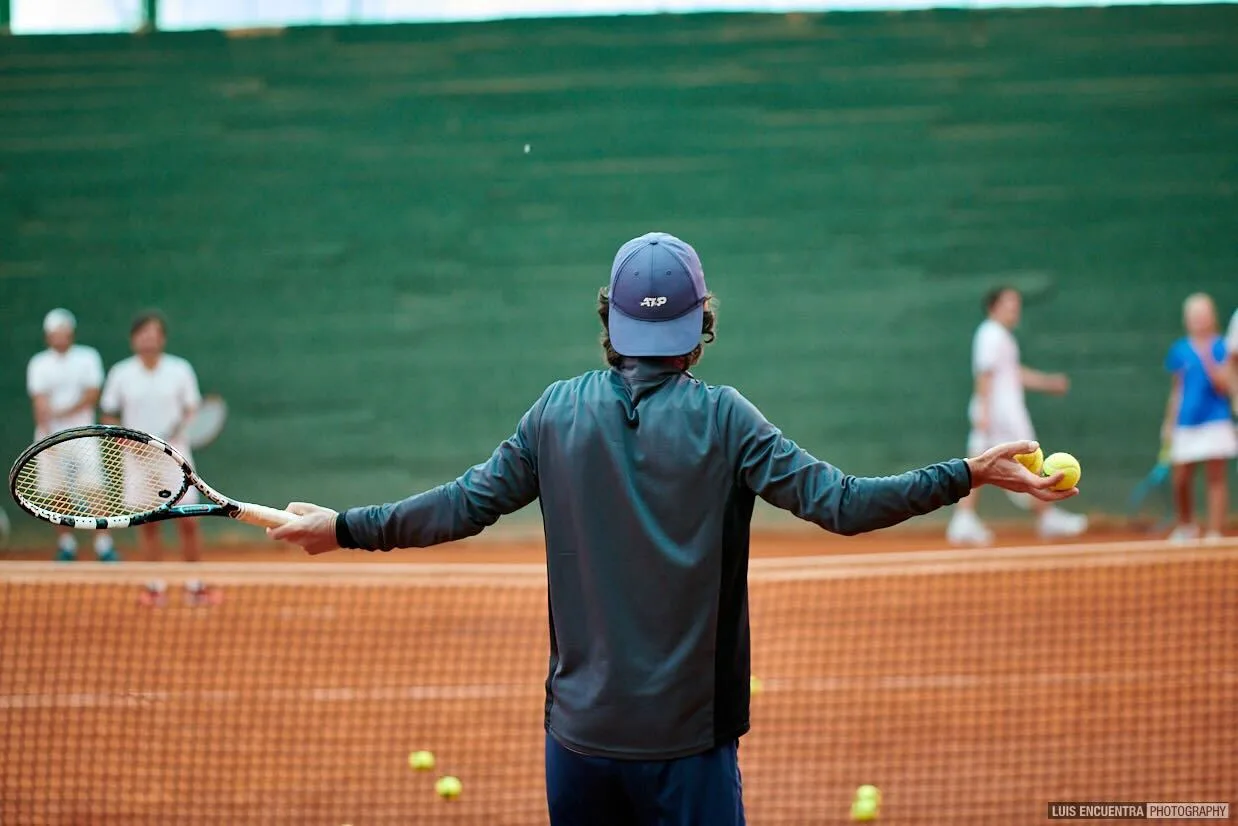
You arrive for the lesson. You change, you put the bag down, you walk on, you hit a few balls with the coach standing on the other side of the net. The coach asks how things have been. You knock up for five or ten minutes. Then they ask what you want to work on, and the lesson begins.
That is the version of a tennis lesson most players know. It is also, in important ways, not the version a good coach is actually running.
A good coach has been running the lesson since the moment you walked on court. Which is a part of what you are actually paying for on the rate card, even before the first fed ball. Those first ten minutes, the ones you thought were warm-up, were the diagnostic. By the time they asked what you wanted to work on, they had already decided what the answer was going to be, and the question was mostly a checking exercise.
This is not a complaint about coaching, and it is not a secret. It is just how it works once you know what to look for. Here is what a good coach is actually doing in those ten minutes you assumed were small talk.
The knock-up is the audit
Most players treat the knock-up as the gentle on-ramp. The coach treats it as the only honest data point of the lesson. It is the only time you will hit balls without thinking about what the coach said, and that is exactly what makes it useful. Whatever your game looks like when nobody is watching for anything in particular is your game.
The coach watches your first ten balls. They are not watching the ball. They are watching how you set up before the ball arrives, where the racket sits when you wait, what your unit turn looks like on a slow rally, where your eyes go, what your footwork does between shots. The mechanics that show up in a relaxed knock-up are the mechanics you actually own. Everything else, including what you can produce when a coach asks you to demonstrate something, is performance.
By the third or fourth ball, a good coach has noticed three or four things. By the tenth, they have a working hypothesis about what is costing you the most. The lesson, the actual lesson, in their head, has already started.
The opening question, and the better questions to ask back
Most coaches will, in the first few minutes, ask you what you want to work on. This is a fair question at the wrong time.
Asked before they have seen you hit a ball, the question is essentially asking you to self-diagnose, which is the thing you were paying them to do in the first place. You give them an answer, usually a vague one ("the forehand has been off"), and they nod and write it down. Now they are running the lesson off your guess about what is wrong, not their professional read of what is wrong. Both of you are worse off than if they had said nothing for five more minutes and watched you hit.
The small upgrade you can make as the player is to gently shift the question back to where it belongs. When the coach asks what you want to work on, try one of these:
"Can we hit for ten minutes first and then talk about what you noticed?"
"Tell me what you see in my warm-up before we decide."
"I have a couple of things on my mind, but I would rather hear what you spotted first."
All three say roughly the same thing. They put the diagnostic back in the coach's hands, where it belongs. Most coaches will be relieved, because they will already have been watching, and they generally prefer to lead with their own observations rather than confirm yours.
Once the warm-up is done, then mention the specific things on your mind. A niggling forehand. A serve toss that has not felt right. A backhand return that keeps breaking down against pace. By that point the coach can either agree, redirect, or fold your concern into a broader pattern they have already spotted. The conversation is now built on something real for both of you, not a guess made in the first thirty seconds.
What good coaches do not do, and this is worth noticing in your own coaches, is run the lesson purely off the player's stated request. If you ask for more topspin and they spend an hour on grip changes when the actual issue is your footwork, the lesson will produce no real change and you will both wonder why. Good coaches match the lesson to what they saw, not to what you asked for. Sometimes those are the same thing. Often they are not.
They are reading your body before they read your game
Tight shoulder from sleeping wrong. A hip that did not warm up on the walk from the changing room. A knee that absorbs the first few lunges with a little more compromise than the player realises. A good coach reads all of this in the first five minutes and adjusts the lesson accordingly, sometimes without saying anything.
This is one of the quiet things a good pro does that a casual rally at your club does not. Whether they are coaching you or hitting with you, a pro on the other side of the net is reading the body first and the game second. The rally they give you in the first ten minutes is the one your body can actually handle today, which is occasionally a different one from the one you would have asked for.
They are testing your level by varying the feed
Watch what a good coach does with their own ball during the knock-up. They are not just trying to give you a comfortable rhythm. They are nudging the pace up and down. They are throwing in a low ball after three high ones. They are feeding to your weaker wing. They are seeing where your contact point drifts, where your footwork starts to get late, where the swing path tightens under pressure.
By the time the formal feeding drill starts, the coach has already calibrated the level you can actually hit at versus the level you think you can hit at. The drills they design will sit just above the second number. That is the band where you improve. Below it, the lesson is a workout. Above it, the lesson is an embarrassment. A coach calibrating that band by feel is the difference between an hour that changes something and an hour that fills the time.
They are deciding what not to work on
Brad Gilbert wrote, in Winning Ugly, that the difference between players who keep improving and players who stay stuck is usually how few things they are working on at once. The same applies to lessons. A coach who tries to cover five things in an hour will improve none of them. A coach who picks one or two and goes deep is the coach whose lessons compound.
Those first ten minutes are when the coach decides what not to touch. The serve might be off, but you are also late on the forehand, and there is something off in your recovery footwork. Pick one. Go deep. Leave the other two for next time, and tell the player so they know it has been seen.
The temptation, on both sides, is to fix everything. The good coach resists this on your behalf. They know, from experience, that one correction held across a month of practice is worth more than five corrections forgotten by Tuesday.
The contract
By the end of the first ten or fifteen minutes, a good coach should be able to say something like this. "Here is what I noticed. Here is what I think is the most useful thing to work on today. Here is what I would like the end of the hour to look like. Does that work for you?"
The phrasing varies. The structure does not. A lesson without a stated focus produces a player who leaves wondering what they were supposed to take away. A lesson with one, even an informally stated one, produces a player who can answer the question "what did you work on?" two weeks later.
If your coach is not doing this, if you arrive, knock up, and then start hitting feeding drills without any explicit framing, you can ask for it. "Before we start, what did you notice in the warm-up? What do you think we should focus on?" A good coach will answer happily. A coach who cannot is telling you something.
The reason this matters to you, even if you do not take regular lessons, is that the same audit a coach runs in those first ten minutes is the audit a touring pro can run on a clip of your game from anywhere. The lens is the same. The skill is the same. The output is the same: here is what your knock-up told me; here is the one thing worth changing; here is what to leave for later.
Upload a clip of your warm-up at allcourt.club/intake and a pro from the All Court network will tell you what they would have told you, in the first ten minutes, if you had walked onto their court instead of typing this into a browser.
What this is for, in the end
A lesson is not the hour. It is the diagnosis at the start and the focus that comes out of it. The hour of hitting balls is the execution, and execution is the easy part. It is also the part a hitting partner can often supply more cheaply than a coach can. Most coaches can run it competently, and most players can hit at the level the coach asks of them. The hard part is knowing what to spend the hour on, and, one step earlier, what kind of hour to buy in the first place.
Good coaches earn their money in the first ten minutes. You earn yours by paying attention to what they do during those minutes, so that the next time you take a lesson, you can ask better questions, get more useful answers, and walk off the court with one thing you are going to work on, deeply, before you take the next one.
Related posts
Why you forget most of your tennis lessons