The reason you're always half a step late on court
Most players who feel perpetually behind the ball blame their speed. The real cause is almost always a positioning or preparation pattern happening earlier in the rally that they cannot see in the moment.

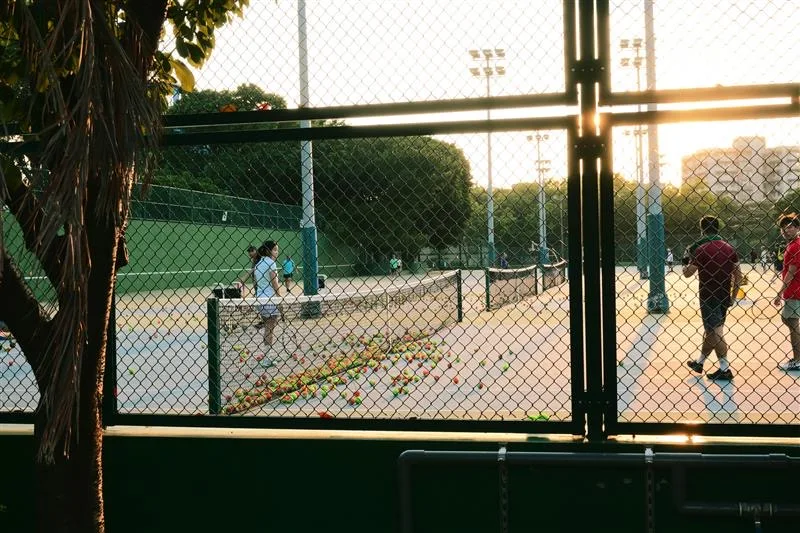
There is a moment in Any Given Sunday where Al Pacino, battered and hoarse, tells his team that the margin between winning and losing is so small it is almost invisible. "The inches we need are everywhere around us," he says. "On this team, we fight for that inch. Because we know when we add up all those inches, that's gonna make the … difference between winning and losing."
He was talking about American football, but he could have been talking about tennis. On a tennis court, the margins are not yards or even feet. They are half-steps. Half a second of preparation. A few inches of court position. The fraction of a moment between being set for a shot and being slightly off balance when it arrives. And unlike football, where you get a huddle between plays to regroup, tennis gives you no such pause. Every half-step you lose compounds into the next shot, and the next, until the point is gone.
You know the feeling before you can articulate it. The ball leaves your opponent's racket and there is a fraction of a second where the body recognises that it is not quite where it needs to be. Not dramatically out of position, not stranded on the wrong side of the court, just half a step behind. Enough that the contact point is slightly cramped, or the weight is slightly wrong, or the recovery takes slightly too long, and by the time the next ball arrives the deficit has compounded. Two shots later, the point is over.
The instinct is to blame speed. "I need to be quicker." And sometimes that is true, in the same way that a faster car will get you to work on time even if you left late. But it does not address why you left late in the first place. For the vast majority of club players who feel perpetually half a step behind the ball, the issue is not reaction time or foot speed. It is what they are doing, or not doing, in the moments between shots that determines whether they arrive on time.
The split step that isn't happening
If there is a single movement pattern that separates players who look comfortable on court from those who always seem to be scrambling, it is the split step, and specifically, when it happens. The timing is everything. A split step is not a jump. It is a brief, light hop that lands at the precise moment the opponent makes contact with the ball, loading the legs so that the first movement toward the ball is explosive rather than flat-footed.
Watch a player who is consistently late and you will almost always find one of two things. Either the split step is missing entirely, replaced by a stationary pause or a vague shifting of weight that does nothing to load the legs, or it is happening too late, landing after the opponent has struck the ball rather than at the moment of contact. The difference is measured in tenths of a second, but on a tennis court, tenths of a second are the difference between a comfortable forehand and a desperate lunge.
What makes this particularly difficult to self-diagnose is that the player does not feel like they are doing anything wrong. They are watching the ball. They are ready. But "ready" without a properly timed split step is a state of alertness without physical preparation, and no amount of concentration can compensate for legs that have not been loaded to move.
Where you recover to matters more than how fast you recover
The second pattern is subtler and, in some ways, more consequential. After playing a shot, most club players recover toward a general area of the court, usually somewhere near the middle, and wait for the next ball. That sounds reasonable. The problem is that "somewhere near the middle" is not a recovery position. It is a location. A good recovery position is determined not by where the centre of the court is, but by where the opponent can realistically hit the next ball from the position they are in.
A player who has just hit a deep crosscourt forehand to the ad side does not need to recover to the centre mark. Their opponent's realistic options from that position are weighted toward one side of the court, and the optimal recovery point reflects that. A player who returns to dead centre after every shot is giving themselves equal distance to cover in both directions, which sounds balanced but in practice means they are slightly too far from the most likely ball on almost every shot.
This is one of those patterns that is almost invisible to the player experiencing it. They feel like they are working hard, covering ground, getting to most balls, but always arriving under pressure. The issue is not effort or speed. It is that their starting position for each movement is a few feet from where it should be, and those few feet, repeated across dozens of rallies, are the difference between controlled tennis and reactive tennis.
Reacting is already too late
There is a widely held assumption among club players that tennis is a reaction sport, that the sequence is: opponent hits the ball, you see where it is going, you move. At the professional level, this model is almost entirely wrong. Elite players are not reacting to the ball after it has been struck. They are reading cues before the strike, the opponent's body position, their racket angle, their court position, the rhythm of their swing, and beginning to move fractionally before contact is made.
This is not some supernatural ability reserved for people with faster nervous systems. It is pattern recognition, built through thousands of hours of watching certain body positions produce certain shots. A player who has seen a thousand open-stance forehands knows, before the ball is struck, roughly where it is going based on the shape of the preparation. They are not guessing. They are reading.
Club players can develop this capacity, but only if they know to look for it. Most do not, because nobody has told them that the information is available before the ball is hit. They wait for contact, process the flight of the ball, then move, and by the time all of that has happened, they are a step behind. The delay is not in their feet. It is in when they start processing the information.
The first step problem
Even when the split step is timed well and the recovery position is sound, there is a final mechanical detail that costs players time: the efficiency of their first step. A well-executed first step is a push off the outside foot toward the ball, using the ground force loaded by the split step to generate an explosive lateral movement. It is compact, low and directional.
What many players do instead is a gravity step: they lift the foot closest to the ball and fall toward it, then catch themselves and start running. It looks like movement, and it is, but it is passive movement. The body is falling rather than driving. The difference in speed over the first two or three steps is considerable, and in a sport where most balls are reached within three or four steps, those opening strides account for a disproportionate share of whether you arrive in balance or in trouble.
A crossover step where the back foot swings across the body is another common pattern for wider balls. When executed well it covers ground efficiently. When it is the default first movement for every ball, including ones that only require a small adjustment, it introduces unnecessary rotation and slows the player down. The right first step depends on the distance to the ball, and choosing the wrong one is another way to lose time that has nothing to do with how fast the player's legs can move.
The real diagnosis
None of these patterns are visible to the player in the moment. That is what makes them so persistent. The experience of being half a step late feels like a speed problem, and so the player tries to run harder, or resolves to concentrate more, or buys a new pair of shoes. But the footage, when it exists, almost always tells a different story. The split step was late, or the recovery position was off, or the first movement was passive, or all three, and the cumulative effect was a player who arrived at every ball under slightly more pressure than they needed to be.
This is a pattern recognition problem dressed up as an athleticism problem. The player who understands that being late is usually a consequence of what happened two shots ago, not a failure of foot speed on the current one, has already changed the way they think about movement on a tennis court. From there, the work is specific. Time the split step to the opponent's contact. Recover to a position based on where the ball can go, not where the court centre is. Read the preparation, not just the ball. Push off the outside foot rather than falling toward the ball.
Find what's putting you behind the ball
Working out which of these — split step timing, recovery position, anticipation, push-off direction — is the one actually putting you a step late is almost impossible to do from the inside. Upload a clip at allcourt.club/intake. A pro will watch a few of your points the way a coach watches a junior, and tell you what they see. It is rarely the thing the player thinks it is.
Each of these adjustments is small. Together, they are the difference between a player who is always chasing the game and one who seems to have all the time in the world.