The four movement patterns that quietly lead to injury
An injury that 'came out of nowhere' almost always has a pattern behind it. You cannot see the pattern from inside the rally. By the time the injury arrives, it has been writing itself for weeks. Four specific patterns to watch for in your own movement.

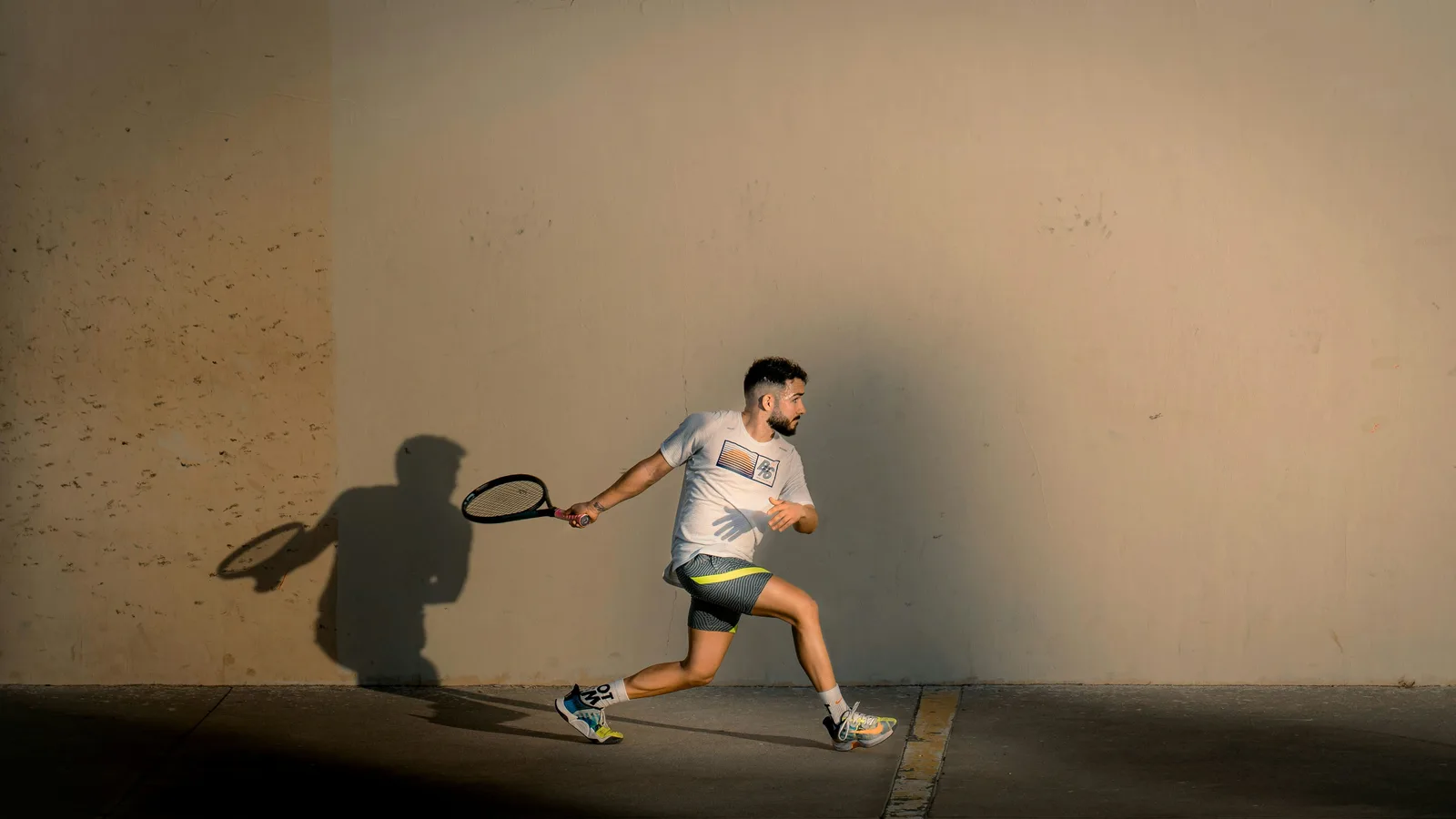
The shoulder did not go on the serve that hurt. The hip flexor that finally tightened up for good last Tuesday did not pick a random ball to do it on. The knee that has started telling you about it on the drive home is not telling you about that morning's session. None of these are the moment they appear to be.
Tennis injuries that arrive cleanly out of nowhere almost always have a pattern behind them. You cannot see the pattern from inside the rally. By the time the injury arrives, the pattern has been writing itself, with the patience of Sinner-Zverev backhand cross court rally. The Hidden Habits piece we ran earlier in the year made this argument at the level of categories: poor rest, ignored signals, moving badly under repetition. This piece is the next layer down. It names the four specific movement patterns that show up most often, in most players, on the road to most of those injuries.
None of these patterns will cause a problem on the day. That is the point. They are diagnostic precisely because they look unremarkable in the moment, accumulate quietly across sessions, and concentrate the load on the structures least equipped to absorb it.
1. Off-balance hitting
What it is, mechanically: the player hits while the body is still moving laterally or backwards. The outside foot has not planted before contact. The trunk is laterally flexed, the spine is in side-bend, and the swing fires through a body that has not stopped moving yet.
Where it shows up most: wide balls to the forehand side at club level, where the player reaches and hits in one motion rather than planting and hitting. Also on the running backhand from a player who learned to "get to" balls but never to "set up to" them. And on stretch volleys at the net, where the chest is leaning away from the body's centre of mass at the moment the strings touch the ball.
What absorbs the cost: the lower back and the hip on the outside leg. The trunk muscles that should have been stabilising the spine are instead generating the swing, because the legs failed to do their job first. Over weeks, the QL and obliques take a load they were not designed to take. The hip flexor on the loading side gets short and tight because it has been doing what the glute should have been doing. The shoulder, asked to swing through an unstable trunk, develops the impingement pattern that may not show up on serves but turns up on overheads.
Why it is invisible: the shot went in. The contact felt awkward but the ball cleared the net. The player walks back to the baseline thinking they got lucky on a hard ball, and does not register that the cost was paid even though the outcome was good. Outcome obscures cost, in tennis as in most other things.
2. Inefficient recovery
What it is, mechanically: between shots, the player recovers to the wrong position, on the wrong line, or with the wrong body orientation. Often all three. The recovery is reactive (chase the ball, then chase back) rather than predictive (read where the opponent can hit, recover to the bisector of those angles).
Where it shows up most: after a wide ball that has pulled the player off the court. Instead of returning to the bisector, the player drifts back to centre by reflex, which is the wrong position for the next shot. Or recovers facing the wrong way, chest open to the side they just hit from rather than loaded for the next direction.
What absorbs the cost: the knee and the Achilles, repeatedly. Every poor recovery means the first step toward the next ball happens late, which means the deceleration into the next contact also happens late, which means the joint absorbs force at a worse angle than it should have. Across a season this compounds into the kind of knee soreness that "wasn't there last year" and the Achilles tightness that takes longer to warm up each month.
Why it is invisible: recovery is not what players watch on their own footage. They watch the shot. Most players have a relatively accurate sense of their own forehand and a wildly inaccurate sense of how they move between shots, because they have never seen themselves do it. The cost shows up two shots downstream, and by the time the bad shot arrives, the recovery that caused it has been forgotten.
3. Late positioning
What it is, mechanically: the player arrives at the ball after they should have, which means the unit turn happens at or after the bounce, which means the racket is still being prepared when the swing should already be unfolding. Contact happens behind the front hip rather than in front. The body is still in motion toward the ball at the moment the strings touch it.
Where it shows up most: every deep ball at any pace. Also any ball the player decided to play after a fraction of indecision. Returns of fast first serves where the player reacts to the bounce rather than to the toss. Drop shots they sprint forward for, hit while still moving, and recover from off-balance.
What absorbs the cost: the shoulder, the elbow, and the lumbar spine, in that order. When the legs have not arrived in time, the upper body generates the shot alone. The kinetic chain that should have transferred force from the ground up is instead trying to manufacture force from the trunk down, which is biomechanical accounting that always comes back around. The serve player who has stopped using their legs into the toss develops the shoulder problem that the player who still loads through the legs does not.
Why it is invisible: late positioning feels like working hard. Exertion is read by the player as effort, and effort is read as virtue. The player thinks they are scrapping for balls. They are, but they are scrapping because they did not start moving early enough, not because the ball was genuinely beyond them.
4. Compensations under pressure
What it is, mechanically: under match pressure, the player reverts to a smaller, safer version of every stroke. The swing shortens. The legs stop contributing. The serve or forehand becomes arm-only. The backhand is hit while leaning back rather than transferring forward. The first step is delayed by half a beat because the body is being managed defensively, not athletically.
Where it shows up most: 4-4 in the third. The break point against. The first match after a week off. Any moment when the player is more aware of the consequence of the next shot than of the shot itself. The mechanics that worked beautifully in the warm-up disappear, replaced by something tighter, more vertical, more reliant on the arm.
What absorbs the cost: the shoulder and the elbow, both, repeatedly. This is where the long-term overuse injury concentrates, because this is where the kinetic chain reliably breaks down. The player who serves with their legs for an hour and then serves arm-only for the eleven crucial points at 5-5 in the second is doing the equivalent of writing with their bad hand at the end of a long page. The cost is concentrated on the structures that were never supposed to bear the load alone.
Why it is invisible: the compensation is what feels safer. The arm-only serve feels like control. The shortened backhand feels like reliability. Under pressure, the body negotiates with the brain to produce a stroke the player believes they can land. Both parties get what they wanted on the day. The structures that paid for the negotiation send the bill three months later, in the form of an elbow that hurts while hurriedly taking out the trash as the garbage truck edges toward the house for its weekly pickup.
Why these four, and not others
These are not the only patterns that hurt tennis players. They are the four that show up across the largest number of club players, with the highest frequency, and whose costs concentrate on the joints and structures that are hardest to rehab and most disruptive to a season. Saša Jezdić, the sports physiotherapist who has worked across the ATP and WTA tours, has talked about how injury patterns at the top of the game are usually three or four mechanical habits the player has lived with for years, finally finding the structure they can damage. The same four patterns reappear in club tennis, just at lower pace and with a longer time horizon.
The reason they are diagnostic, rather than just descriptive, is that each one is fixable in coaching terms. None of them requires more strength or more flexibility, although both help. They require the player to see the pattern, name it, and then deliberately interrupt it across enough sessions for the new pattern to outweigh the old one. That is coaching territory, not gym territory.
Get a pro to spot these in your game
The hardest part of this work is that all four patterns are invisible to the player who is producing them. The body is doing what it has trained itself to do, and the conscious mind is busy with the ball. The single most useful intervention you can make is to have an outside eye name which of the four is costing you the most, before you commit a month of practice to changing it.
Upload a clip at allcourt.club/intake and a touring pro from the All Court network will watch your movement specifically, across two or three rallies, and tell you which of these four patterns is showing up most often in your game. Most players are surprised. Almost nobody guesses right about themselves.
What this is for, in the end
The injury that arrives without warning was being written, in legible handwriting, for months before it appeared. The four patterns above are some of the most common sentences in that handwriting. Naming them does not mean you have to fix all of them at once, or any of them on your own. It means the next time something quietly starts to ache, you have somewhere specific to look before you assume it came out of nowhere.
It rarely does.
Related posts
Playing tennis for life: how to stay on court as you get older