Alcaraz 7-6, 4-6, 6-1 Michelsen: the Japan Open round-one stats
Carlos Alcaraz beat Alex Michelsen 7-6, 4-6, 6-1 in the first round of the Japan Open on 1 October 2026. A short stats breakdown: one number did almost all the work, and the data the public feed doesn't show you.


Carlos Alcaraz began his defence of the Japan Open on Thursday with a 7-6, 4-6, 6-1 win over Alex Michelsen on the Coliseum court in Tokyo. Alcaraz is the world number three. Michelsen is a 22-year-old American ranked 34, his career high. The match took almost three hours. On most of the published numbers the two players were close. On one number they were a long way apart. That is the number that decided it.
First serve
A player’s first serve is their most important shot. It is the shot they are allowed to miss once before losing a point, so most players hit it as hard as they can. If a lot of first serves land in and win a lot of points, the player holds easily and the opponent is defending for most of the match.
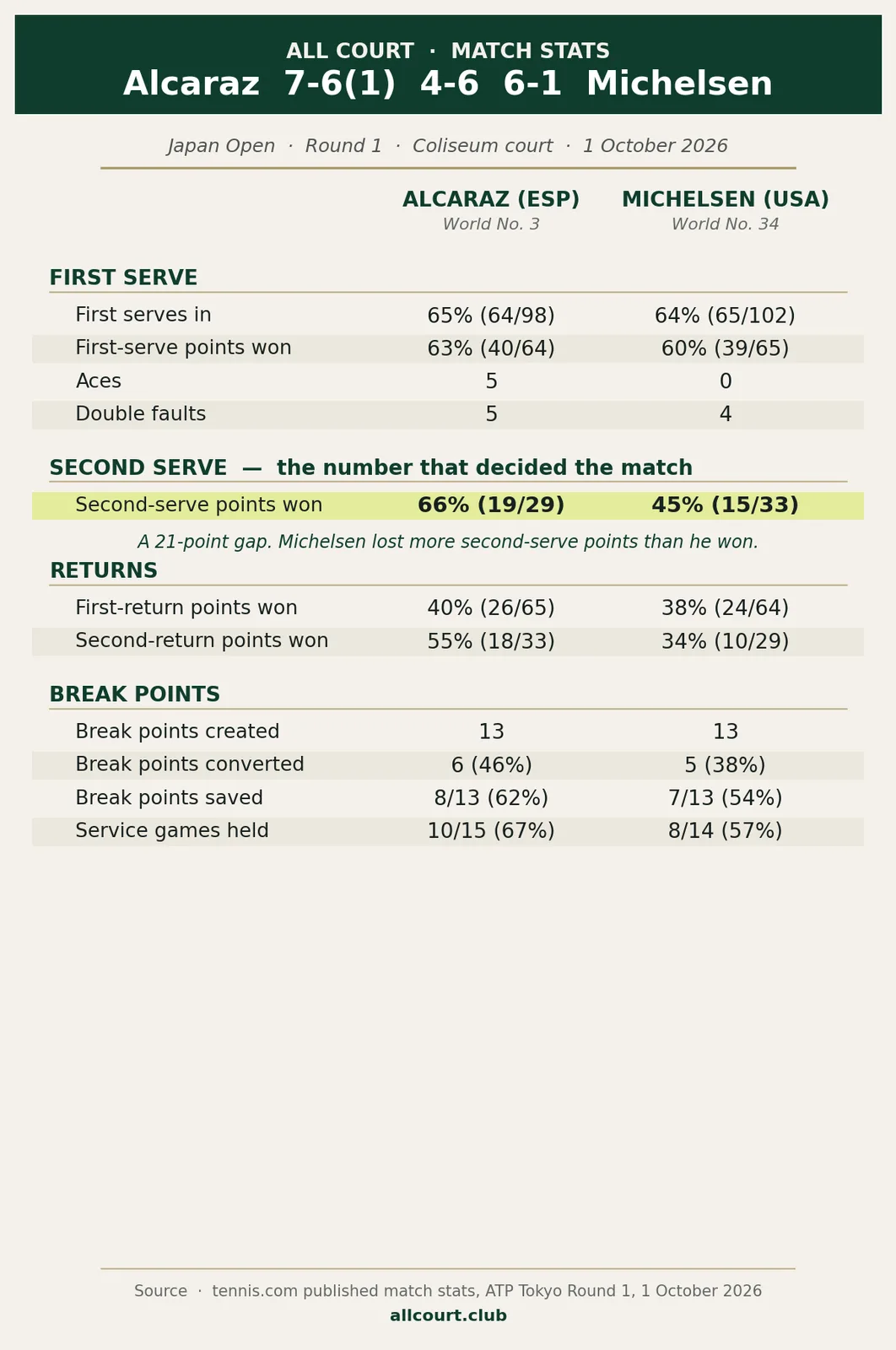
Michelsen landed slightly more first serves than Alcaraz (65 of his 102 to 64 of 98) and won almost as many points from them (60 per cent to 63). The difference on first serves was the aces column. Alcaraz hit five aces. Michelsen hit zero across 102 attempts. For a big server like Michelsen that is a surprising data point. His first serves found the box. They did not find the places in the box that ended the point immediately.
Second serve
When a player misses their first serve they get a second one. They almost always hit it slower and safer than the first, so the opponent has a chance to attack. If a player wins the majority of their second-serve points they stay in the match. If they do not, they lose it.
Alcaraz won 66 per cent of his second-serve points. Michelsen won 45 per cent. That is a 21-point gap, and it is the only big number in the match. It means that every time Michelsen missed a first serve, which happens to every player a third of the time or so, he was then more likely to lose the point than win it. Alcaraz, in the same situation, was winning two thirds. In a three-set match played between two players who are otherwise close on serve, the second-serve gap did the work by itself.
Break points
A break point is a chance to win the opponent’s service game. Break points are the points that decide tennis matches, because almost everything else is a hold of serve by the server.
Both players had 13 break-point chances. That is a lot in a three-set match and it tells you both players were constantly under pressure on serve. Alcaraz converted six of his 13 (46 per cent). Michelsen converted five of his 13 (38 per cent). The difference is one extra conversion by Alcaraz. That is the margin of the match in a single number: Alcaraz earned one more break of serve and the pressure he put on Michelsen's second serve, as shown by the stats, contributed to that.
Alcaraz also saved slightly more of the break points Michelsen earned (eight out of 13 to seven out of 13). So on both sides of the net, Alcaraz was just better under pressure.
The sets
Alcaraz won the first set 7-6 after taking the tiebreak 7-1. He lost the second set 4-6 after being broken back late. He won the third 6-1 as Michelsen stopped winning his own serve and from what we saw when watching the match, he legs fatigued as Alcaraz kept the returns deep and Michelsen couldn't find an ace. The pattern that runs through all three sets is the second-serve number above. When the match was close in the first two sets, it was close by small margins. When Michelsen’s second serve finally stopped holding up in set three, the scoreline was 6-1.
What the public stats do not tell you
The numbers above are all the published match statistics for Alcaraz v Michelsen that tennis.com and the ATP Tour website release to the public. They are good numbers but don't tell the full story transpiring at court level or why those numbers are occurring.
They do not tell you how far either player ran or the amount of foot strikes to the approach to the ball and to get back to a recovery position. They do not tell you how many ground-strokes each man hit, how many high-intensity accelerations both players had to go through, when either player’s legs went in the third set, or what the physical cost of 26 break-point rallies looked like on each player’s body. That data exists. It is tracked on wearables and vision systems by both players’ performance teams, and it stays inside the player box.
The All Court Rating, which is the proprietary rating system we are building for amateur players, is the amateur version of that same data. The pro’s entourage sees distance covered, workload, movement quality and shot-level mechanics on every session. We are putting the equivalent in the hands of the club player on footage filmed from the back fence of a public court. If you want to see your own tennis the way Alcaraz’s team sees his, stick with us.