How to choose a tennis racket
There are more rackets worth knowing about than the four brands on the shop wall would suggest, four reader-"types" (that's you) that should determine which one you buy, and one famously painted-over reality at the top of the men's game that explains most of what is wrong with the way club players currently choose.

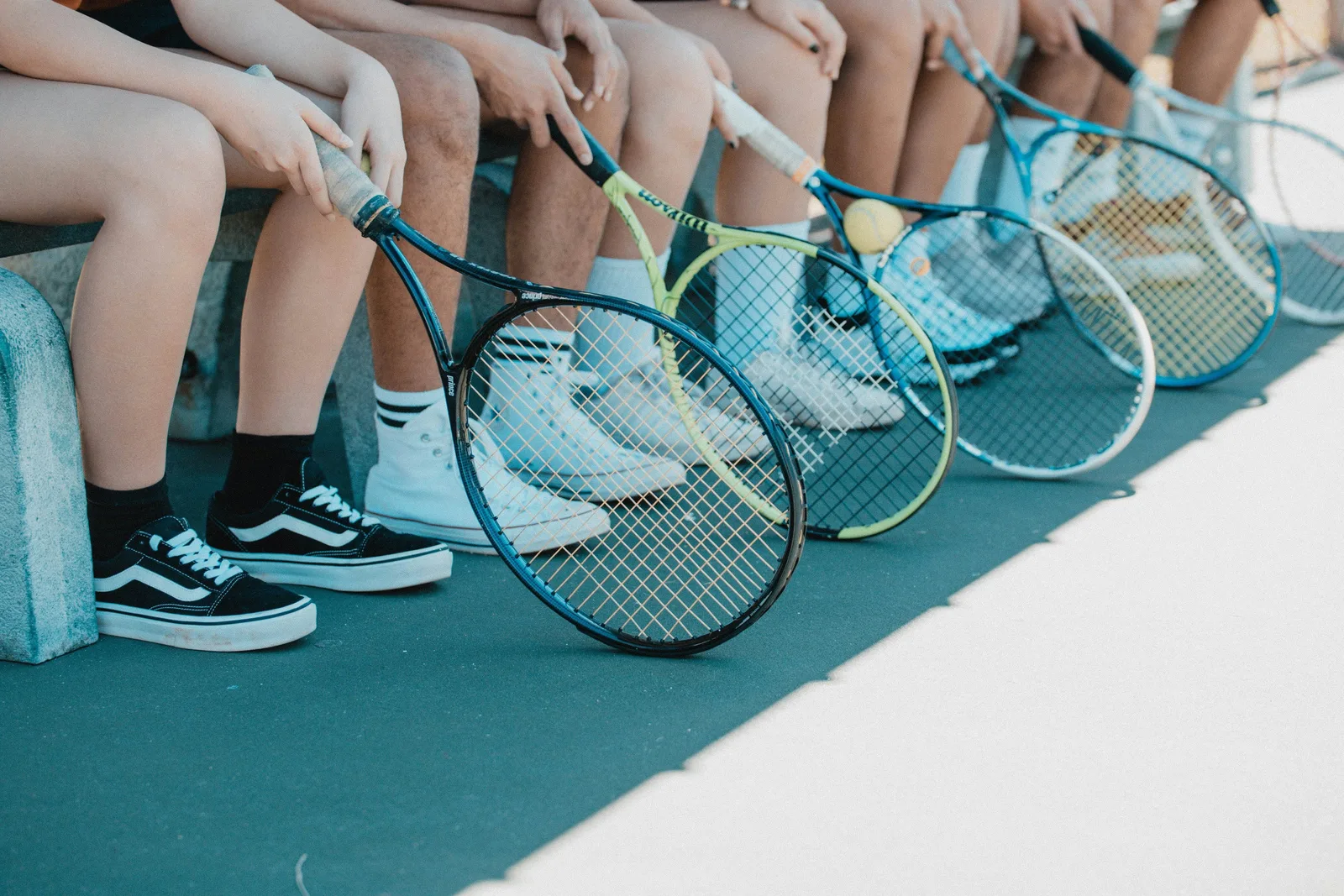
Walk into any decent sporting-goods shop and you will be shown a wall of tennis rackets that, from a distance of more than three feet, are indistinguishable from one another. There will be Wilson, Head, Babolat, and probably Yonex (and maybe Tecnifibre), in that order, arranged by which sponsorship contract is most expensive at the moment. There will be a Federer one, a Nadal one, a Sinner one, and a Swiatek one. There will be a man or woman in a polo shirt who will ask which player you most enjoy watching and then sell you the racket of whichever name you say first. They will not ask what kind of tennis you play, or how hard you hit the ball, or whether your elbow hurts. They will sell you something that costs between £180 and £280, and you will leave the shop believing you have made an informed decision.
You almost certainly have not. Nine in ten club players currently choose their racket between four brands, and the choice they actually make is between sponsorship campaigns rather than between frames. The good news is that the racket you would have bought is, in the broad sense, fine. The better news is that with a small amount of attention to four things that genuinely matter, and an honest answer to one question about what kind of player you are now buying for, you can do considerably better.
The four readers of this article
This is the question that everyone walking into the racket shop is failing to answer for themselves. You are not, when you stand in front of that wall, a generic player buying a generic racket. You are one of four people, and each of you should be making a different decision.
The first is the beginner who has never bought a racket and is trying not to feel out of place at lessons. The second is the player whose game has improved over the past year or two and who is feeling, correctly, that the racket they bought at level one is not quite enough at level three. The third is the player who has been a Babolat man or a Wilson woman for a decade and is wondering whether they have been missing something on the other side of the brand wall the whole time. The fourth, and the most interesting, is the player hunting for a frame that was discontinued in 2009 because they once borrowed it from a college team-mate and have never felt anything quite like it since.
The four things that actually matter
Before we go any further, a sentence on what the dimensions even are, because it is impossible to discuss the four use cases without referring to them. There are roughly four spec numbers that determine how a racket plays: head size, weight, balance, and stiffness. String type and pattern matter as much as anything in this list, but they belong to a separate question covered in our companion piece on strings and tension. There are several other spec numbers that matter less than they sound.
A quick word on the categories the rest of this article refers to. Rackets are broadly split into three families. A player's frame is typically heavier, more head-light, and lower powered, giving advanced players greater control and feedback. A game-improvement frame is generally lighter, more powerful, more forgiving, and often stiffer, helping the player generate depth and pace with less effort. A tweener sits between the two, combining accessible power with reasonable control. In today's market, most rackets sold, and many used at the professional level, fall somewhere within the tweener category, which reflects the modern game's preference for a blend of power, spin and forgiveness. The four dimensions below describe how each family gets to its character.
Head size is the surface area of the strung face. The legacy small frame was 85 square inches (Wimbledon-era Sampras and Edberg were here; McEnroe was on the wooden Dunlop Maxply Fort before him, and famously won the last men's wooden Wimbledon in 1984 on it). The modern small head is 95-97. The "midplus" band, where most rackets sold today live, is 98-105 square inches. Within that band, a frame combining a midplus head with mid-weight and mid-stiffness specs is conventionally called a "tweener", because it sits between a player's frame and a game-improvement one. Anything 106 square inches or larger is in the oversize or game-improvement category, which offers a bigger sweet spot and easier power in exchange for less control and feedback off the strings. Bigger heads forgive off-centre contact and give you more pop on the rough shots. Smaller heads reward clean contact and give you more control when you hit them clean.
Weight is measured in grams, strung. Light rackets sit below 290 grams, mid-weights between 290 and 305, player frames between 305 and 320, and the cult heavy frames push past 325. Heavier rackets produce more pace from the same swing, absorb the opponent's pace better, and demand more of your shoulder over a two-hour match. Lighter rackets are easier to swing and easier to hurt yourself with in the long term.
Balance is where the weight sits along the length of the frame. A head-heavy racket carries its centre of mass towards the strings, a head-light racket towards the handle. The shift is measured from the geometric midpoint of the frame and reported either as a distance in centimetres or in "points", where one point equals one-eighth of an inch (so eight points equal one inch, or roughly 2.5 centimetres). Modern player frames typically sit 6 to 12 points head-light, which is roughly 2 to 3 centimetres of head-light shift from the midpoint, and which gives you control at the cost of needing to generate your own pace. Modern game-improvement frames sit 4 to 8 points head-heavy, which is roughly 1.5 to 2.5 centimetres of head-heavy shift, and which gives you free pace at the cost of control.
Stiffness is what the marketing literature calls a "racket rating" and what the engineers call the RA value. The legacy frames sit around 60-63 on the RA scale, which is forgiving on the arm and quiet through the contact. Modern power frames sit at 70-75, which is louder and more brutal on the elbow and the wrist of a player whose technique has not caught up to the stick. The elbow problems you hear about at your club are, by a margin, problems of frame stiffness and string tension before they are problems of how anyone hits the ball.
That is the toolkit. Now the four readers.
The first racket
If you are buying your first proper adult racket, the single most useful piece of advice is the one the shop attendant will not give you, which is to ignore the player whose name is on the throat of the frame. A nineteen-year-old top-50 professional who hits twenty-five forehand winners in a five-set match needs nothing the same as you do, and the racket they actually play is rarely the racket bearing their name in the shop anyway. Spend a moment with the four dimensions instead.
For a first racket, the right answer is almost always a mid-weight (290-300 grams), evenly balanced or fractionally head-heavy, 100-square-inch frame at a moderate stiffness (RA 65-69). The Wilson Clash 100, the Head Boom MP, the Babolat Pure Drive Team, and the Yonex EZONE 100 are all variants of this same animal. Any of them will be fine. None of them will be uniquely transformative. Try two or three at a demo programme (Tennis Warehouse will send four to your house in the United States; in the United Kingdom the Tennis Bag and Racquet Depot both run good demo schemes), play with each for a fortnight, and pick the one your forehand seems to like best.
What to avoid: the heavy player frame in the Sampras tradition, because you do not yet have the strokes to make it useful and you will hurt yourself swinging it on the move; the over-light power frame at 280 grams or less, because it will dominate your arm with vibration; and the racket your friend at the club says is the only one to play because it changed his game, because his game and your game are not in fact the same game.
The upgrade
The player who has improved since their last purchase has different problems, and we treat this reader in much more depth in our companion buyer's guide for the intermediate-to-advanced player, which covers pro voices, string setups, and the swingweight spec most upgraders ignore. They have started winning matches and are now noticing that the things they want to do, harder spins, more bite on the slice, an actual second serve, are being limited by the racket they learned on. The honest answer to this reader is that they are now ready to give up a small amount of forgiveness in exchange for more control and a slightly better-feeling ball off the strings.
The traditional upgrade move is a step down in head size (from 100 to 98), a step up in weight (from 290 to 300-310 grams), and a move toward frames that prioritise control and feedback over easy power. The Wilson Pro Staff 97, the Head Prestige MP, the Yonex Percept 97 (the current name for what used to be the VCORE Pro line), and the Babolat Pure Strike 98 are the obvious candidates. Each will demand more of your timing and reward more of your good shots, and the trade-off is real: you give up some margin on the mishits in exchange for a higher ceiling on the well-struck balls. The other path, which more players take than the racket-shop literature would admit, is to stay within the tweener category but move to a heavier and more head-light tweener. The Wilson Blade 100 in its 16x19 pattern and the Head Boom Pro are good examples. Both let you keep the larger sweet spot while adding the head-light balance and feel of a more demanding frame. Either path is what upgrading actually means at the level of physics, and either path is why the first three sessions on a new frame tend to feel harder rather than better. The difficulty in those early sessions is usually the adjustment rather than the frame itself, and it tends to settle within a fortnight.
One thing worth doing if you can: demo the candidates rather than buying on instinct. The instinct that drives an upgrade is often less about how the frame will actually play than about how you would like it to play, and two weeks on each demo will tell you which of the two is closer to the truth for your game.
The brand switch
If you have been playing Babolat for fifteen years and are wondering whether you should try a Wilson, the honest answer is that you probably should not bother. The big four brands have, between them, built rackets in roughly every spec combination available, and the Wilson equivalent of your Babolat exists. It will feel different at first, the way a new pair of shoes from a different maker feels different on the first walk, and after a fortnight you will play roughly the same tennis on it.
The brand switches worth making are the ones that move you out of the big four entirely. If you have been on a Pure Aero for ten years and have developed the elbow problem that the Pure Aero is known to give to club players who have not also developed the swing for it, the switch to a Pro Kennex Ki Q+ Tour, with its kinetic vibration-damping mass, will probably help. If you have been on a Wilson stick and have always preferred control to power but have spent every winter wishing the ball came off the strings with a little more bite, the move to a Yonex VCORE or a Volkl V-Cell is a real move rather than a marketing move. The point of brand switching is not to find the better brand. It is to find the spec your current brand does not make.
The other reason to switch is the one almost nobody admits: aesthetics. If a Mantis 305 in the matte black and yellow finish makes you happier to walk on to the court, that is reason enough on its own. Tennis is a long game and morale matters at every level of it.
The hunt for a discontinued frame
This reader has been thinking about a single racket for ten years. They borrowed a Wilson K Factor Six.One Tour from a college team-mate in 2009 and have never quite played as cleanly on anything since. They bought a Head Liquidmetal Radical at university and have spent the past decade trying to find one in unbroken condition. They saw a Prince Original Graphite Mid in a glass case at a club in Belgium and have not been able to think about anything else.
You are not alone, and there is a small industry of dealers and forums dedicated to people like you. Holabird Sports in Maryland keeps a deep used-frame inventory that turns over slowly. Tennis Warehouse runs a used-rackets section and a trade-in programme that produces the occasional gold. The classifieds at Talk Tennis (the Tennis Warehouse forum) are where the cult frames change hands at honest prices among people who actually know what they are buying. eBay is where they change hands at less honest prices. If you find a frame you love in playable condition at under £200, you are doing well.
What to be honest about: the frame you remember is not necessarily the frame the shop will sell you. Frames flex differently when they age, particularly the older graphite-Kevlar composites. The Wilson Pro Staff Original 6.0 85 that Sampras played in 1995 is a different stick from the one you buy on eBay in 2026, and not only because the strings have changed since. The romance is real. The exact reproduction of the romance, less so.
Paint jobs at the top of the game
It is worth knowing, before you choose your next frame, what the rackets your favourite players are actually using. The short version is that for most of the past forty years they have not been the rackets the marketing department would have liked you to believe.
Pete Sampras played the Wilson Pro Staff Original 6.0 85 from his early teenage years until retirement, and every endorsement frame Wilson released bearing the name Pro Staff or Sampras during the back half of his career bore essentially no mechanical relationship to what he was actually swinging. His stringer Roman Prokes, who has strung more US Open finals than anyone alive, has said publicly that everyone in his camp tried to push Sampras to a larger frame because the old 85 felt brutal on his arm by his thirties, and that Sampras refused, and that he only switched after retirement because his elbow had had enough.
Maria Sharapova spent the early part of 2010 playing what tennis press at the time strongly suspected was a Head frame disguised under a Prince paint job, before openly signing with Head later that year and switching publicly at the 2011 Australian Open. The polite way to phrase what she was up to is that she was working through a transition. The accurate way to phrase it is that the on-court frame and the on-billboard frame had stopped matching for several months before the announcement caught up.
Andre Agassi played a Head Radical Tour 260 Trisys, the so-called Bumblebee in its original yellow-and-black livery, his entire career. Each year Head released a new Radical with a new colourway and a new top-line spec, and each year Agassi continued to play the same frame underneath the new paint. He is at his most generous on the subject in Open, his autobiography, where he writes about his racket as something he has rebuilt so many times that the question of whether it is the same object is open. The actual frame underneath the rebuilds did not change for fifteen years.
Roger Federer is the partial counterpoint. He played the Wilson Pro Staff Original 6.0 85 as a junior, moved to the nCode Six.One Tour 90 for the bulk of his prime, and then in mid-2014 co-developed and switched to the Wilson Pro Staff RF97 Autograph, the 97-square-inch racket bearing his initials. This frame is genuinely his frame, with no paint job underneath it. He won the 2017 Australian Open with it. There is, in other words, exactly one signature racket on the men's side of the past two decades that is honestly what it claims to be, and the player who plays it had the leverage to insist on that arrangement only because he had spent twenty years being the most marketable man in the sport.
The lesson, for a club player choosing a frame in 2026: the racket on the wall labelled with a player's name is almost certainly not the racket the player is actually using. Choose for your own game.
The brands worth knowing about that are not Wilson, Head, Babolat or Yonex
The big four (or five if you count Tecnifibre) account for upwards of 90 per cent of professional and club use. The remaining 10 per cent is where the more interesting frames live. They are harder to buy on the high street and they are not advertised on the centre court. Here, in no particular order, are the ones worth knowing.
Mantis, founded in London in 2000, has spent the past quarter-century quietly being the best-kept secret of the British club coaching circuit. Models are named for their unstrung weight in grams (the Mantis 285 is 285 grams, the 295 is 295, and so on up to the 315), the frames have a classical feel without the classical price tag, and they are distributed through independent racket shops including All Things Tennis and Racquet Depot rather than the chains. Greg Rusedski and Heather Watson have both used Mantis frames at points in their careers. They sit in the £100-£180 range, which is roughly half what a Wilson Pro Staff costs new.
Pro Kennex, based in Taiwan and the inheritor of an old joint-friendly damping technology called Kinetic, makes the Q+ Tour series. Players who have had elbow or shoulder problems on stiffer frames often find their way to a Pro Kennex eventually and stay there. The brand is niche enough that even your stringer may not have heard of them, which is part of the point.
Volkl, the German brand whose ski heritage runs to the 1920s, has been making tennis rackets since 1972 and quietly courted Boris Becker as a major shareholder around the millennium. The V-Cell and V-Feel lines are dense-strung classical sticks for control-oriented players. They are the European version of what Pacific (a similar German operation that took over Fischer's racket production in 2009) does for the same audience.
Angell Custom, founded in 2004 by Paul Angell after twenty-five years at Dunlop and Slazenger, makes bespoke frames in the UK. You choose the head size, the weight, the balance, the grip shape, and the string pattern, and they build the frame to your specification. The TC95, TC97, TC100, and TC101 are the standard chassis. They are not cheap (£200-£280), but for a player who knows what their game wants and cannot find it in the shop, they are sometimes the answer.
Vantage, based in Cambridge, does a similar thing at a similar price. The VT series is bespoke down to weight and balance.
Diadem, the Florida-based outfit founded in 2015, is often described as the last American tennis brand standing. The Nova line is power, the Elevate line is control. They are not yet broadly distributed in the UK but Holabird and direct ordering both work.
Solinco, the American string house, started making rackets in 2022 under the Whiteout and Blackout names. Rajeev Ram has played them. The Bryan brothers, since their retirement in 2020, have endorsed the Blackout 300 XTD. The frames are good in the way the strings are good, which is to say: built by people who know what string does inside a racket.
Toalson, the Japanese string-and-racket maker founded in Kobe in 1956 and now based in Oita Prefecture, is primarily a string house with a small racket line on the side. The strings, the Mugen multifilament for comfort, the Asterista synthetic gut for hybrid setups, the Rencon Devil Spin co-poly for spin, are quietly respected by stringers who know what they are looking at. The frames are fewer in number but include genuine player rackets: the Forty-Love at 98 square inches and 305 grams, which Tennisnerd called "probably the most arm friendly player's frame" it had tested, and the S-Mach Pro 97 at 295g and 310g. Sven Groeneveld, the coach who has worked with Sharapova and Murray among others, has been the global ambassador since 2015, which is roughly the level of pro endorsement Toalson seeks. No top-100 ATP or WTA player currently plays Toalson, which is part of the point. In the UK, Racquet Depot stocks them; elsewhere they take some hunting.
Dunlop's performance catalogue runs across three lines: the CX (control), the FX (power) and the SX (spin). The headline ATP names, Jack Draper and Alexei Popyrin on the FX and Miomir Kecmanovic on the SX, are all on the bigger-hitting lines, which leaves the CX 200 and the CX 200 Tour 18x20, the control-oriented player frames in the range, without a marquee face. That absence is part of what makes Dunlop quietly excellent value at the player-frame end. You can get a control frame at a slightly lower price because the marketing department is busy elsewhere.
Slazenger, the British heritage brand carried into four Wimbledon semi-finals by Tim Henman in his Slazenger Pro Braided era, has retreated out of the performance market entirely in the past decade. The current adult lineup is entry-level aluminium and composite frames (the Razor at 100 square inches, the Smash at 105, the Volt, the Classic) sold through Sports Direct, Argos and the other Frasers Group channels rather than dedicated tennis shops. They will get a beginner on court adequately and with much less cash outlay. They are not a serious choice for a competitive frame, and a player who has read this far in the article is unlikely to be in the market for one.
Donnay, the Belgian brand founded in 1910 and made famous by Björn Borg through his 1970s Wimbledon era, exists today in a series of revivals that the brand-history-respecting player will appreciate and the brand-loyalty-suspecting player will read past. They are not a serious choice for a competitive frame in 2026, but they are a serious choice for the romance of one.
The string question, very briefly
String choice and tension are responsible for roughly as much of the playing feel of a racket as the frame itself. The frame is the chassis and the string is the engine. We have an article coming on this site about how to choose strings and tension separately, and the short version is that the rougher the string and the tighter the tension, the harsher the racket will play, no matter what the frame is doing. If you have already chosen a frame and the ball is not coming off the strings the way you want, change the string before you change the frame.
What to do with all of this
Choosing a tennis racket honestly is, at the end, a question of being honest about which of the four readers you are. The beginner who buys a Federer Pro Staff because they like watching Federer is making a different mistake from the upgrader who refuses to demo, and a different mistake again from the brand switcher who switches without diagnosing what they actually want, and a different mistake from the discontinued-frame hunter who pays £450 on eBay for a frame the cracks in which are not yet visible.
None of these mistakes will ruin your tennis. All of them will produce a slightly worse version of the next two years of it than was on offer for the same money.
If you would like a touring pro to watch you play and tell you which of the four readers you actually are, and which frame and which string would actually fit the game you have now, the All Court waitlist is the way in. Access is being released in batches, and what comes back when your turn arrives is specific, in writing, and aimed at the parts of your game that the racket on the wall would not, in fact, have helped.
The wall of rackets is not a wall of tennis. It is a wall of dreams and aspirations, most of which will not survive contact with a forehand. Choose the frame for the player you are. The polo-shirted shop attendant will not mind.
Related posts
The reset Raducanu got right at Queen's, and the one she did not get to in time