Why no one can agree on your tennis level, and how to read the one that matters
One amateur who has moved between the US, France, Germany and the UK can end up with five different tennis ratings that do not speak to each other. The five systems, the limit that all of them share, and the one number that captures how most people play tennis.


There is a specific bad afternoon that happens to every amateur tennis player who moves countries. You have found a court in a city that is not the city you last had a ranking in. You have arranged a hit with someone whose game you do not yet know. Racquet in the boot, jacket on, out into the cold, twenty minutes to the venue, five minutes of small talk on the walk to the court. Then the question. What's your level?
It sounds like a question. It is a small crisis. An amateur who grew up playing in the US, took a detour through Berlin, spent a year in Saint Germain trying to be a writer and abandoning it, then hunkered down in London, could be a 4.0 under the USTA's NTRP system, a 7.5 on the Universal Tennis Rating, a 20 on the ITF's World Tennis Number, a 15/4 in France and an LK-12 in Germany. Five numbers, each of them may be arithmetically correct. None of them speaks to any of the others. All five, as we will see, share a deeper problem: they only mean anything if you have played a lot of ranked matches under the institution that awarded them. Most people who play tennis have not or don't care to play tennis that way.
Five systems, five different answers
NTRP. The National Tennis Rating Program, USTA-run, American. Scale 1.5 to 7.0 in half-point increments. Started as a self-assessment (you read the descriptions and picked the one that sounded most like you) and gets adjusted upward or downward by the USTA over time on the basis of your competitive results in sanctioned league play. NTRP decides which flight of USTA league you can enter next season. If you play American leagues, it is the only rating that decides anything. If you do not, it is a language nobody at your club is speaking. Current guidance is in the USTA's own explainer.
UTR. Universal Tennis Rating. Scale 1.00 to 16.50, algorithmic, calculated from your actual match scores and weighted by the strength of the opponent and how recently you played them. Most competitive recreational players sit between 4 and 9. Top touring men pros sit above 13 and women tour pros above 11. UTR is not owned by any national federation, which is either its strength or its limitation depending on what you want the number for. As a global comparison, it is the best we have and is heavily used particularly in US College tennis. Full algorithm at Wikipedia. Under twenty rated matches, though, the number can carry wide error bars.
WTN. ITF World Tennis Number. Scale 40 (beginners) down to 1 (top recreational), and "Pro" for anyone with an ATP or WTA ranking. Backed by the ITF directly. In Britain, WTN replaced the old LTA rating (10.2 down to 1.1) as the official system on 28 April 2025. The transition is complete. Your old LTA number still exists in memory and on faded club match cards; the number the tournament software reads at the door is your WTN. LTA's own explainer is the source.
FFT. The French Federation runs its own notation, which reads to an outsider like a mathematician's shopping list. Beginners are NC (Non Classé). From there: 30/5, 30/4, 30/3, 30/2, 30/1, 30, 15/5, 15/4, 15/3, 15/2, 15/1, 15, then into the elite bracket at 5/6, 4/6, 3/6, 2/6, 1/6, 0, -2/6, -4/6, -15, -30. Assigned by the Fédération Française de Tennis on the basis of tournament wins and losses. Explainer in English at Tenniscall. If you play tennis in France, this is the only number that gets you into a draw. Outside France it is a curiosity.
LK. Leistungsklasse, the German system. Scale LK 25 (entry-level competitive) down to LK 1 (national elite). Updated weekly by the state association on the basis of tournament and team results. A player entering the DTB-LK system for the first time starts at LK 24 and improves through wins in LK-relevant competitions. DTB explainer in German. If you play in Germany, LK is what the tournament software reads. Outside Germany, it barely surfaces.
Five systems. Five different, correct, non-interoperable answers to the same question.
The problem all five share
The ITF's Global Tennis Report 2024 put the number of people who play tennis worldwide at 106 million, spread across 199 countries. A 25.6% rise on the 84.4 million recorded five years earlier. The report is the biggest survey of global tennis participation ever done.
The vast majority of those 106 million people (more now in 2026 as I write this) do not play enough ranked matches, under any federation's auspices, for their number in any of the five systems above to be meaningful. To have a real UTR you need matches. To have a real WTN you need matches. To move NTRP above the self-assessed floor you need adjusted league results. To have an FFT ranking that decides anything, you need tournament wins. To have an LK that reflects your game rather than the default entry point you need weekly LK-relevant competition. Take away the volume and every one of these ratings is either missing or noisy enough to be worse than no number at all. My physio has a line she uses about knees: an MRI does not have a personality. Nor does a tennis rating. You are not your MRI. You are not your tennis rating, especially if you are playing like most people which is some competitive sets, rallies, training with coaches and hitting partners and fun first-to-eleven point type hits.
Self-rating fills the void, mostly badly. Depending on personality and culture, an amateur is as likely to describe themselves as advanced despite an inability to strike a backhand as they are to describe themselves as a beginner having played competitive juniors twenty years ago. And there is nothing worse in tennis than making the time, finding an available court, sidling out the door racquet in hand, travelling to the venue in the cold, and finding that you are either hitting with an ex-US-college player when you thought it was an intermediate session, or that the ball keeps sailing over the fence from the other side of the net.
The federation systems solve a real problem for the players who compete under their auspices often enough. They do not solve the what's your level question for the hundred million amateurs who do not.
Which one to actually track (if you play enough to bother)
If you do play enough ranked matches to have a real number, the rule is one line. Track whichever rating governs where you want to play.
American leagues: NTRP is decisive. British competition: WTN. France: FFT. Germany: LK. A global comparison unattached to any federation: UTR is the one to log, because it is the only one that may still mean something after your next move. Improvement rather than access: track whichever is calculated from live match play rather than self-assessment. UTR, WTN, FFT, LK and post-adjustment NTRP all clear that bar.
The conversion table
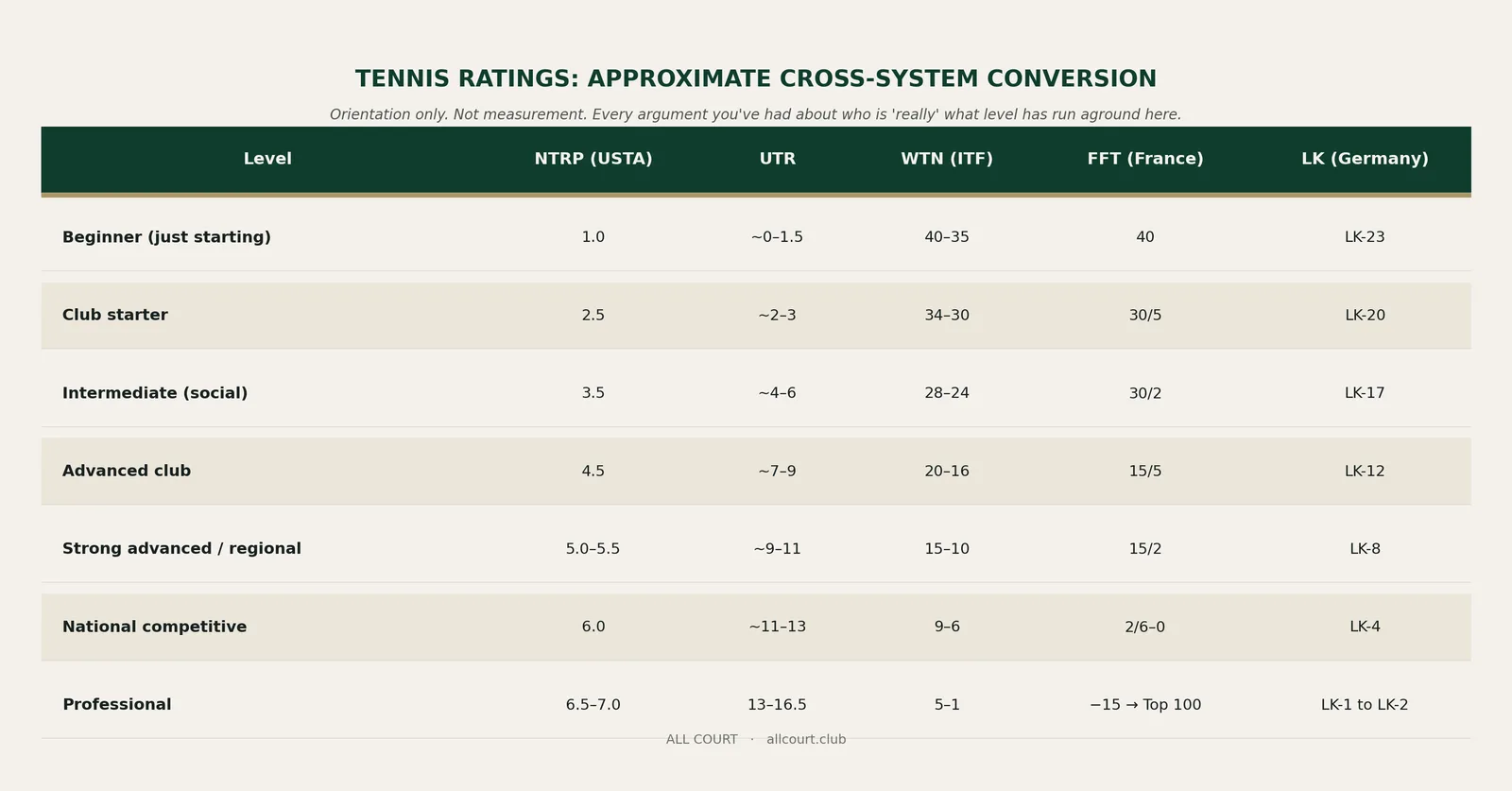
No official conversion exists between the five systems. What follows is our working triangulation, cross-referenced against published guidance from MyTennisRatings, the FFT and the DTB. Every row is an orientation point, not a measurement. Every argument you have ever heard about who is really what level has run aground on this exact ambiguity.
What actually moves any of these numbers
For every algorithmic rating (UTR, WTN, FFT, LK and post-adjustment NTRP), four things move the number.
Winning above yourself. The biggest lever. Beating someone rated well above you moves your number more than beating anyone at your own level. It is the reason ratings-conscious players spend the summer trying to be the lowest-rated player in the highest-rated match they can get into. It is also why sometimes you hear of higher rated players forfeiting matches early if they are down more than the algorithm would expect.
Losing well against someone above yourself. A close 6-4, 7-5 loss to a player rated a full point higher can move you upward, because the algorithm reads that scoreline as a competitive account of yourself against a stronger player. If you never get on court with players above your level, you never improve your rating, even if you win everything at your own level.
Recency. All the algorithms weight recent matches more heavily than older ones. A number from six months ago tells you what you were doing six months ago, not what you will do on Thursday.
Volume. Ratings built on twenty-plus matches are far more reliable than ratings built on five. If you play three tournaments a year, your number is noise dressed up as information. If you play thirty matches a year, your number is telling the truth.
The karate-belt problem, and what tennis is missing
Every one of the five systems above rewards volume. Play more ranked matches, get a truer number. It is a reasonable design for the competitive minority. For the other hundred million plus people who are actually holding a racquet, it produces a ratings vacuum, and a self-rating culture that is worse than useless because it dresses inaccuracy up in confidence.
What tennis actually needs is a scorecard. A tennis ID that follows the amateur around and lets them progress. A tennis passport the amateur can pull out and hand to the coach or the hitter across the net. Karate figured this out generations ago. A karate belt is structured, respected, portable, and does not require the holder to enter a competitive fight to be graded. Millions of amateur martial artists walk into a dojo carrying a rating that means something wherever they go. Tennis has never had that.
An All Court Rating without ever entering a ranked draw
Every rating in this piece requires you to play a large volume of competitive sets under a specific federation's auspices to give you a meaningful number. One reason that All Court exists is to give the amateur the rating that has been missing from the sport: one that lives on your phone, moves with you regardless of federation, and depends only on whether you play, not on whether you play a lot of ranked matches. You put your phone against the back fence, film a session, and upload it. You get a "talking head" session inside your own video from a touring professional because it's not just about a number but about working through a performance plan. Plus the AI-enabled platform compares those ratings against thousands of shots from hundreds of players graded by the same touring pros and elite coaches. The output is a personalised coaching session on your footage and an All Court Rating for each shot you hit and a cumulative All Court Rating that compounds every time you film more of your play, so that you can see which parts of your game are improving and which parts a stronger opponent would attack, without ever having to enter a ranked tournament to prove it. There is no nominator, no joining fee, and no waitlist that closes inside a generation. Join the waitlist at allcourt.club/join.
This piece grew out of a note I put on LinkedIn earlier this year.
Related posts
The Slams are out on their own. Nineteen players just put it in writing.