The Roland Garros experience most people miss
Centre Court tickets are the easy part of going to Roland Garros, and the least interesting one. Here is what tennis fans who have done the trip a few times actually do with their day.


Roland Garros has nothing to prove. Of the four Grand Slams, it is the one most comfortable in its own skin. Wimbledon performs its own tradition for the cameras. The US Open performs its own scale. The Australian Open performs its own holiday. Roland Garros, in late May into early June, just opens its gates, lays out the clay, and trusts that the people who care about tennis will find their way in and arrange themselves around the matches. The tournament does not court its visitors. It expects them to come into its rhythm.
If you are going for the first or second time, the temptation is to spend all your effort getting a ticket to Philippe-Chatrier and treating the day as a Centre Court visit. That is the package the resale market is built around, and it is the package most travel content recommends. It is also, for almost anyone who actually likes tennis, the worst version of the experience available to you.
What follows is what tennis fans who have done the trip a few times actually do with the day. For everything else about Paris itself, the food, the hotels, the left bank and the right bank, see our earlier postcard from the city. This piece is about what happens inside the gates.
The best matches are not on Centre Court
This sounds like the kind of contrarian thing tennis writers say to feel clever. It is not. It is a structural fact about how a Grand Slam draw works.
The first week of Roland Garros has 128 men and 128 women in the singles draws, and on any given day in the first three rounds, the top seeds play perfectly competent matches against opponents they are expected to beat. The matches that actually breathe, the five-setters between two players ranked thirty places apart who both think they have something to prove, the qualifier who is suddenly playing the match of her life against a top-twenty seed, the doubles tie that an entire small country has come to watch, almost always happen on the outside courts.
And on the outside courts, you are close. You can see the tape on the wrist. You can hear the coach. You can watch a player change rackets between points and read what they say to the stringer when the new one comes back. You can sit on a sun-baked terrace at Court 14 with a glass of rosé and watch a tie-break play out in front of you that, on Chatrier, would be ten thousand seats and a video screen away.
The further down the court numbers you go, the more this is true. The major show courts are stadiums. The outside courts are tennis. The visitors who go home talking about how good the tennis was usually spent more of their day on Court 7 than on Philippe-Chatrier.
The practice courts, which most visitors miss entirely
The practice courts at Roland Garros are accessible to anyone with a ground pass, and during the first week, especially the days before the main draw begins, this is where the closest player access of the entire trip is on offer. The world's top players hit on small, fenced courts with maybe twenty people watching, and the people watching are, almost without exception, the ones who knew to be there.
Check the published practice schedule the morning of your visit. Top players tend to hit early in the morning or late in the afternoon, often with a hitting partner or a junior, sometimes with a doubles partner. The intensity is real. You are watching the work, not the show. If you have ever wanted to know what world-class hitting actually sounds like from three metres away, this is the moment.

The last-minute ticket question
Roland Garros has an official resale platform that opens on the morning of each session, and tickets get released throughout the day as ticket holders sell back their unused seats. Refresh the page. Refresh it again. Tickets you did not think were available do appear, especially in the late afternoon as plans change and people decide they cannot stay for the evening session.
Two specific points are worth knowing. First: the night session on Philippe-Chatrier, which Roland Garros introduced in 2021, is a separately ticketed event. People who only want the day session sometimes resell their evening tickets even though those tickets are technically valid for the late match. Watch for that pattern. Second: the ground pass, which gets you everywhere except the three main show courts, is the most undervalued ticket at the tournament. It is also the one that gives you the experience the rest of this piece is about. Buy it directly from Roland Garros if you can. Even on a sold-out day, the ground pass is rarely impossible.
If you are buying through resale, use the official platform. The unofficial market for Grand Slam tickets is large and unforgiving, and Roland Garros, which checks bag tickets against ID at the gate, is the Slam most likely to refuse a ticket that did not come through proper channels.
Pacing the day
A day at Roland Garros runs from about eleven in the morning to ten or eleven at night, sometimes later. That is twelve hours. Almost no first-time visitor paces it correctly.
The mistake is to try to watch everything. The right approach is to plan in blocks. A morning block on the practice courts and the early outside-court matches. A long lunch with a glass of something, taken slowly, somewhere on the grounds where you can see one of the lower courts from your table. An afternoon block on a deliberately chosen outside-court match, ideally one with a player you have not seen play live before. A break in the middle to walk, to look at the bookshop, to sit somewhere quiet for half an hour. A late-afternoon move toward Suzanne-Lenglen or Simonne-Mathieu for the headline match. Dinner, if you have stamina, before the night session.
Wear the shoes that already broke in three weeks ago, not the ones you bought for the trip. The grounds are larger than they look on the map and the surface between courts is mostly hard, hot stone. Carry a refillable bottle. The fountains around the grounds are good. The bottled water in the food village costs what bottled water at a Grand Slam costs.
The food on site has improved meaningfully in the last few years. There is no longer any reason to bring sandwiches. The Village area near Philippe-Chatrier has a rotating set of Parisian operators, and there is decent wine on the grounds at decent prices, which is true of approximately no other Grand Slam.
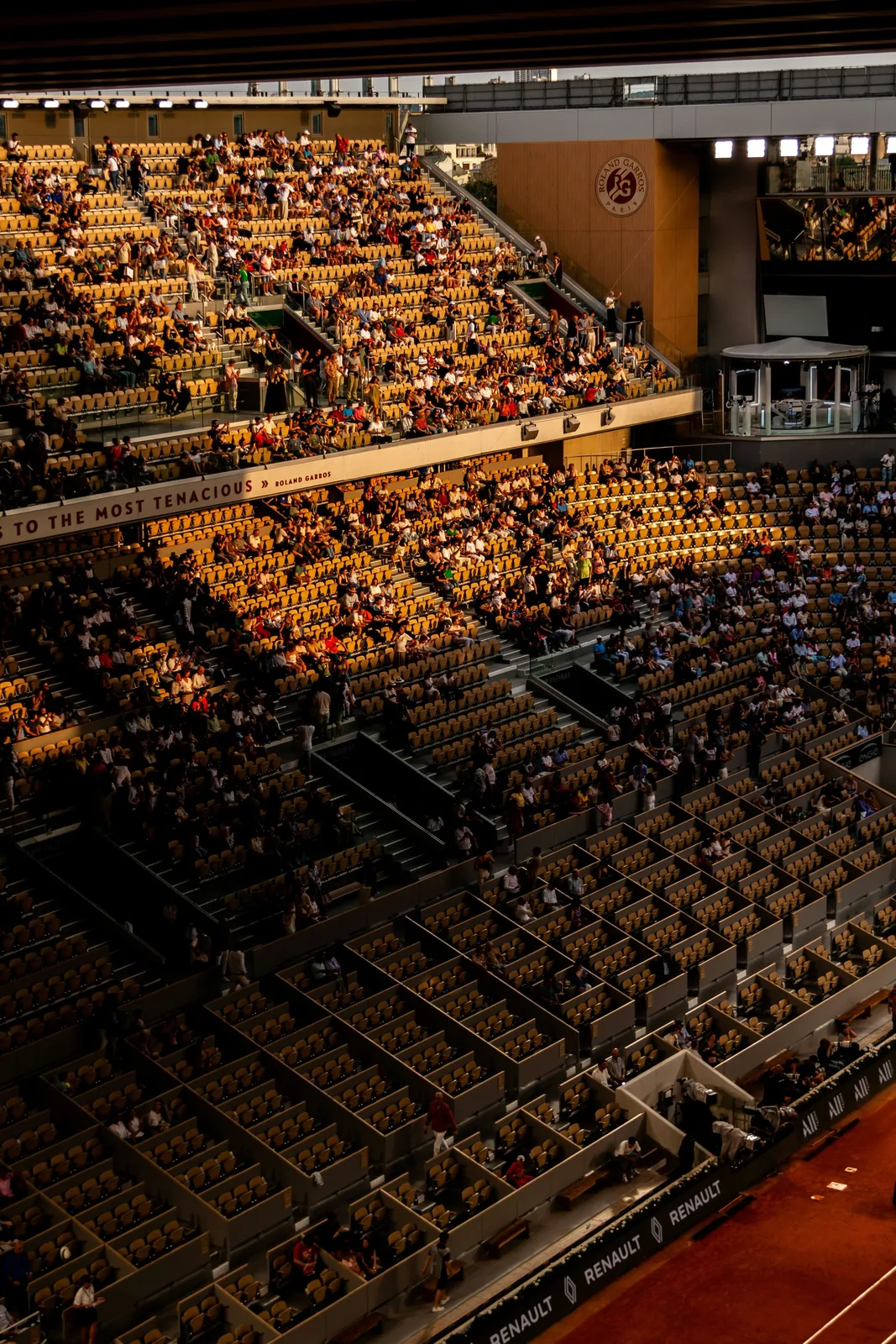
What makes Roland Garros different
The clay is the obvious answer and the partial one. Clay is slower than hard courts and grass, which means the points are longer, the rallies build, the construction of a winner takes more shots than it does at the other three Slams. A spectator at Roland Garros watches more tennis per minute of court time than a spectator anywhere else.
The less obvious thing is the rhythm of the place. At the US Open, fans tend to file in for a session, watch a match, and leave. At Wimbledon, the strawberries-and-Pimm's choreography keeps people moving on a schedule. At the Australian Open, the heat tends to sort the day into sessions whether you like it or not. At Roland Garros, fans stay. They circulate. They move from one outside court to another and back to a show court in the late afternoon. They have an unhurried lunch and an even more unhurried glass of wine. The Parisian habit of treating an afternoon as a thing to be inhabited rather than rushed through translates onto the tournament grounds in a way it does not at other Slams.
The other quiet thing about Roland Garros is the architecture. Philippe-Chatrier, after the 2020 retractable-roof renovation, is a serious modern stadium that still feels like a French civic building. Simonne-Mathieu, opened in 2019, is built inside an actual botanical greenhouse complex on the western edge of the grounds, with four glass walls of plants behind the back of each court. Court 14, smaller and older, has the energy of a French village square mid-rally. None of these are accidents. The tournament thinks about how its venues feel, and you notice the difference once you are inside them.
What this is for, in the end
The reason most people leave Roland Garros disappointed is that they treated it like a sightseeing visit to a major sporting venue. It is not really that. It is a fortnight in late spring in Paris in which the best tennis players in the world are playing on red clay, fifteen minutes from the city centre, in a setting that has been quietly perfected over a hundred years. Treated as such, with the right pacing and the right ticket and a willingness to wander, it is one of the better fortnights the sporting calendar offers.
The other thing worth doing while you are there
One side benefit of spending three or four days at Roland Garros watching live tennis on clay is that you start to notice things about the game you had not noticed before. The geometry of a cross-court rally. How a top-level player builds a point over six or seven shots. Where the contact point lives. What a heavy ball actually looks like in the air, off the court, off the strings. You leave the grounds thinking about your own game in a way you almost certainly did not before you went in.
That is the right instinct. Film a session when you get home and have a touring pro from the All Court network watch it, and the gap between what you thought you saw on the courts in Paris and what you are actually doing on a court at home tends to clarify itself quickly. Most players are surprised by how much of what they admired in the pros is already, in some smaller version, available to them.
The bag check at Porte d'Auteuil
Last practical note. The main entrance security line at Porte d'Auteuil can run thirty or forty minutes at peak, especially on the first weekend of the tournament. The lesser-used Porte des Mousquetaires entrance is consistently faster. If you have a choice of which gate to use, choose that one. The taxi drivers and the city's motorcycle taxi services know it.
Do not bring a backpack larger than the published limit. They will not let it in, and the cloakroom queue is its own kind of opportunity cost.
Otherwise, you are set. Get the ground pass. Find the practice courts in the morning. Pick one outside-court match in the afternoon and commit to it. Leave the show-court match for the late afternoon, if you have the ticket for it, and the night session for after dinner, if you have the stamina. Drink the wine. Walk slowly between courts. Stay late. The tournament is not in a hurry.
Related posts
Where to play tennis during the Italian Open