The reset Raducanu got right at Queen's, and the one she did not get to in time
Donna Vekic won the HSBC Championships women's final 6-0, 7-6(6), but the score is a poor summary of the second set, in which Emma Raducanu changed her game enough to get back into the match and then watched Vekic change hers back.

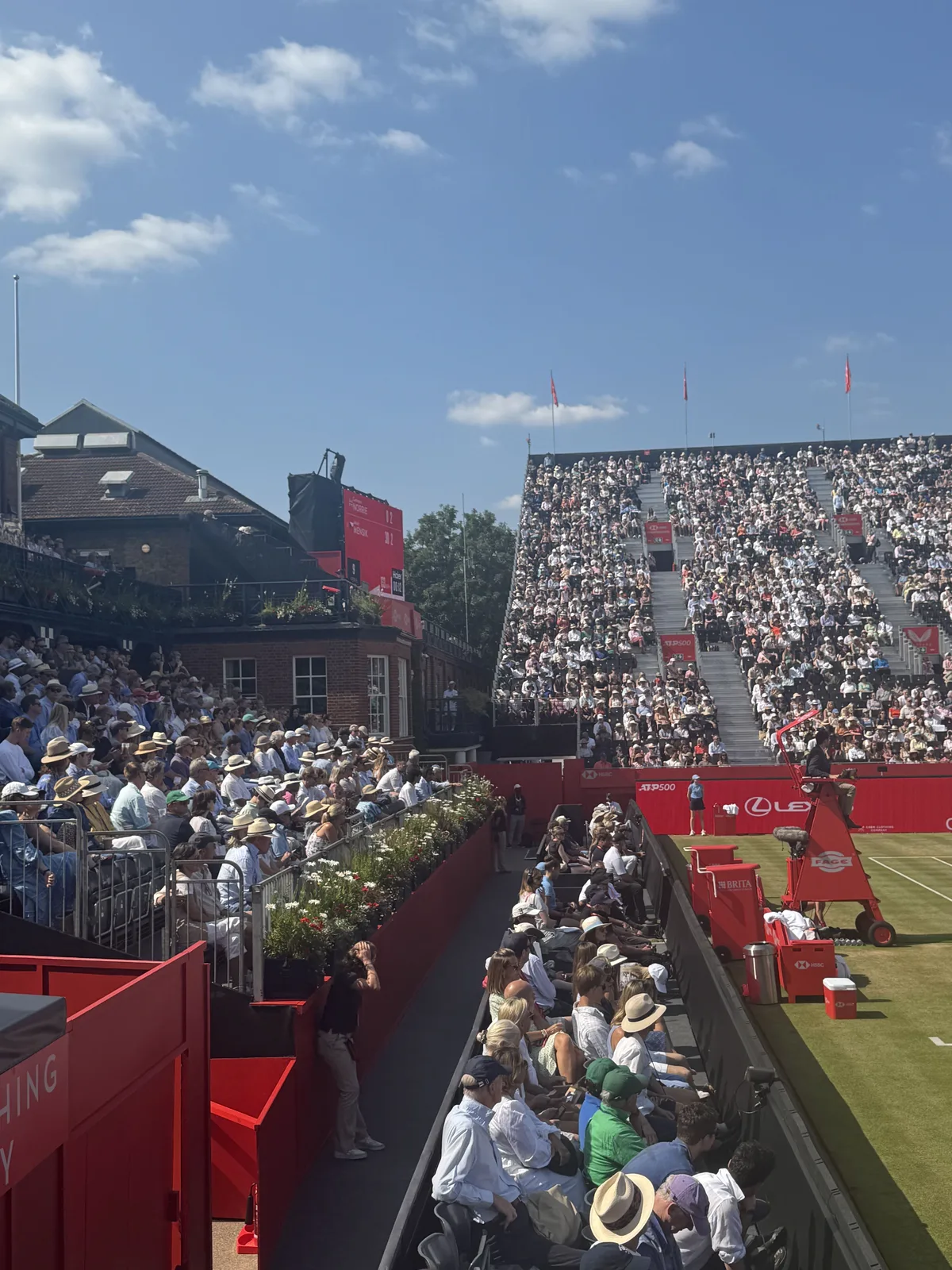
The scoreline of the Queen's women's final reads as a routine straight-sets win for Donna Vekic, and the first set was every bit of that. The second set was not. In the second set Emma Raducanu broke twice, generated 8 break points to Vekic's 4, and was the better player by every measure of point construction that the WTA stat sheet records (see end of this article). She lost the set in a tiebreak after leading 5-2, and the way that lead got whittled back is the more interesting story of the match than the way the first set was lost.
The first set lasted twenty-eight minutes and produced a bagel. Raducanu landed 47 per cent of her first serves, won 50 per cent of those when she did, and faced three break points without saving one. She did not generate a single break point on the other end. The total points went 27 to 12 in favour of Vekic who was hitting cleanly from both wings, kept Raducanu off rhythm with the power baseline pattern that wins her matches at this level, and was 1-0 in sets in less time than some World Cup rehydration breaks. Raducanu, by her own admission afterwards, had not turned up for the start.
How the second set started
The Raducanu who walked back onto Andy Murray Arena for the second set was visibly a different player. The aggressive intent that the first set had not contained arrived in a noticeable way: she stood further forward on return, the ball-toss was settled on serve, and her body language oozed grit, with frequent determined glances up to her box between points.
The specific tactical changes were three, and they were visible inside the first few games. On return of serve, she started floating the ball deeper and more towards the middle of the court rather than chasing angles, which produced a shorter ball on the next shot more often than not. On Vekic's second serve in particular, she took it noticeably earlier and started dictating the point off the first or second shot rather than constructing through a longer rally. And upon getting mid-court balls through a more consistent first and second serve, she began moving forward with intent, often continuing through to the net for the volley rather than playing the half-court approach and recovering to the baseline.
The effect was the breaking of Vekic's rhythm. The clean power baseline pattern that had won the first set in twenty-eight minutes does not work as cleanly against an opponent who is standing further forward, taking the ball earlier, and finishing at the net. Raducanu broke serve once, then again, and was leading 5-2 inside about half an hour of the second set.
The stat sheet reads what the eye saw. Across the second set, Raducanu landed 73 per cent of her first serves to Vekic's 67. She won 71 per cent of her second-serve points to Vekic's 36. She generated 8 break points to Vekic's 4. By the numbers, she was the better player in the second set on serve, on return, and on most things in between.
The two break points that mattered
Vekic, facing defeat in the set and a probable third, converted two of her four break points in the second set. The 25 per cent conversion rate reads like a poor number on paper. The two breaks that the rate produced were not poor breaks. They were the two breaks that closed Raducanu's 5-2 lead, got Vekic back on serve, and forced the tiebreak in which she eventually won the title.
That is clutch tennis in the strictest sense. Vekic was being out-rallied, out-positioned and out-served at the points those break opportunities arrived. She converted them anyway. Raducanu, serving for the set at 5-4 with two set points, did not. Vekic took the next four games. The set finished 6-6 and went to a tiebreak, and the tiebreak went 8-6.
What Raducanu did not do next
The part of the match worth lingering on is what happened between Raducanu leading 5-2 and the set reaching the tiebreak. Vekic, looking at a set slipping away and a likely third on the horizon, reset her own game in the way elite players do when they are about to lose. She started hitting harder. Not different. Just harder. The power baseline pattern that had not been working against a Raducanu who was rushing it began to work again when the pace through the ball came up. The mid-court balls that had been Raducanu's invitation to come forward became balls that punched past her before she could finish moving up.
This was the moment in the match at which Raducanu had her second decision to make. She had reset her game once at the start of the second set, and the reset had worked all the way to a 5-2 lead. Her opponent had now reset her own in response. The question Raducanu had not anticipated, and arguably had not been prepared for in that moment, was what to do when the thing that had been working stopped working.
She held the same strategy. The aggressive intent that had got her back into the match did not change shape when Vekic's response arrived. The variety that might have introduced a new question for Vekic, a slice, a deeper return, a chip-charge, a higher second-serve return, did not arrive. The matching of Vekic's higher gear with her own first-strike power, which she has when she wants it, did not arrive either. The strategy that had pulled her into the lead was the strategy that watched the lead get whittled back.
By the time the set reached 5-5, the match was Vekic's. Raducanu saved three championship points to hold serve and force the breaker, and a fourth in the breaker itself, and the forehand that found the net on Vekic's fifth match point will be the shot she remembers.
What this was not
The fatigue narrative will get written, because Raducanu had played a Saturday doubleheader to reach the final and had two hours and nineteen minutes more on court than Vekic going in. It probably did some of the work in the first set. The bagel was the body. The second set was the player at full tactical capability, generating chances, executing the things her game can do when her game is working. That set was not lost because she was tired. It was lost because the move that won her the first three-quarters of the set was not followed by a second move when her opponent forced one.
The third move
The lesson for any player at any level is that a good tactical adjustment will work until the opponent makes one of their own. The skill that wins matches at the top of the women's game, and at the top of any club competition, is not the first adjustment. It is the second one, made in response to the opponent's response.
When you find something that works against an opponent, expect them to respond. The aggression that broke Vekic's rhythm in the first half of the second set is the kind of adjustment that almost any committed player can make in a particular match. The variety, or the change of gear, or the new pattern that you can pull out of your bag when your opponent has solved your first move, is harder. That is the toolkit the players who consistently win finals have, and it is the toolkit the players who consistently lose them are missing.
If you want a touring pro to watch you play, name the pattern you are running, and tell you what your second response should be when an opponent adjusts to your first, the All Court waitlist is the way in. Access is being released in batches, and what comes back when your turn arrives is specific, in writing, and aimed at the part of your toolkit that is missing rather than the part that is already working.
Vekic deserves the title. She was the more believable player on the court for the duration of the first set, and she was the more clutch player at the only points in the second set that the result depended on. But the more useful match analysis is the one that names the moment in the second set at which Raducanu had a decision to make and did not make it, and the decision Vekic made instead.
The numbers, in full
All statistics from the WTA Match Centre.
Set one: Vekic 6-0, twenty-eight minutes
Aces: Vekic 0, Raducanu 0
Double faults: Vekic 1, Raducanu 2
First serve in: Vekic 59.1% (13/22), Raducanu 47.1% (8/17)
Win on 1st serve: Vekic 92.3% (12/13), Raducanu 50% (4/8)
Win on 2nd serve: Vekic 33.3% (3/9), Raducanu 11.1% (1/9)
Break points faced: Vekic 0, Raducanu 3
Break points saved: Vekic 0/0, Raducanu 0/3
Break points converted: Vekic 100% (3/3), Raducanu 0/0
1st return points won: Vekic 50% (4/8), Raducanu 7.7% (1/13)
2nd return points won: Vekic 88.9% (8/9), Raducanu 66.7% (6/9)
Total service points won: Vekic 68.2% (15/22), Raducanu 29.4% (5/17)
Total return points won: Vekic 70.6% (15/22), Raducanu 31.8% (5/17)
Total points won: Vekic 69.2% (27/39), Raducanu 30.8% (12/39)
Set two: Vekic 7-6(6), one hour twenty minutes
Aces: Vekic 3, Raducanu 1
Double faults: Vekic 1, Raducanu 0
First serve in: Vekic 66.7% (28/42), Raducanu 73.1% (38/52)
Win on 1st serve: Vekic 75% (21/28), Raducanu 52.6% (20/38)
Win on 2nd serve: Vekic 35.7% (5/14), Raducanu 71.4% (10/14)
Break points faced: Vekic 4, Raducanu 8
Break points saved: Vekic 50% (2/4), Raducanu 75% (6/8)
Break points converted: Vekic 25% (2/8), Raducanu 50% (2/4)
1st return points won: Vekic 47.4% (18/38), Raducanu 25% (7/28)
2nd return points won: Vekic 28.6% (4/14), Raducanu 64.3% (9/14)
Total service points won: Vekic 61.9% (26/42), Raducanu 57.7% (30/52)
Total return points won: Vekic 42.3% (26/42), Raducanu 38.1% (30/52)
Total points won: Vekic 51.1% (48/94), Raducanu 48.9% (46/94)
Related posts
Cobolli held the pattern for four sets. The fifth set was a different sport.