Mirra Andreeva and Maja Chwalinska: the two routes to the Roland Garros final
Andreeva won her first major in one hour and twenty-two minutes on Philippe-Chatrier this afternoon. Chwalinska, once Iga Swiatek's junior doubles partner, was the qualifier on the other side of the net. Their backgrounds tell the longer story.

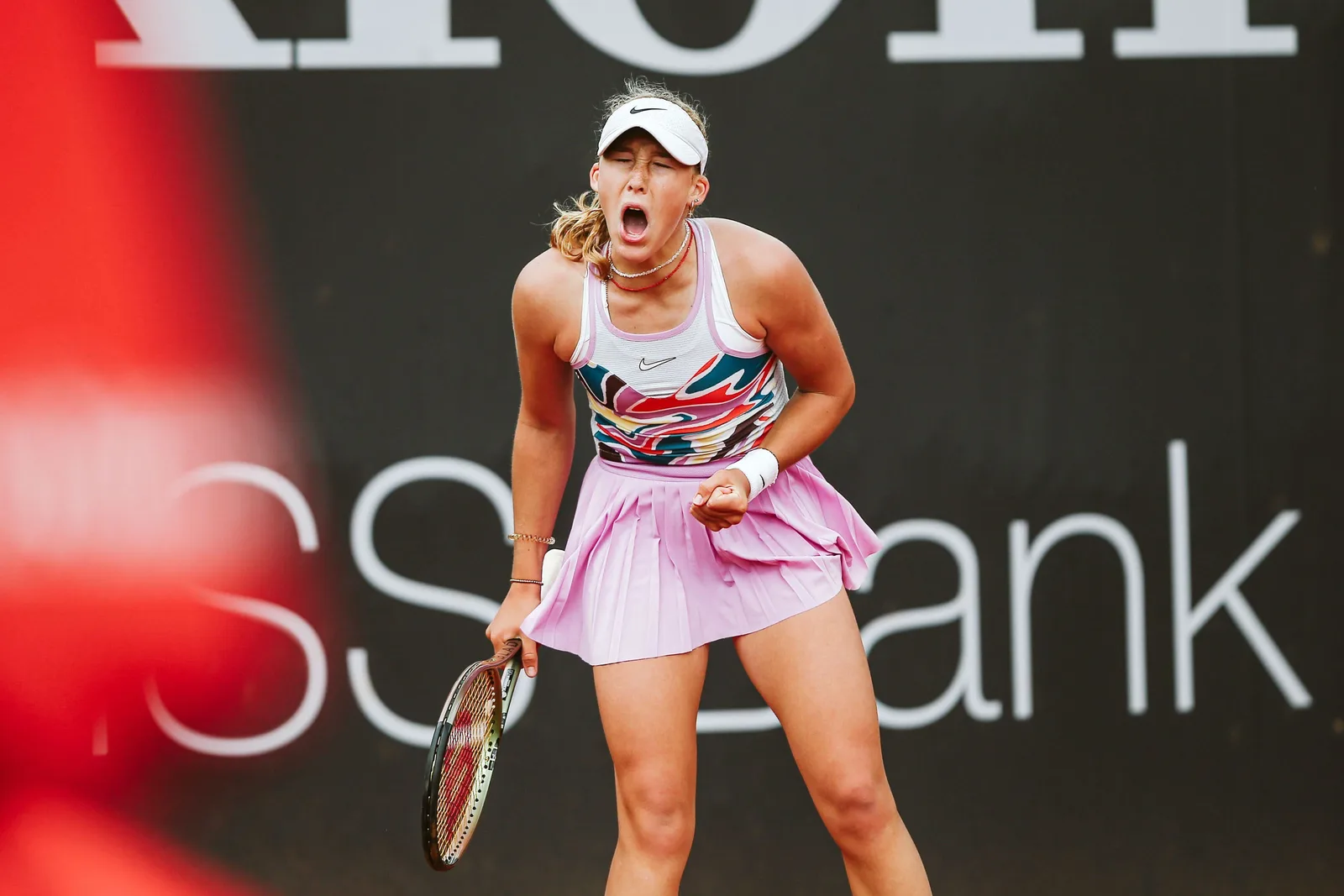
The first ball of the Roland Garros women's final was struck by a left-handed Polish player ranked No. 114 in the world. The second ball was struck by a nineteen-year-old Russian whose coach won this tournament in 1994. The match lasted one hour and twenty-two minutes. The scoreline read 6-3, 6-2 to Mirra Andreeva. The longer story, the story that explains how the world No. 8 and a qualifier ranked outside the top 100 ended up playing for the most prestigious title in women's tennis, is in the backgrounds of the two women who walked onto Philippe-Chatrier this afternoon.
The prodigy
Mirra Andreeva was born on 29 April 2007, in Krasnoyarsk in central Siberia. She is the younger sister of Erika Andreeva, currently ranked around No. 230 on the WTA tour and also a former Top 100 player. The two sisters moved to the Elite Tennis Center in Cannes in 2022 to train together, and the move set the template for the next four years of Mirra's career: a French base, Russian discipline, and the kind of access to professional coaches and full-time hitting partners that almost no nineteen-year-old in the world has.
She turned professional at fifteen. She made the third round of the French Open and the round of sixteen at Wimbledon in the same year. In 2024, at seventeen and ranked No. 38 in the world, she reached the semifinals of Roland Garros and was beaten by Jasmine Paolini, the eventual finalist. In April of that year she began working with Conchita Martinez, the Spaniard who won Wimbledon in 1994 and remains the most successful clay-court coach of her generation. The arrangement was reported, at the time, as an experiment.
Two years later, the experiment has produced the youngest French Open champion since Monica Seles in 1992 and the first Russian to win the title since Maria Sharapova in 2014. Andreeva collected $3,272,127 in prize money this afternoon. She also collected, in a small ceremony a few minutes after match point, the Coupe Suzanne Lenglen.
What Martinez has done with her is specific and worth naming. Andreeva, before the partnership, was a hard ball-striker with a flat forehand and an excellent backhand and a habit of trying to win points in three shots. What Martinez has built into her game, slowly, over twenty-six months, is everything else. The ability to absorb pace and return it changed. The ability to slice the backhand and pull the opponent in. The willingness to approach the net at the right moment, which is the classic Spanish clay-court template that Martinez herself rode to Wimbledon a generation ago. The result is an Andreeva who, at nineteen, plays the most varied game in the women's draw.
This afternoon she demonstrated all of it. She won 82 per cent of her return points on Chwalinska's second serve, which is a number that does not happen to good players. She served 9 km/h faster on average than her opponent. She hit 23 winners against 26 unforced errors against a player whose entire game is built on baiting unforced errors. She did not look nervous, and she did not look as if she expected to win every point. She looked like a player who knew, with some confidence, what she was going to do with the ball before her opponent had hit it.
The qualifier
Maja Chwalinska was born on 11 October 2001 in Dąbrowa Górnicza, a coal and steel town in southern Poland of about a hundred and twenty thousand people. She is five foot five, left-handed, with a two-handed backhand. Her career-high singles ranking, achieved a month ago, is No. 113. She entered Roland Garros ranked No. 114.
She has been coached since she was eighteen by Jaroslav Machovsky, a Czech who has been with her for six years and is, by his own admission, more of a father figure than a tactician. Her commercial manager is Piotr Szczypka, who owns the BKT Advantage tennis academy in Bielsko-Biała on the Polish side of the Czech border, the academy that scouted Maja from local junior tournaments when she was twelve and developed her through her teens.
She had never reached the third round of a Grand Slam before this tournament. She had never beaten a top-50 player. Her two previous main-draw Slam appearances ended in the second round of Wimbledon 2022 and the first round of the Australian Open 2025.
And yet. In 2017, at the Australian Open girls' doubles, the fifteen-year-old Maja Chwalinska reached the final partnering another sixteen-year-old Polish junior who had won the Junior Fed Cup with her the previous year. Her partner's name was Iga Swiatek. They lost the final to Bianca Andreescu and Carson Branstine, 1-6 and 6-7, with the second-set tiebreak going against them. Nine years later, Swiatek is the world No. 2 and has been Roland Garros champion four times. Chwalinska, twenty-four, played the Roland Garros final this afternoon.
Between those two facts there is a four-month break in 2021 that Chwalinska took for depression, a coach who has stayed with her through every ranking from the four hundreds upwards, and the kind of grinding career on the lower-level tour that produces the players you have never heard of. She plays chess. She talks about her game in the language of a problem to be solved rather than a performance to be delivered. She is aware, she has said this fortnight, that her game can be very annoying for other players.
The game is slice, drop shot, height change, rhythm denial. Coverage this fortnight has called it junk-balling. The description is accurate and inadequate at the same time. Junk-balling implies a player without weapons. Chwalinska has the weapons, she has just chosen not to use them in the conventional sequence. She holds the ball on the racket longer than her opponents read. She changes direction late. She slices when the rally is set up for a winner and goes for a winner when the rally is set up for a slice. The effect, over the course of a match, is that opponents who can beat top-50 players lose to her because they are playing rallies they have not seen before.
It worked through six matches. She beat Zheng Qinwen, a former US Open finalist, 6-4 and 6-0 in round one. Elise Mertens, seeded 23, by the same score in round two. Maria Sakkari, the former world No. 3, in three sets in round three. Diane Parry in straight sets in round four. Anna Kalinskaya, seeded 22, in the quarter-final. Diana Shnaider, seeded 25 and the only left-hander in the women's draw with a comparable lefty-forehand pattern to her own, in the semifinal. Six matches against three seeded players and three unseeded players, all in straight sets except for the Sakkari and Kalinskaya wins.
Somewhere between the fourth and fifth rounds, with her player at a stage of the tournament that the team's pre-tournament budgeting had not contemplated, Piotr Szczypka began publicly worrying about hotel bills. The story made the rounds of the Polish tennis press. Within a few days a Polish drinks brand called Oshee had stepped in to fund the rest of her stay. It is the kind of detail that sits exactly at the seam of professional tennis, the seam between the players who can afford to lose a tournament early without consequence and the players who reach the second week of a Slam and have to find someone willing to pay for the hotel.
The match
For about forty minutes this afternoon, Chwalinska's template did to Andreeva what it had done to six other players. She held her opening service game, held her second service game, broke Andreeva for 3-2 on a backhand drop shot that Andreeva read late, and looked, for a moment, like a player capable of taking a set off the eighth seed in a Grand Slam final.
Then Andreeva broke back. Then she broke again. Then she won the first set 6-3, and the second set 6-2, and by the time she was serving for the match at 5-2 in the second the conversation among the people watching at home had shifted from whether Chwalinska could win to whether she could hold serve. She did not. Andreeva won the match on her first break point of the eighth game, on a return that pulled Chwalinska wide and then a backhand into the open court.
The stat sheet tells the story cleanly. Andreeva had 12 break-point opportunities to Chwalinska's 8. She converted 78 per cent of the games in which she had break-point opportunities, against Chwalinska's 50 per cent. She struck 23 winners to 10. She faced 8 break points and saved 5. She held three of her own service games to love against an opponent built on extending points, which is a kind of demoralisation that does not show up in the score.
The second serve, on both ends, was the column the match was decided in. Chwalinska won 18 per cent of her own second-serve points. Andreeva won 55 per cent of hers. The differential was the match. A player whose entire game depends on her opponent making errors on second-serve returns has nothing to fall back on when the opponent stops missing.
What the two routes tell us
The two players who walked onto Philippe-Chatrier this afternoon arrived there along the longest distance the women's tour can put between two careers. Andreeva is the platonic prodigy: spotted young, trained at one of the best academies in Europe, moved across borders to access the right coaching, retrained tactically by a former major champion, and arrived at her first Grand Slam title before her twentieth birthday. Chwalinska is the late arrival: small-town Polish junior, modest junior career on the Tennis Europe circuit, depression at twenty, ranked outside the top 200 for most of her early twenties, qualified for the main draw, won six matches in a row against players she had never beaten before, and lost her first major final in straight sets. Both routes are real. Most professional tennis careers look more like the second than the first.
The first Russian woman to win Roland Garros since 2014 lifted the trophy this afternoon. The first qualifier in the Open Era to reach the Roland Garros final, second qualifier ever to reach any Grand Slam final after Emma Raducanu in 2021, walked back to the locker room with a runner-up cheque of €1.4 million, more than her entire career had paid her before this fortnight, and the knowledge that she had played the second week of a major for the first time and made the final.
What is more interesting is what each of them now becomes. Andreeva, at nineteen, has the first major. The next twelve months will tell whether she becomes Sharapova or Swiatek, a generational player whose first major was the first of many, or one of the many players whose first major was the only one. Conchita Martinez has not had to coach her through that particular conversation yet. She will now.
Chwalinska, at twenty-four, has the more interesting medium-term story. She will be ranked around No. 21 in the world on Monday morning. She will play her next tournament as a player ranked more than 90 places higher than she has ever been. She will need a different coach, in the language of professional tennis, because the game she has used to qualify for and reach the final of a Grand Slam is not the game that wins at the top 30. Or perhaps she will not change a thing, on the basis that there is no point in changing a template that has just paid for the academy and the team and the hotel and the next three years of her career.
Watching them shake hands at the net was watching the women's tour at its most generous and least sentimental. Andreeva said the right things. Chwalinska said the right things. The crowd applauded both. Somewhere in the box, Conchita Martinez looked the way Conchita Martinez always looks. Somewhere in the other box, Jaroslav Machovsky ate a slice of pizza, which is a thing he has been doing every day of this tournament as a superstition. Both will be back in Paris, at some level of the sport, next year.
If you ever wanted a single Saturday afternoon of tennis that summarises the entire structure of the women's tour, you could do worse than the one we just watched.
If you want a touring pro to look at your own game with the same eye Conchita Martinez has used on Mirra Andreeva's, join the All Court waitlist. Access is being released in batches. When your turn comes, one outside eye is enough to see the patterns that have stopped working.
Related posts
The Roland Garros pattern that picked Andreeva, and now picks Cobolli