Cobolli held the pattern for four sets. The fifth set was a different sport.
Alexander Zverev won the Roland Garros men's title on his fourth attempt this afternoon, beating Flavio Cobolli 6-1, 4-6, 6-4, 6-7(5), 6-1. The pick we made yesterday held for four sets. The thing that overruled it in the fifth was not tactical.

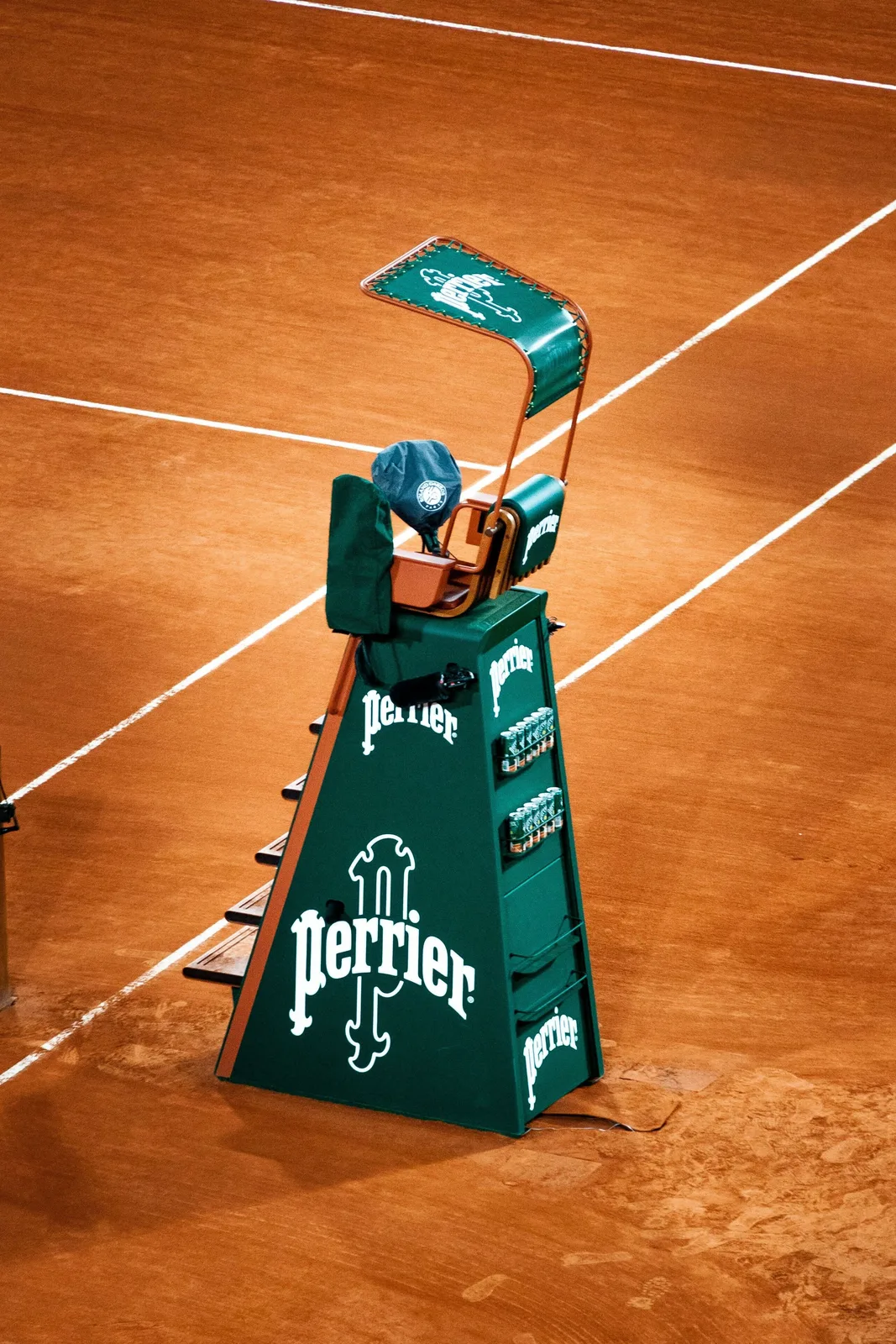
Flavio Cobolli won the fourth-set tie-break this afternoon on a running forehand that he might think about for the rest of his career. The shot saved a set-clinching opportunity for Alexander Zverev, broke Zverev's 26-2 Roland Garros tie-break record, and pulled the men's final back to two sets all. Cobolli walked off Philippe-Chatrier for the five-minute break a player in his first major final, level with the world No. 3, one set from the title.
He came back without his legs. He had felt his calf cramp in the tie-break and the quad followed in the second game of the fifth, by his own account in the post-match press conference. Two breaks of serve later, the match was effectively over. Zverev won the fifth set 6-1 in twenty-six minutes. The trophy ceremony followed. The first German man to win a major since Boris Becker won the 1996 Australian Open lifted the Coupe des Mousquetaires, the cup named for the Borotra, Brugnon, Cochet and Lacoste quartet or the "four French tennis musketeers" that owned this court a century ago, above his head.
What yesterday's piece picked
The article we published on this site yesterday picked Cobolli to win this match. The diagnostic was the one named on Wednesday and vindicated by Mirra Andreeva on Saturday: the recent coaching reset. Cobolli had added Vincenzo Santopadre to his father's team in 2025. The work has been specific, eighteen months of stepping into the forehand earlier and constructing rallies through pressure rather than collapsing in it. The pattern from the rest of the tournament said the player with the most recently rewritten tactical template tends to find an answer the player without one has not seen yet.
For four sets, the pattern held. Cobolli took the second set 6-4. He took the fourth-set tie-break 7-5 against the player with the best tie-break record at this tournament in five years. He had Zverev cramping during the fourth set, calling for electrolytes at the changeover, looking less than convinced about his own physical state. By the start of the fifth set, the pick on this site was about to become correct.
Then it was not. The pattern from yesterday's article picked the better tactical player. The fifth set picked the better body. Both readings were real. They were measuring different things.
The fifth set, in numbers
The match ended 6-1, 4-6, 6-4, 6-7(5), 6-1 in four hours and sixteen minutes. The Infosys stat sheet, published as the trophy was being handed out, contains a single number that explains everything about it.
Points won by rally length, across the whole match. In rallies of one to four shots, the serve-led short-pattern phase, the two players finished essentially even: Cobolli 67, Zverev 66. In rallies of five to eight shots, the medium constructional phase that Cobolli and Vincenzo Santopadre have spent the past eighteen months building, the two players finished exactly level: 57 each. In rallies of nine or more shots, the long attritional phase where fitness shows up, Zverev won 39 points. Cobolli won 12.
Three to one on the long rallies. Even everywhere else.
That is not a tactical gap. Cobolli was matching Zverev shot for shot on the short and the medium points, the phases of the rally the recent-coaching-reset work had retrained him for. He lost three times as many of the long ones. The fifth set was where most of the long rallies landed, because the fifth set was the one in which Zverev started building the long rallies on purpose, and Cobolli could not refuse them.
The serve numbers tell the same story from the other end. Cobolli landed 52 per cent of his first serves across the match. Zverev landed 76 per cent. When the first serve went in, Cobolli won the point 64 per cent of the time and Zverev won it 73 per cent. The 9-point gap on serve effectiveness is real, but it is the kind of gap a player can play through if his body is intact and the rallies stay inside his retrained patterns. Cobolli's body was not intact, and the rallies, by the fifth, were not staying inside his patterns.
In the decider specifically, Zverev landed 83 per cent of his first serves and saved every break point he faced. Cobolli, with a calf and a quad both compromised, lost serve twice in the first three games and never recovered. He lost the set 6-1 in twenty-six minutes. The first four sets had been a tactical contest decided at the margins. The fifth was decided at the body, with the rally-length split as the receipt.
What the diagnostic does and does not pick
The leading indicator from yesterday's piece is a tactical one. It picks the player whose template has been most recently retrained by someone who watched them play. It does not pick the player whose body holds up to four-plus hours of clay-court attrition in a heatwave at the end of a fortnight in which one of them had played the most physical road to the semifinals in tournament history and the other had not played a competitive match in four days because his semifinal opponent withdrew with a virus.
Those are different questions. The first is about the gap between a tactical template and the conditions of the day. The second is about the gap between the volume of physical work a body has done in the past two weeks and the volume the next match demands. The Cobolli pick was made against the first question. It was overruled by the second.
This is the part of yesterday's piece that needed flagging more clearly. The recent-reset diagnostic is necessary but not sufficient. The tactical answer matters most when both players can still play. When one player physically cannot, the diagnostic is overruled by the more basic question of whose body can still execute the answers the brain knows. Cobolli had the tactical answers all afternoon. He had the body to execute them for four sets. The fifth set asked a question his body could not answer.
Zverev, finally
Zverev becomes only the eighth man in the Open Era to lose his first three Grand Slam finals and then win the fourth. The company is Andre Agassi, Goran Ivanisevic and Dominic Thiem. The interpretation of the achievement depends on how generous you are about the previous three. Zverev led Thiem two sets to none and a break in New York in 2020. He led Carlos Alcaraz two sets to one in this same stadium in 2024. He was straight-setted by Jannik Sinner in Melbourne last year. Today he led Cobolli two sets to one, lost his serve and his tie-break record in the fourth-set tie-break, and won the title because he was the player who could still run in the fifth.
His own framing, in the trophy interview, was both more honest than the script and more generous to himself than the previous three finals had allowed. "First of all, I didn't believe that I won," he said. "Then I saw my box, and they all were celebrating." He talked about the 2022 injury in this stadium when he tore the ankle ligaments and did not know if he would come back. He talked about the lost final to Alcaraz on the same court. He said, in the line that will be quoted, that no matter what happens now, he will always be a Grand Slam champion, and nobody can take that away from him. The version of Zverev who plays the next major will be a different player from the one who walked onto Philippe-Chatrier today.
What Cobolli leaves with
Cobolli leaves with the runner-up cheque, a career-high ranking of No. 10 as of today, his first-ever major final, and a quote that will sit on the wall of the Italian tennis press for a while: "My body left me on the court." He also leaves with one of the more dignified concession speeches the tournament has produced, including a sentence that more first-time finalists should keep ready: "When you reach the first final, why not a second?"
The tactical reset that put him in this match has not been undone by this match. Santopadre's work over the past eighteen months remains the work that took Cobolli from the player ranked outside the top forty at the start of last season to the world No. 10 as of the time of writing. The next twelve months will tell whether the body that gave out in the fifth set this afternoon is a body that can be conditioned to do what the tactical template now demands of it. That is a different conversation, with different coaches, and it will not happen in the next twenty-four hours.
The honest revision to yesterday's diagnostic
For a club player reading both pieces back to back, the through-line is the one we should have stated more cleanly the first time. A tactical reset is the leading indicator for whether you can win the points the conditions of the match present. The fitness to sustain the tactical answer for the duration of the match is a separate variable and a non-negotiable one. Cobolli is not the cautionary tale. He is the proof that you need both. He had the first. He did not, today, have the second.
Join the All Court waitlist for a free pro video review. Access is being released in batches. When your turn comes, a touring pro will watch a clip of one of your matches and tell you what is costing you the most. One outside eye is enough to see the patterns that have stopped working. The conditioning to sustain the new patterns for a full match, however, is on you.
Both finalists were back in the locker room within an hour of match point. Zverev with the first major. Cobolli with the first final. The pattern from yesterday's piece picked the better tactical player and was vindicated for four sets. The match picked the better body and was decided in twenty-six minutes. Both readings were real. The piece we wrote yesterday should have been written with that asterisk attached.
Related posts
Mirra Andreeva and Maja Chwalinska: the two routes to the Roland Garros final